

After Ravan sensed he might LOSE Lanka War to Shri Ram, he became desperate to win.
He planned a ‘secret’ attack on Ram. Asked the “Ruler of Patal Lok”, his brother, to KIDNAP Ram & Lakshman & KILL them.
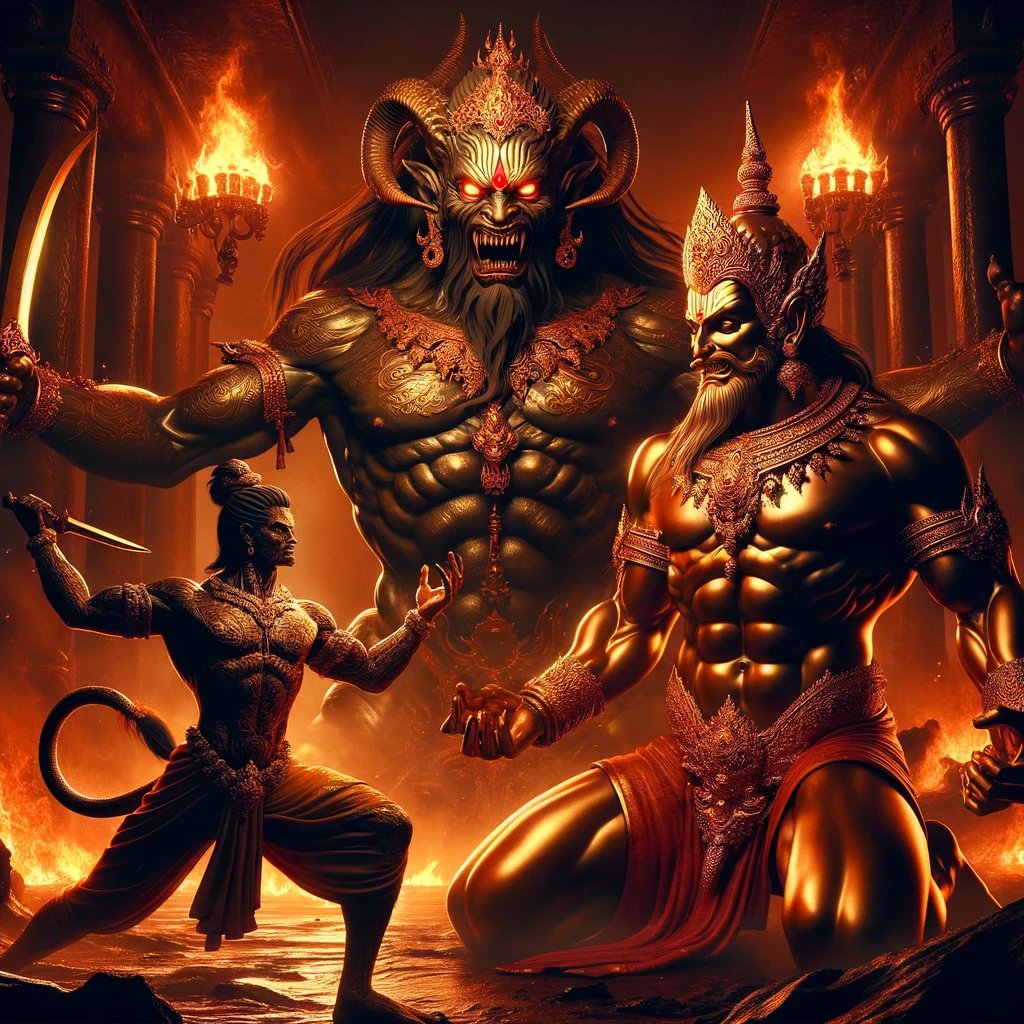
Hanuman Ji in anger, went to Patal Lok (Hell) in his most DEADLY avatar…
He planned a ‘secret’ attack on Ram. Asked the “Ruler of Patal Lok”, his brother, to KIDNAP Ram & Lakshman & KILL them.
Hanuman Ji in anger, went to Patal Lok (Hell) in his most DEADLY avatar…

Hanuman.
Mahavir. Chiranjeevi. Ramadoot. Sankatmochan.
Bajrang Bali.
Hanuman Ji taught us the true meaning of unconditional love & worship
This is the story of Hanuman Ji’s most DEADLY avatar "Panchmukhi" and how he saved Ram & Lakshman from Patal Lok's strongest demon...
Mahavir. Chiranjeevi. Ramadoot. Sankatmochan.
Bajrang Bali.
Hanuman Ji taught us the true meaning of unconditional love & worship
This is the story of Hanuman Ji’s most DEADLY avatar "Panchmukhi" and how he saved Ram & Lakshman from Patal Lok's strongest demon...


Mahiravan, also known as Ahiravan in some texts, was a sorcerer and the ruler of Patal Lok (the netherworld). He was a brother of Ravana, the demon king of Lanka, who sought his help to defeat Rama and Lakshman in the epic battle of Ramayana. Mahiravan was well-versed in magical arts and possessed powers that made him a formidable foe, including the ability to become invisible and change form at will.


As the war between Rama and Ravana raged on, Ravana, desperate to turn the tide in his favor, sought the help of Mahiravan. Mahiravan, in his loyalty to his brother, devised a plan to kidnap Rama and Lakshman and sacrifice them to the goddess Kali to gain invincibility.


Using his magical powers, Mahiravan managed to enter the camp where Rama and Lakshman were resting and kidnapped them using his sorcery. He transported them to Patal Lok, intending to perform a ritual sacrifice. The sudden disappearance of Rama and Lakshman caused great distress among their allies.


Upon learning of the abduction of Rama and Lakshman, Hanuman was consumed with rage and concern for their safety. His devotion to Rama was unparalleled, and the thought of them being in danger ignited a fierce determination in him to bring them back at any cost. Hanuman's immediate response was to set out on a rescue mission, utilizing his divine powers to track down Mahiravan and infiltrate Patal Lok, the netherworld where Mahiravan had taken Rama and Lakshman.


Mahiravan, a master of dark arts and sorcery, had received a powerful boon that made him nearly invincible. This boon granted him the ability to become invisible at will, making it exceedingly difficult for anyone to track or fight him. Mahiravan, endowed with a boon that made him nearly invincible, had kidnapped Lord Rama and Lakshman to sacrifice them to Goddess Kali.


Mahiravan could only be killed when five lamps, representing his life force and placed in five different directions, were extinguished simultaneously. This condition made defeating Mahiravan a daunting task. This task was seemingly impossible for any ordinary being due to the strategic placement of the lamps.


Understanding the gravity of the situation and the unique challenge posed by Mahiravan's boon, Hanuman Ji devised a plan to tackle the sorcerer's defences. His deep knowledge of divine powers, coupled with his ingenuity, played a crucial role in formulating a strategy to defeat Mahiravan.


Looking at the entire situation, Hanuman Ji acted in his prowess and took his DEADLIEST avatar…
PANCHMUKHI
Five-faced avatar—A divine manifestation with five faces, each representing a distinct deity and direction:
PANCHMUKHI
Five-faced avatar—A divine manifestation with five faces, each representing a distinct deity and direction:


Hanuman (East) - His original face, embodying devotion, strength, and protection.
Narasimha (South) - The lion-man avatar of Lord Vishnu, symbolizing fierce valor and the ability to overcome obstacles.
Garuda (West) - The mighty eagle, representing speed and the power to counteract negative forces.
Varaha (North) - The boar avatar of Lord Vishnu, denoting resilience and the capacity to uplift.
Hayagriva (Upwards) - The horse-faced avatar, associated with wisdom and knowledge.
Narasimha (South) - The lion-man avatar of Lord Vishnu, symbolizing fierce valor and the ability to overcome obstacles.
Garuda (West) - The mighty eagle, representing speed and the power to counteract negative forces.
Varaha (North) - The boar avatar of Lord Vishnu, denoting resilience and the capacity to uplift.
Hayagriva (Upwards) - The horse-faced avatar, associated with wisdom and knowledge.


Armed with his Panchmukhi form, Hanuman Ji descended into Patal Lok, ready to confront Mahiravan and his dark forces. The battle that ensued was monumental, showcasing Hanuman's unparalleled might and the strategic genius of his Panchmukhi avatar. With each face wielding distinct powers, Hanuman was able to counter Mahiravan's sorcery, combat his minions, and keep the lamps in his sights.


Despite Mahiravan's formidable magical prowess, he was no match for the divine might of Panchmukhi Hanuman. The turning point came when Hanuman, using the unique capabilities of his five faces, extinguished the five lamps simultaneously, effectively stripping Mahiravan of his invincibility.


With the lamps extinguished, Mahiravan's boon was nullified, rendering him vulnerable. Hanuman seized this opportunity to engage Mahiravan in direct combat. The battle was fierce, but Hanuman's divine strength, coupled with the strategic advantage of his Panchmukhi form, ultimately led to Mahiravan's defeat.


With Mahiravan vanquished, Hanuman Ji quickly located the captive Lord Rama and Lakshman. Using his immense strength and divine powers, Hanuman liberated them from their confines and escorted them safely out of Patal Lok. The return journey was swift, with Hanuman ensuring their safety and comfort throughout. They returned with the spirit, as the great Lanka war awaited their final duel...


Loading suggestions...