

The Egyptologist Jan Assmann has passed. His work is indispensable for anyone interested in the rise of monotheism and its relationship to polytheistic “primary religions”, specifically “Of God and Gods: Egypt, Israel, and the Rise of Monotheism” and “The Price of Monotheism”
From the Intro of The Price of Monotheism, where Assmann draws a useful distinction between “primary” and “secondary” religions. He also calls the latter “counter religions”


On the violent nature of the rupture between primary and secondary religions:
“…the monotheistic shift… takes the form of a rupture, a break with the past that rests on the distinction between truth and falsehood…”
“…the monotheistic shift… takes the form of a rupture, a break with the past that rests on the distinction between truth and falsehood…”


On the “Mosaic Distinction”, which Assmann highlights as the truly revolutionary aspect of biblical monotheism:
“I use the concept of the ‘Mosaic distinction’ to designate the most important aspect of this shift…”
“I use the concept of the ‘Mosaic distinction’ to designate the most important aspect of this shift…”
“What seems crucial to me is not the distinction between the One God and many gods but the distinction between truth and falsehood in religion, between the true god and false gods, true doctrine and false doctrine, knowledge and ignorance, belief and unbelief.”
“What I call ‘anti-monotheism’ designates an attitude directed against the Mosaic distinction, that is, against the distinction between true and false religion. Tellingly, this attitude has since antiquity gone hand in hand with a strong insistence on the unity of the divine.”
“The counterposition to monotheism does not claim ‘God is Many,’ but rather ‘God is One and All.’ It would therefore be misleading to label it polytheism. What is important is not that the divine be manifold…”
“but that the fullness and richness of its innerworldly manifestations not be hemmed in by any dogmatic boundary lines. In essence, the issue here is the godliness of the world. Jewish, Christian, and Muslim monotheisms draw a strict border between god and the world.“
“Precisely this border was opposed by ancient anti-monotheism as iconoclasm, or rather theoclasm. That is why I have proposed to speak here of cosmotheism instead of polytheism.”
“What, then, is distinctive about a world of gods, in contrast to the One God familiar to us from our Occidental tradition?“
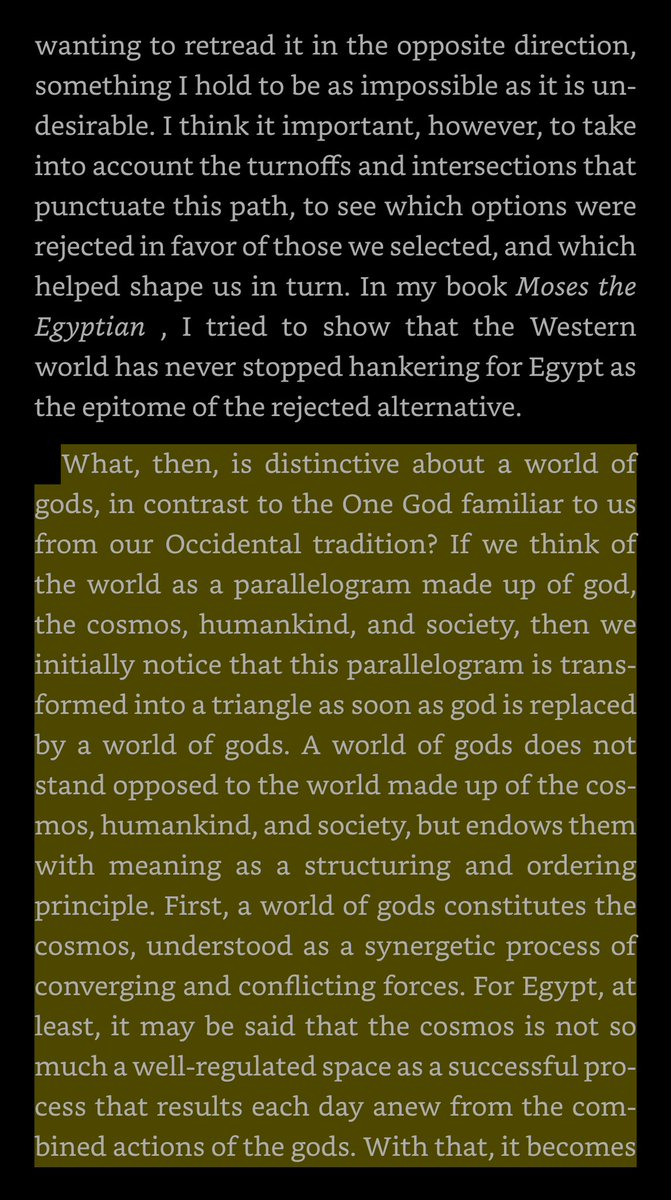
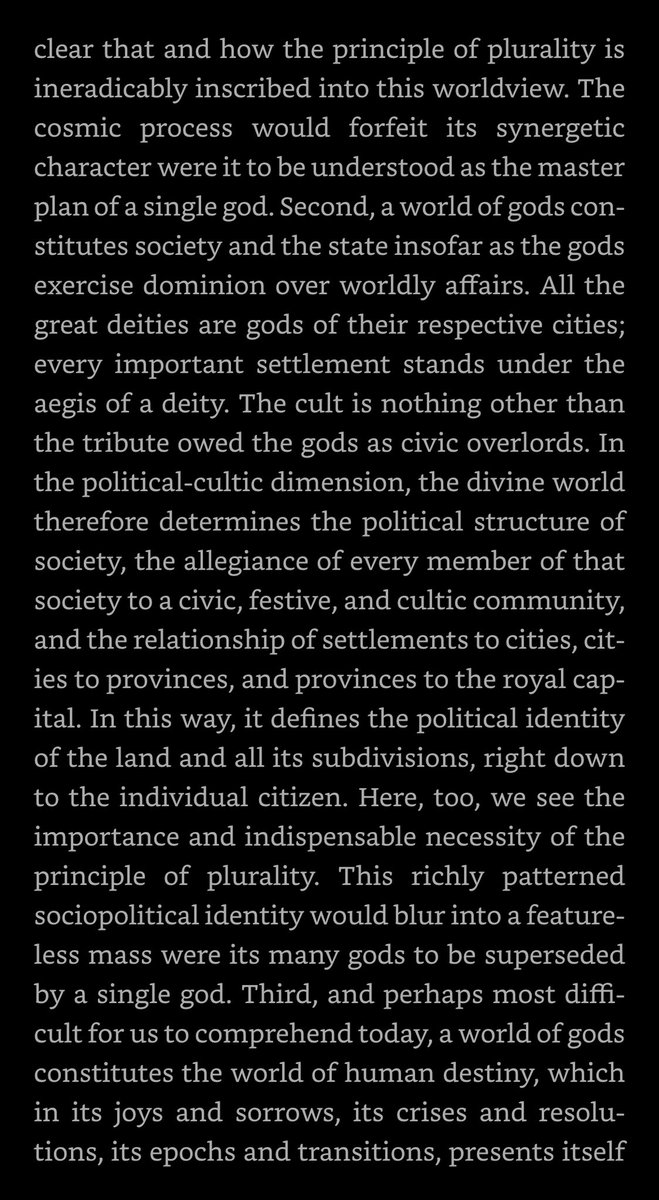
“If we think of the world as a parallelogram made up of god, the cosmos, humankind, and society, then we initially notice that this parallelogram is transformed into a triangle as soon as god is replaced by a world of gods.”
“A world of gods does not stand opposed to the world made up of the cosmos, humankind, and society, but endows them with meaning as a structuring and ordering principle.“
“That is the theology attacked by monotheism. Plurality is the bone of contention, to be sure, but the decisive factor is not the numerical principle of plurality but the indistinction of the divine and the mundane from which plurality necessarily follows.”
“The divine in the world is inscribed in the three dimensions of nature, state, and myth. Polytheism is cosmotheism. The divine cannot be divorced from the world.“
“Monotheism, however, sets out to do just that. The divine is emancipated from its symbiotic attachment to the cosmos, society, and fate and turns to face the world as a sovereign power.”
“In the same stroke, man is likewise emancipated from his symbiotic relationship with the world and develops, in partnership with the One God, who dwells outside the world yet turned towards it, into an autonomous—or rather theonomous—individual.”
“The opposite of monotheism is not polytheism, nor even idol-worship, but cosmotheism, the religion of an immanent god and a veiled truth that shows and conceals itself in a thousand images that illuminate and complement, rather than logically exclude, one another.“
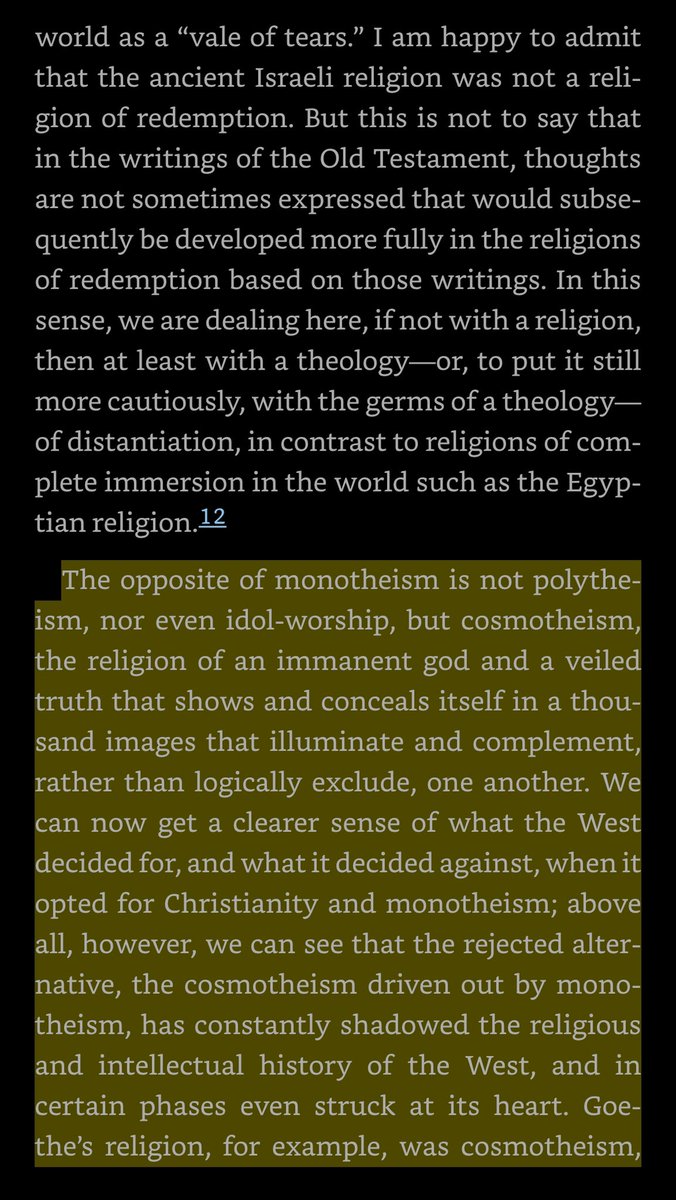
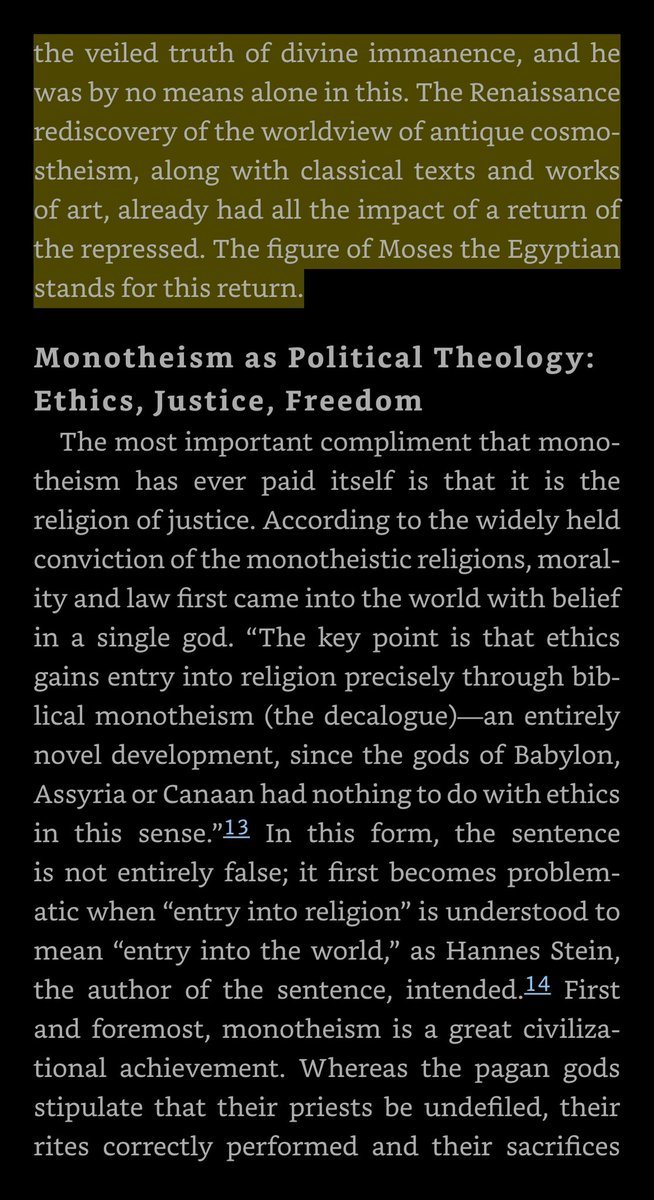
“We can now get a clearer sense of what the West decided for, and what it decided against, when it opted for Christianity and monotheism; above all, however, we can see that the rejected alternative, the cosmotheism driven out by monotheism…”
“has constantly shadowed the religious and intellectual history of the West, and in certain phases even struck at its heart. Goethe’s religion, for example, was cosmotheism, the veiled truth of divine immanence, and he was by no means alone in this.”
“The Renaissance rediscovery of the worldview of antique cosmostheism, along with classical texts and works of art, already had all the impact of a return of the repressed. The figure of Moses the Egyptian stands for this return.”
Loading suggestions...