

A problem with large neural networks:
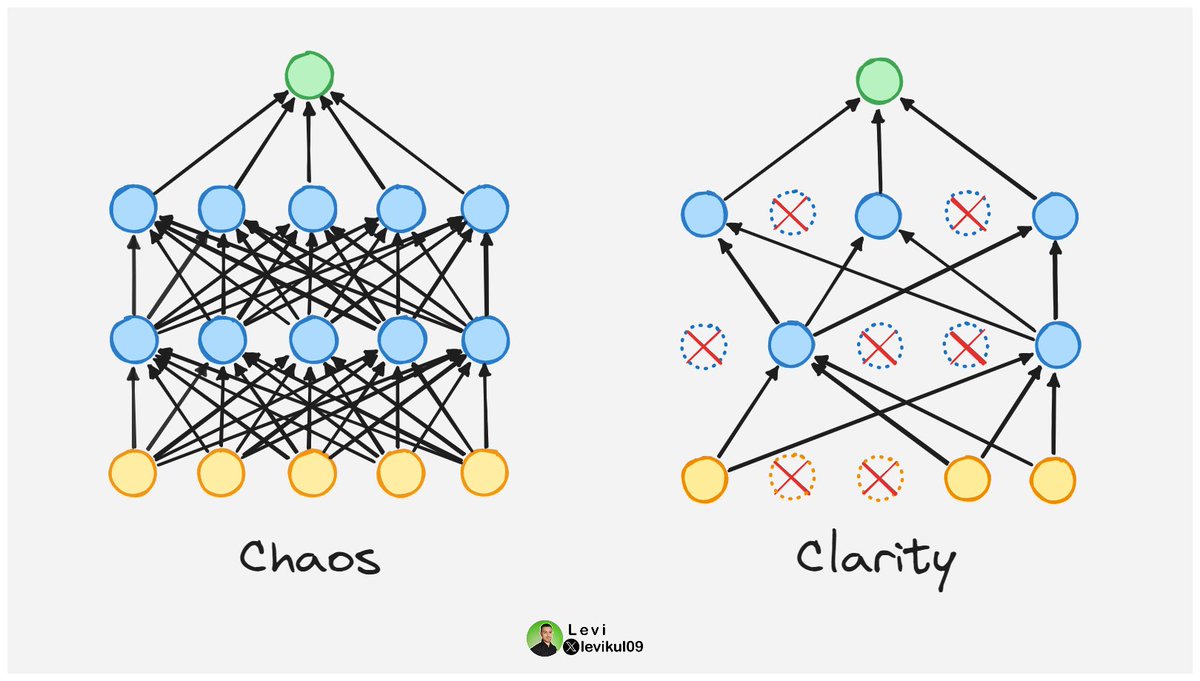
They look like a mess. Chaos leads to issues.
Here is a technique to introduce clarity 🔽
1/7
They look like a mess. Chaos leads to issues.
Here is a technique to introduce clarity 🔽
1/7
NNs with a large number of parameters are powerful.
But
• They tend to overfit since they also learn the noise.
• They are complex, hence slow.
Dropout is a technique to solve these problems.
How it works?
2/7
But
• They tend to overfit since they also learn the noise.
• They are complex, hence slow.
Dropout is a technique to solve these problems.
How it works?
2/7
It randomly selects some nodes and connections and turns them off temporarily (drops them out).
The result:
• We get a more clear network.
3/7
The result:
• We get a more clear network.
3/7
• Because different subsets of neurons are dropped out in each iteration, the remaining neurons must learn to generalize well, so they become more powerful.
• The network is less sensitive to the specific weights, making the model more effective.
4/7
• The network is less sensitive to the specific weights, making the model more effective.
4/7
Ensemble learning achieves similar results, but that process also requires a lot of training power.
Dropout simulates ensembling by randomly zeroing out different neurons during training and using a scaled-down version of the network in testing.
5/7
Dropout simulates ensembling by randomly zeroing out different neurons during training and using a scaled-down version of the network in testing.
5/7
Did you like this post?
Hit that follow button for me and pay back with your support.
It literally takes 1 second for you but makes me 10x happier.
Thanks 😉
6/7
Hit that follow button for me and pay back with your support.
It literally takes 1 second for you but makes me 10x happier.
Thanks 😉
6/7
If you haven't already, join our newsletter DSBoost.
We share:
• Interviews
• Podcast notes
• Learning resources
• Interesting collections of content
dsboost.dev
7/7
We share:
• Interviews
• Podcast notes
• Learning resources
• Interesting collections of content
dsboost.dev
7/7

Loading suggestions...