

Cybersecurity career path roadmap.
On our Career Path Road map this week, we will be looking at ‘SOC Analyst”
Becoming a SOC Analyst in cybersecurity requires a structured approach and dedication.
🧵 1/11
On our Career Path Road map this week, we will be looking at ‘SOC Analyst”
Becoming a SOC Analyst in cybersecurity requires a structured approach and dedication.
🧵 1/11
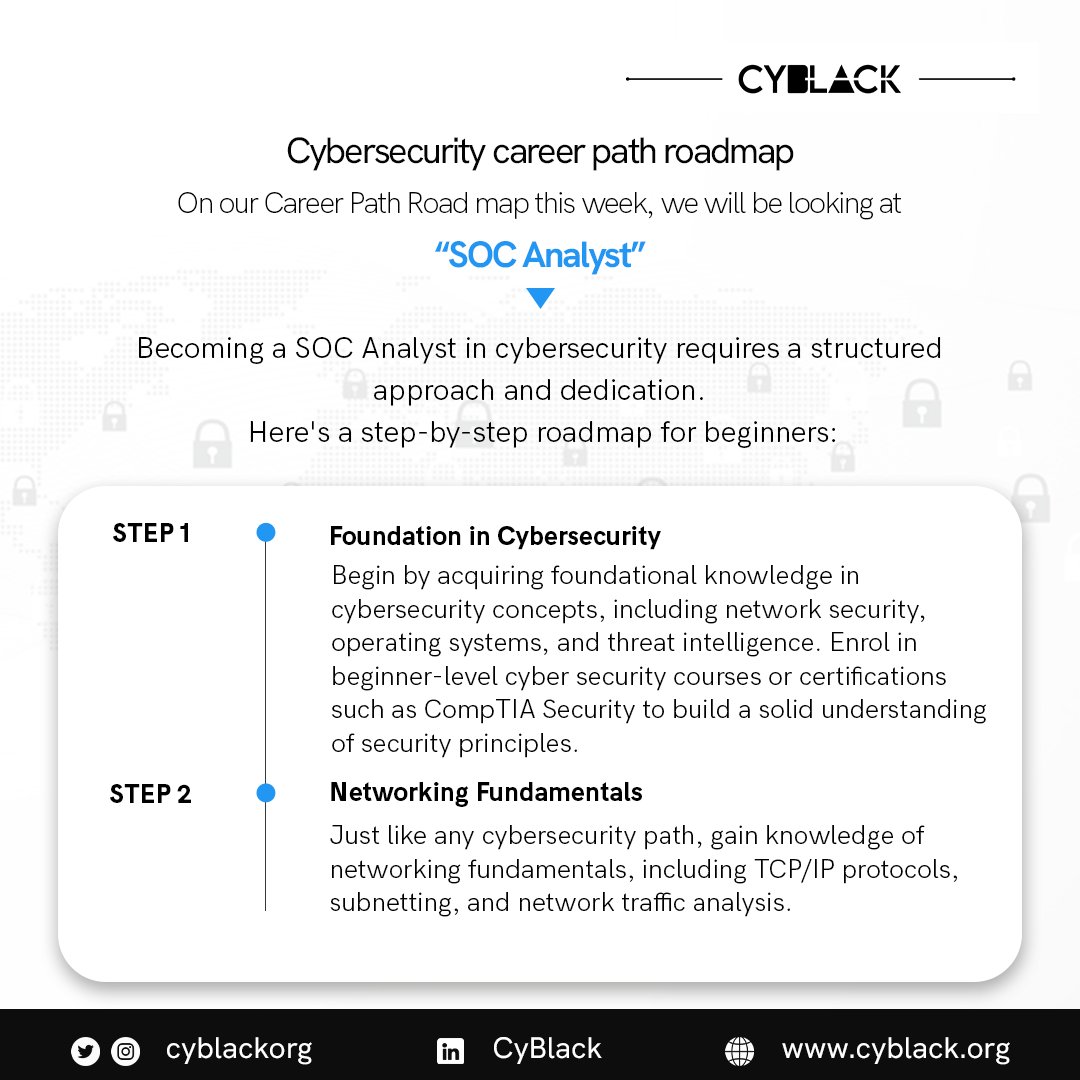


*Foundation in Cybersecurity: Begin by acquiring foundational knowledge in cybersecurity concepts, including network security, operating systems, and threat intelligence. Enrol in beginner-level cyber security courses or certifications such as CompTIA Security to...
2/11
2/11
build a solid understanding of security principles.
*Networking Fundamentals: Just like any cybersecurity path, gain knowledge of networking fundamentals, including TCP/IP protocols, subnetting, and network traffic analysis.
3/11
*Networking Fundamentals: Just like any cybersecurity path, gain knowledge of networking fundamentals, including TCP/IP protocols, subnetting, and network traffic analysis.
3/11
This will enable you to monitor and analyse network traffic within a SOC environment.
*Understanding SOC Operations: Familiarise yourself with the role and responsibilities of a Security Operations Center (SOC) Analyst.
4/11
*Understanding SOC Operations: Familiarise yourself with the role and responsibilities of a Security Operations Center (SOC) Analyst.
4/11
Learn about the tools and technologies commonly used in SOC environments, such as Security Information and Event Management (SIEM) systems, intrusion detection systems (IDS), and endpoint security solutions.
5/11
5/11
*Incident Response and Handling:Develop skills in incident response and handling procedures, including incident detection, triage, analysis, containment, eradication, and recovery.Learn about different types of security incidents, threat actors, and attack vectors to...
6/11
6/11
effectively respond to security breaches and incidents.
*Security Monitoring and Analysis: Learn how to monitor security events and alerts generated by various security devices and systems.
Develop the ability to analyze security logs, identify suspicious activities...
7/11
*Security Monitoring and Analysis: Learn how to monitor security events and alerts generated by various security devices and systems.
Develop the ability to analyze security logs, identify suspicious activities...
7/11
and investigate security incidents to determine their scope and impact.
*Know your Security Tools : Gain hands-on experience with security tools and technologies used in SOC environments, including SIEM platforms, threat intelligence feeds, and forensic analysis tools.
8/11
*Know your Security Tools : Gain hands-on experience with security tools and technologies used in SOC environments, including SIEM platforms, threat intelligence feeds, and forensic analysis tools.
8/11
Practice using these tools to correlate and analyze security events, detect anomalies, and respond to security incidents in real time.
*Continuous Learning and Certification: Stay updated with the latest cybersecurity trends, threat landscape...
9/11
*Continuous Learning and Certification: Stay updated with the latest cybersecurity trends, threat landscape...
9/11
and industry best practices through continuous learning and professional development.You may take relevant certifications such as Certified SOC Analyst (CSA) or Certified Incident Handler (GCIH), to validate your skills and knowledge as a SOC Analyst.
10/11
10/11
*Gain Practical Experience:Seek internship opportunities or entry-level positions in SOC environments to gain practical experience and hands-on exposure to real-world security operations.Collaborate with experienced SOC analysts and security professionals to learn from...
11/11
11/11
their expertise and best practices.
By following this roadmap, aspiring cybersecurity professionals can build a strong foundation of knowledge and skills to embark on a rewarding career path as a SOC Analyst.
#CyBlack #CyberSecurity #CybersecurityCareerPath #SOCAnalyst
By following this roadmap, aspiring cybersecurity professionals can build a strong foundation of knowledge and skills to embark on a rewarding career path as a SOC Analyst.
#CyBlack #CyberSecurity #CybersecurityCareerPath #SOCAnalyst
Loading suggestions...