

Are Small caps in a bubble? (Mar-2024 Update)
Here is a quick summary thread of our 5-Lens Framework to evaluate small caps where the attempt is to try and "identify the elephant"
Source: FundsIndia
Here is a quick summary thread of our 5-Lens Framework to evaluate small caps where the attempt is to try and "identify the elephant"
Source: FundsIndia

2/n Let's evaluate Smallcaps using these 5 lenses:
1) Price Cycles (Long + Short)
2) Valuations
3) Flows & Sentiment
4) Earnings Growth Cycle
5) Past Returns
1) Price Cycles (Long + Short)
2) Valuations
3) Flows & Sentiment
4) Earnings Growth Cycle
5) Past Returns
3/n LENS 1: PRICE CYCLES
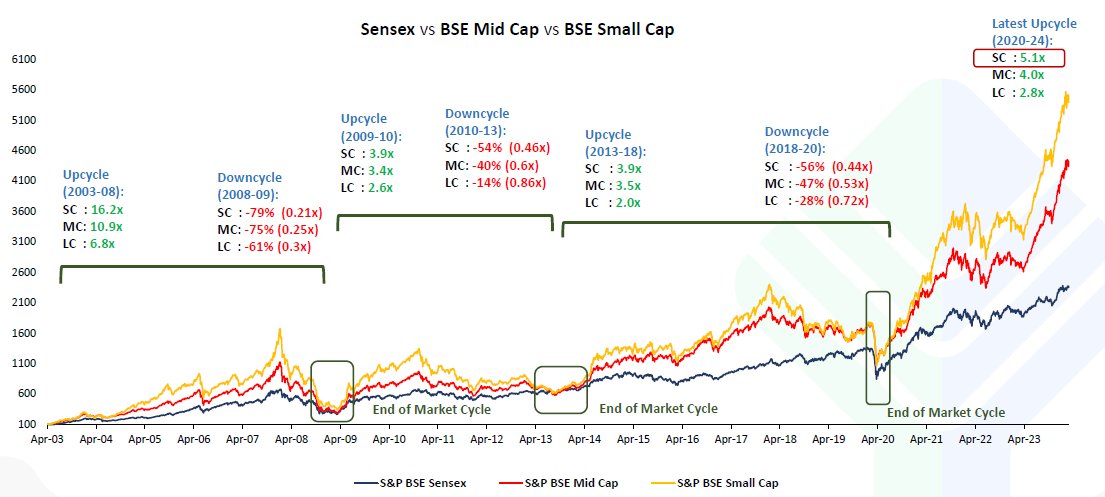
Long Cycle Lens - Large, Mid & Small Caps tend to converge over long cycles - but small caps do disproportionately well in upcycles and vice versa!
Where are we in the long cycle?
Long Cycle Lens - Large, Mid & Small Caps tend to converge over long cycles - but small caps do disproportionately well in upcycles and vice versa!
Where are we in the long cycle?
4/n
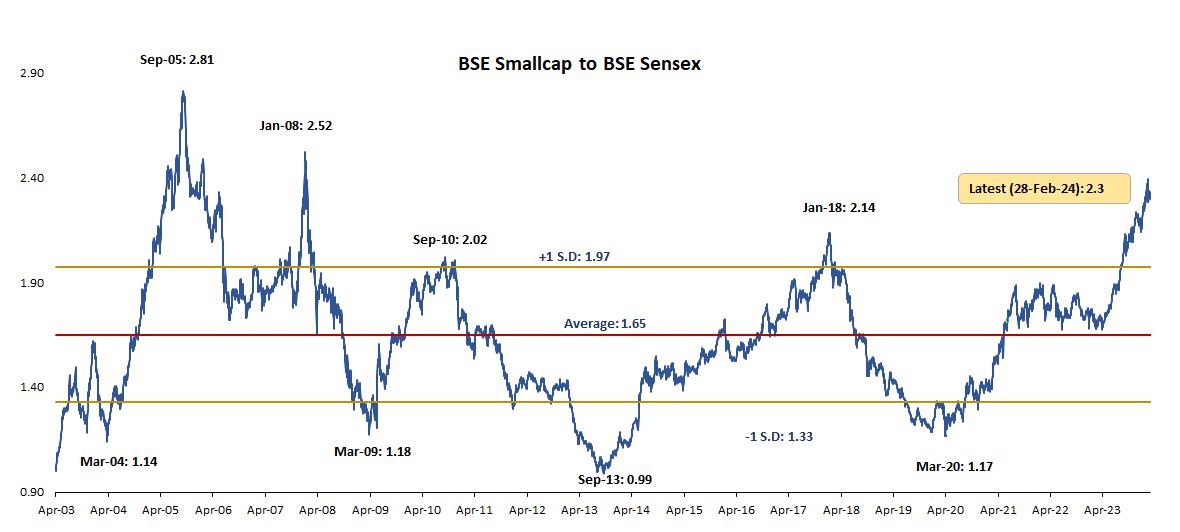
Long Cycle Lens is flashing 'RED' (has crossed Jan-2018 levels)
Long Cycle Lens is flashing 'RED' (has crossed Jan-2018 levels)
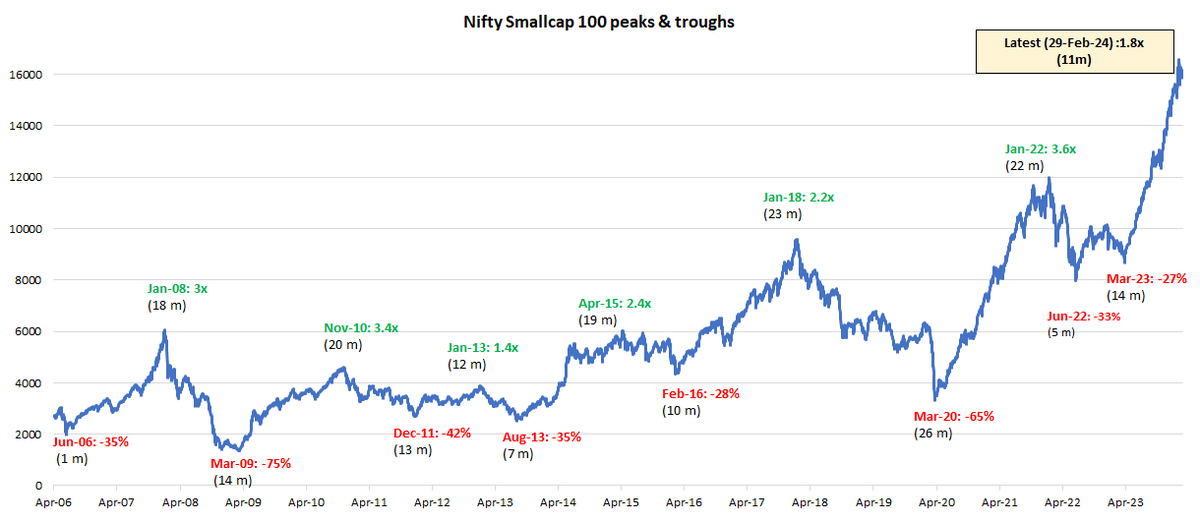
5/n Short Cycle Lens -> Some more steam left!
1) Avg upside to peak after decline ~2-3x – Current Rally at 1.8x!
2) Avg time to peak ~18-24 months – Current Rally at 11 months!
1) Avg upside to peak after decline ~2-3x – Current Rally at 1.8x!
2) Avg time to peak ~18-24 months – Current Rally at 11 months!
6/n LENS 2: VALUATIONS - Expensive
Small Cap MCAP as a % of total MCAP whenever they cross 15% warrant caution (profit share is ~12%) - Now at 17%
Small Cap MCAP as a % of total MCAP whenever they cross 15% warrant caution (profit share is ~12%) - Now at 17%

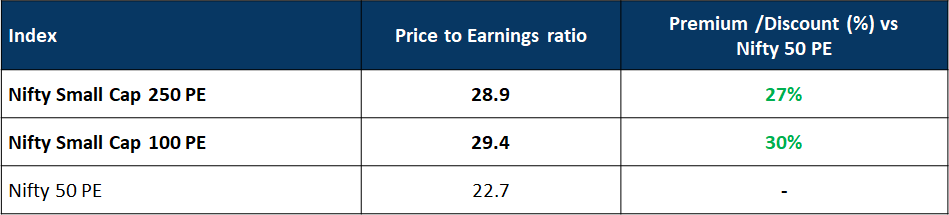
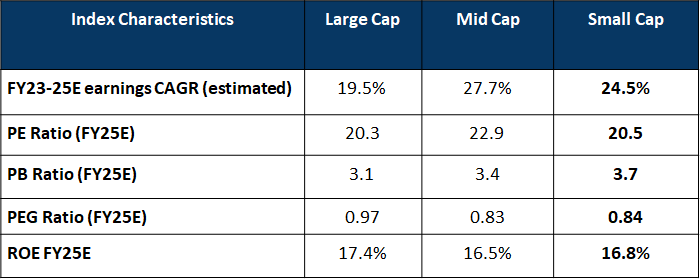
7/n PE and PB valuation for small-cap segment at significant premium to large caps
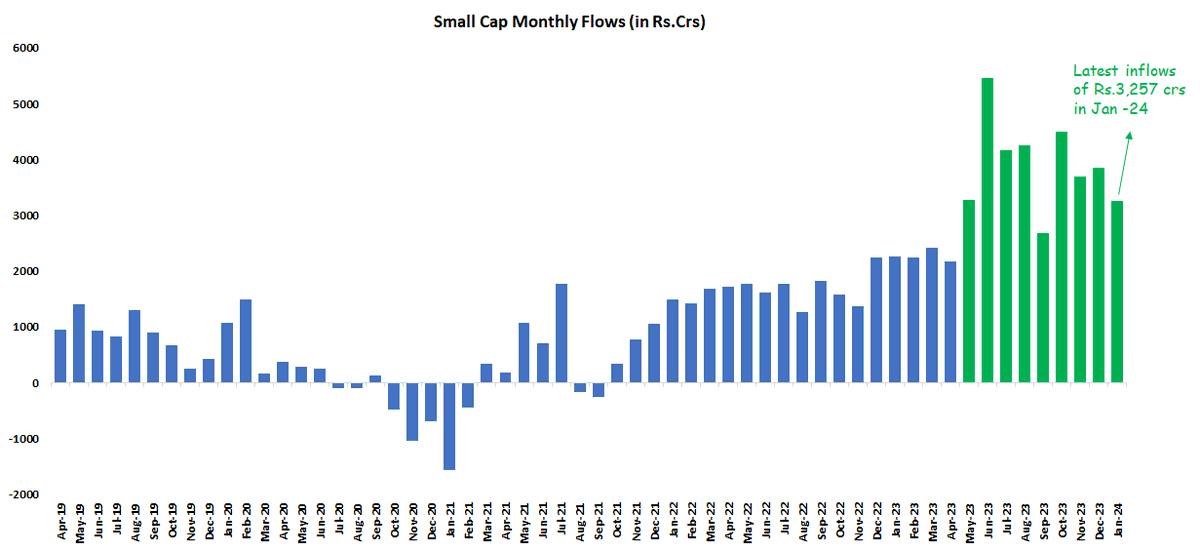
8/n LENS 3: Flows and Sentiment - Warrants Caution
Record high inflows in the last few months + Rising No of Small Cap Folios
Record high inflows in the last few months + Rising No of Small Cap Folios
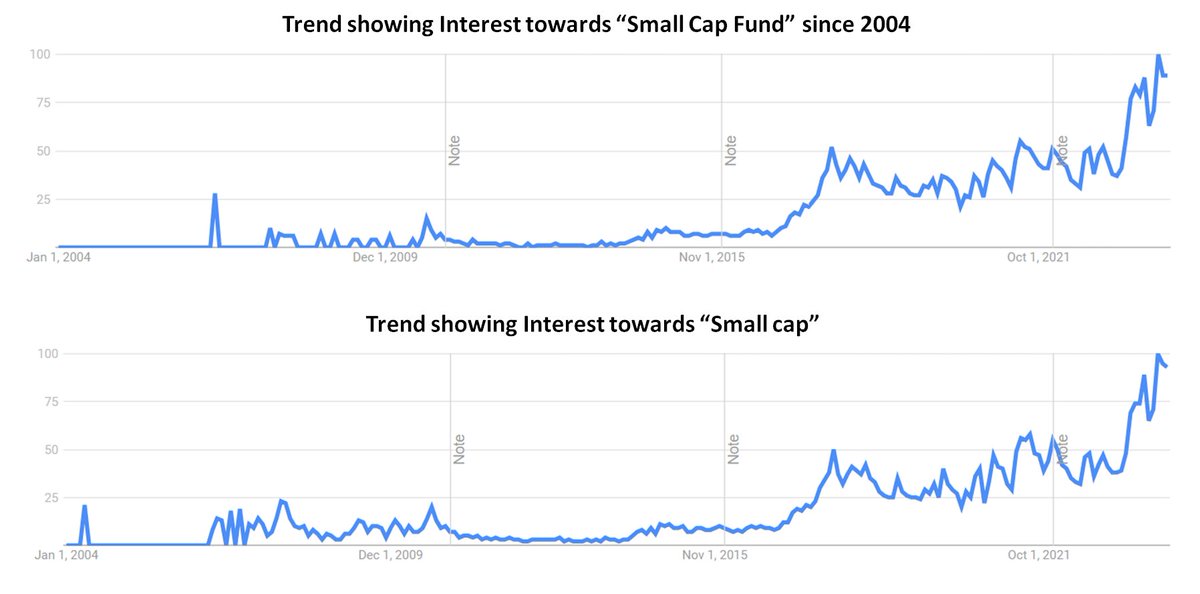
9/n Google Trends - Rising interest in Small Caps
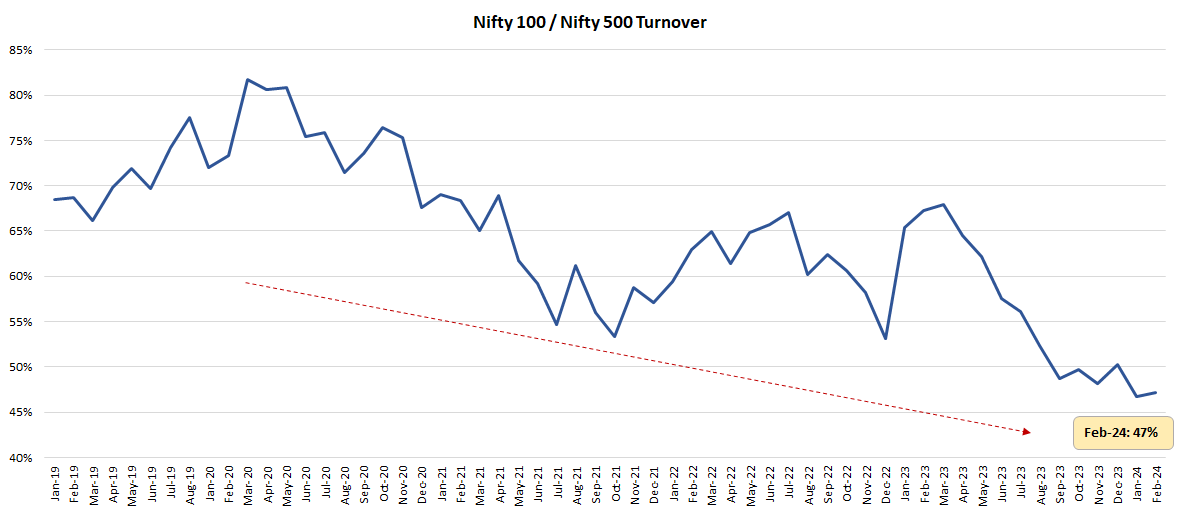
10/n Risk ON sentiment!
Nifty 100 Trading volume as a % of Nifty 500 has decreased indicating high risk-taking sentiments!
Nifty 100 Trading volume as a % of Nifty 500 has decreased indicating high risk-taking sentiments!
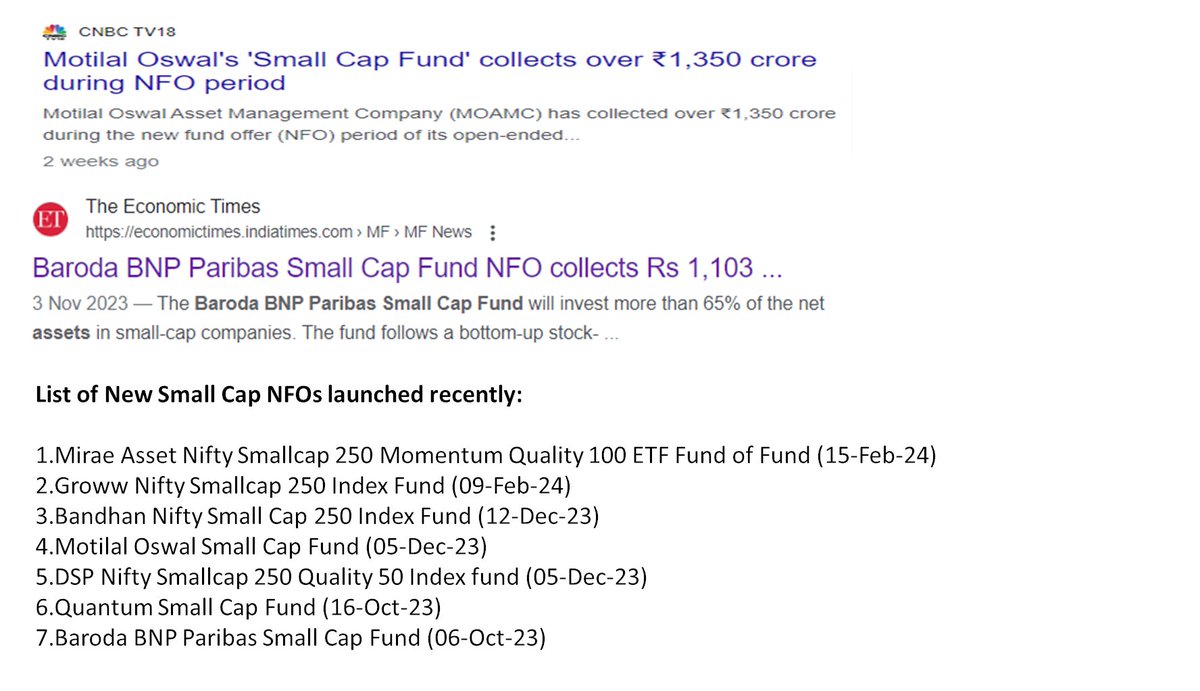
11/n Lot of new small-cap funds getting launched + garnering high AUMs
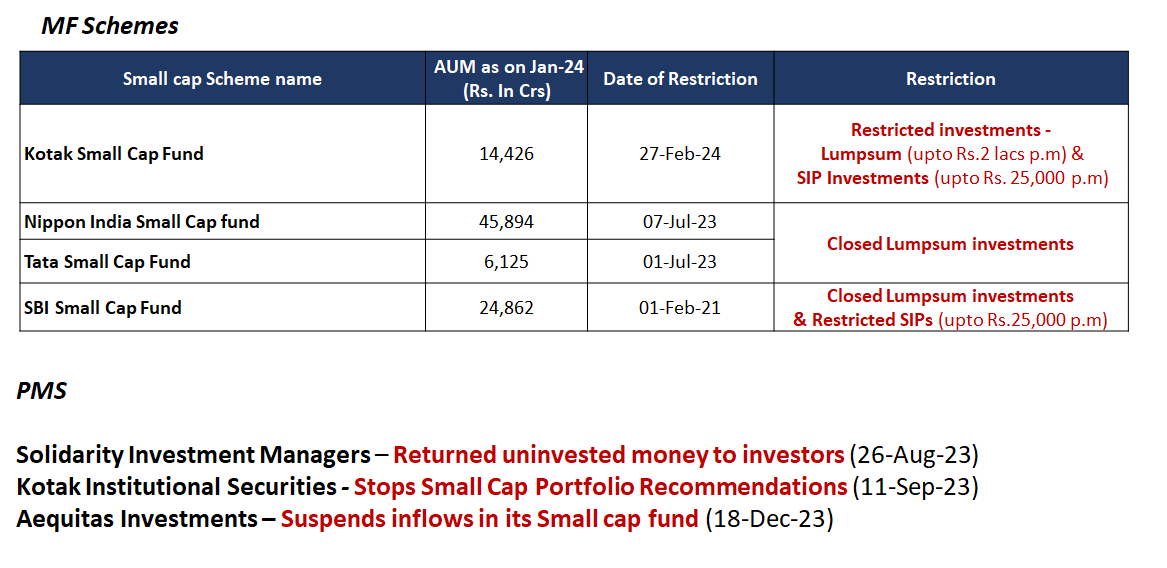
12/n But few Small Cap MF/PMS Funds have closed Inflows - due to concerns on flows and valuations
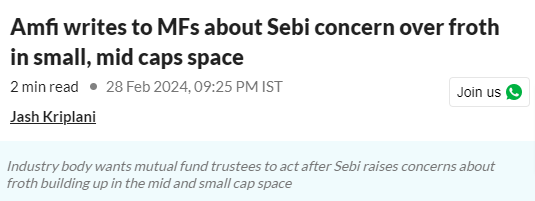
13/n MF Regulator SEBI has raised concerns of ‘froth building up in small and midcap segments’ amid continuing flows in mid- and small-cap funds.
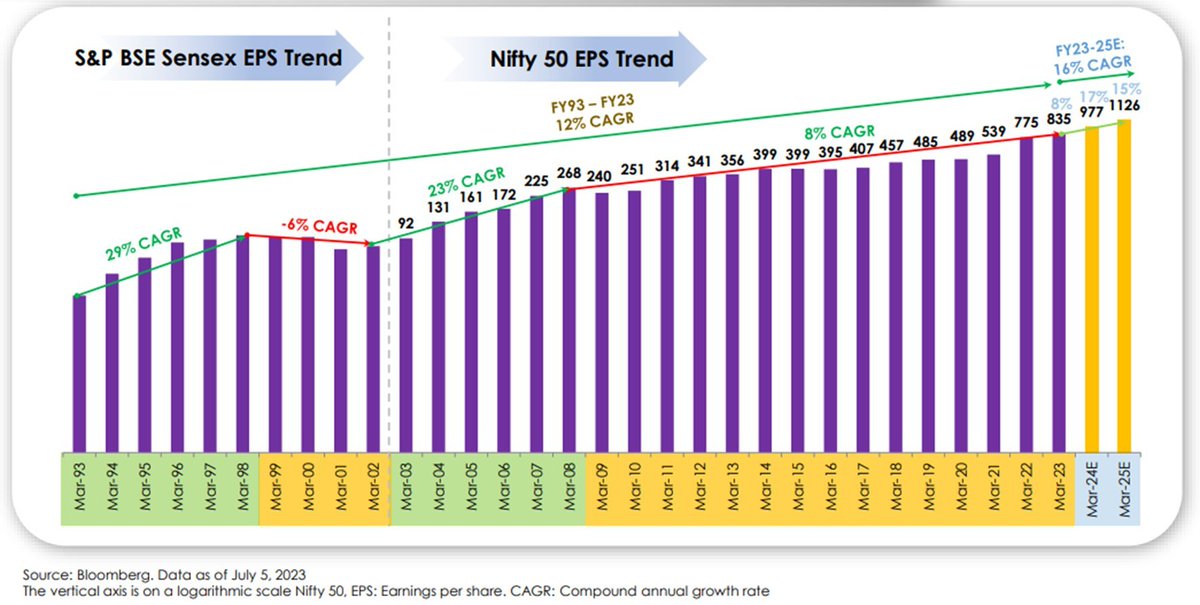
14/n Lens 4: Earnings Growth Cycle
Strong Broad-based Earnings Growth expected over next 2-3 years - Augurs well for Smallcaps
Source: UTI MF
Strong Broad-based Earnings Growth expected over next 2-3 years - Augurs well for Smallcaps
Source: UTI MF
15/n Higher valuations of small caps vs large caps driven by higher earnings growth expectation
Source: Bandhan MF
Source: Bandhan MF
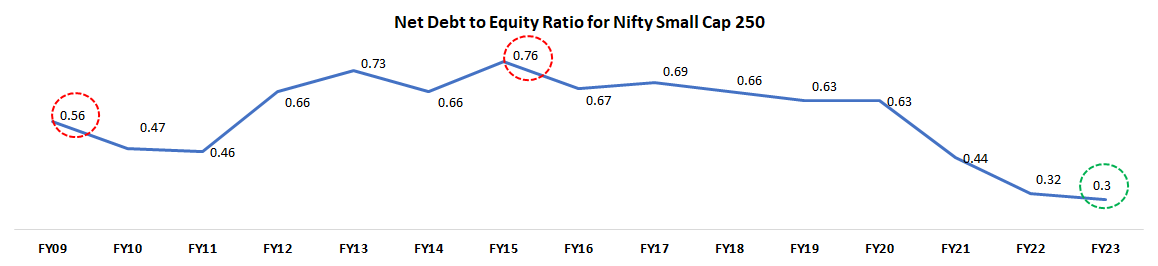
16/n Balance Sheets are Strong - Debt to Equity ratio has reduced to 0.3x in FY23 (vs 0.8x in FY 15)
Source: MOSL MF
Source: MOSL MF
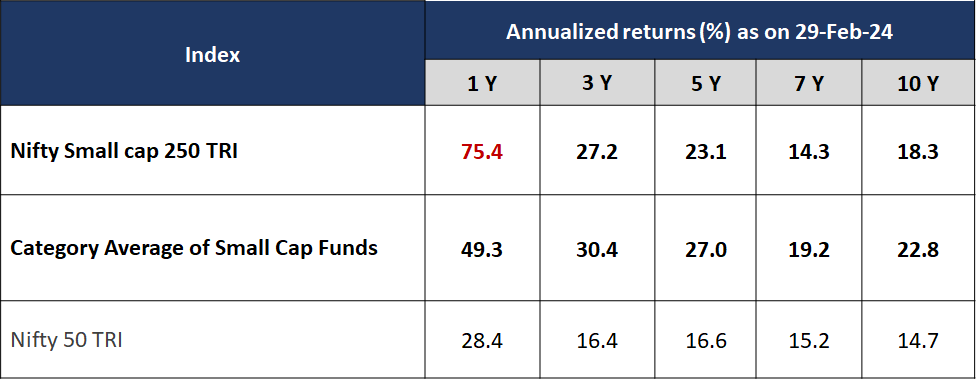
17/n LENS 5: Past Performance Lens - Flashing 'RED'
1) Last 1Y Returns are usually above 50% during past bubbles - currently at 75%!
2) 3Y/5Y/7Y Returns are in the 20-30% range (similar to 20-25% range in past bubbles)
1) Last 1Y Returns are usually above 50% during past bubbles - currently at 75%!
2) 3Y/5Y/7Y Returns are in the 20-30% range (similar to 20-25% range in past bubbles)
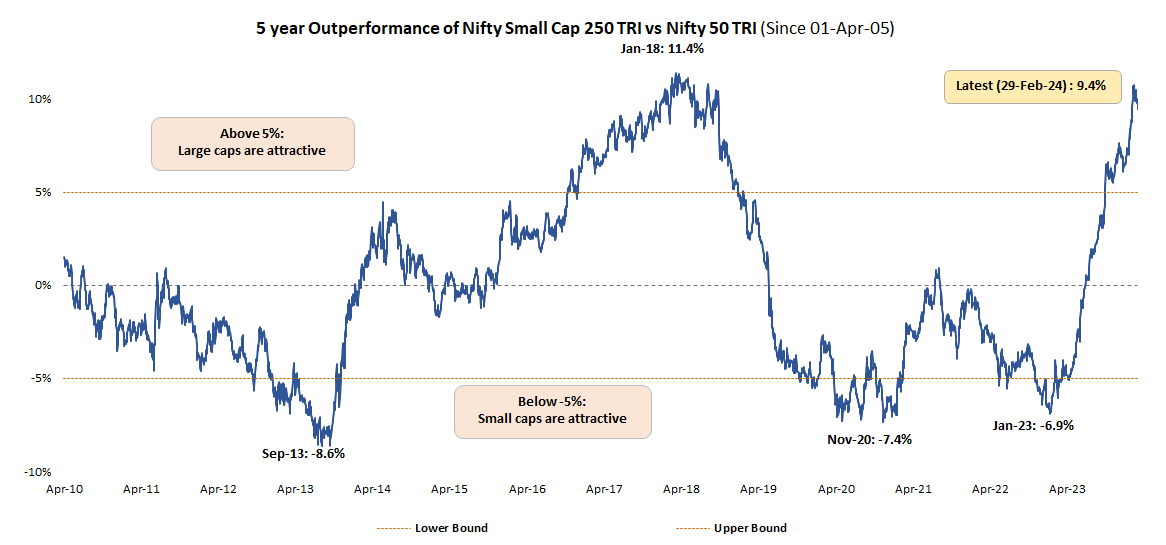
18/n 5Yr Rolling Return Outperformance of Small Caps vs Large Caps is close to Jan-2018 levels
19/n Putting all this together:
Lens 1: Price Cycle
Long Cycle -> Flashing RED (crossed 2018 levels) Short Cycle -> Some more steam left
Lens 2: Valuations -> Expensive
Lens 3: Flows/Sentiment -> High Flows + Sentiments indicate 'high risk taking' & 'greed'
Lens 1: Price Cycle
Long Cycle -> Flashing RED (crossed 2018 levels) Short Cycle -> Some more steam left
Lens 2: Valuations -> Expensive
Lens 3: Flows/Sentiment -> High Flows + Sentiments indicate 'high risk taking' & 'greed'
20/n Lens 4: Robust Earnings Growth + Strong Balance Sheet - Favors Small Caps
Lens 5: Very High Past Returns - Flashing RED
Trigger to Monitor: SEBI's actions to moderate flows + MF Stress Test Results + Liquidity risk in small cap funds/PMS
-> Time to be CAUTIOUS!
Lens 5: Very High Past Returns - Flashing RED
Trigger to Monitor: SEBI's actions to moderate flows + MF Stress Test Results + Liquidity risk in small cap funds/PMS
-> Time to be CAUTIOUS!
21/n What should you do now?
1) Keep a close watch on flows in small-cap funds
2) Avoid incremental lumpsum allocation
3) If overexposed - reduce to <15-20% of the equity portfolio (as per your risk profile)
4) Continue SIP only if your time frame is >7 years
1) Keep a close watch on flows in small-cap funds
2) Avoid incremental lumpsum allocation
3) If overexposed - reduce to <15-20% of the equity portfolio (as per your risk profile)
4) Continue SIP only if your time frame is >7 years
Loading suggestions...