

Chinese EV exports to EU were down significantly in Jan-Feb.
The decline was likely driven mainly by foreign foreign MNCs like Tesla.
scmp.com
The decline was likely driven mainly by foreign foreign MNCs like Tesla.
scmp.com

How do we know this?
1. While unit volumes were down ~20%, export values was down by a third despite a weaker ¥/€, implying lower ASPs
This means fewer higher-cost vehicles were exported as part of the mix. Foreign EVs tend to cost more.
@Brad_Setser
1. While unit volumes were down ~20%, export values was down by a third despite a weaker ¥/€, implying lower ASPs
This means fewer higher-cost vehicles were exported as part of the mix. Foreign EVs tend to cost more.
@Brad_Setser
2. Tesla's GF Berlin has ramped up over the past year from ~4k units/month to ~6k units/month.
It has been steadily reducing exports to the EU since the launch of the factory.
reuters.com
It has been steadily reducing exports to the EU since the launch of the factory.
reuters.com

Meanwhile EV exports to free-trade partners in the RCEP are +36%.
The EU and RCEP now are about equal in unit volume exports (~30% each).
At one point the EU had been more than half of volume (and a large majority of export value).
The EU and RCEP now are about equal in unit volume exports (~30% each).
At one point the EU had been more than half of volume (and a large majority of export value).
This corroborates the seismic shift in China's trade flows:
The rising importance of developing economies in regions like ASEAN (which makes up much of RCEP) that I have been discussing this past year.
Expect this to continue / accelerate.
The rising importance of developing economies in regions like ASEAN (which makes up much of RCEP) that I have been discussing this past year.
Expect this to continue / accelerate.
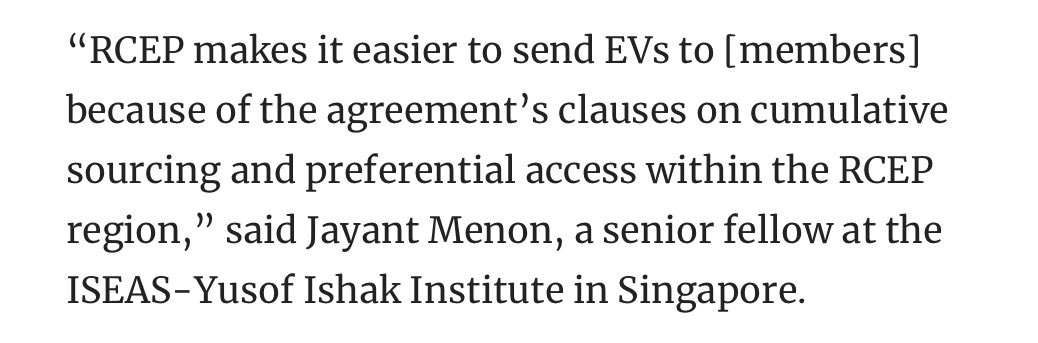
One tidbit from the article worth highlighting:
"German producers trying to compete with China in ASEAN won’t have that advantage"
Besides having to deal with higher labor and production costs, EVs manufactured outside RCEP also have a trade disadvantage to deal with.
"German producers trying to compete with China in ASEAN won’t have that advantage"
Besides having to deal with higher labor and production costs, EVs manufactured outside RCEP also have a trade disadvantage to deal with.
The major branded automakers within RCEP are from China, Korea and Japan.
Thailand, Indonesia and Malaysia also produce vehicles — today mainly for Japan brands.
These account for ~2/5ths of global vehicle production.
Thailand, Indonesia and Malaysia also produce vehicles — today mainly for Japan brands.
These account for ~2/5ths of global vehicle production.
For all intents and purposes, to serve RCEP countries, you will have to manufacture in the region given both the cost and trade advantages.
Japan is MIA on EVs 👇 so the only major branded EV makers in RCEP are Chinese and Korean.
Japan is MIA on EVs 👇 so the only major branded EV makers in RCEP are Chinese and Korean.
With established China operations, German automakers and Tesla also have a foot in the door.
But the Chinese automakers are taking it a step further and aggressively investing directly into the region in Thailand, Malaysia and Indonesia (which have established supply chains).
But the Chinese automakers are taking it a step further and aggressively investing directly into the region in Thailand, Malaysia and Indonesia (which have established supply chains).
That last point also illustrates the other major point here from the decline in China-EU EV trade.
Local mfg., once online, will convert exports to local production. So focusing so much on exports is missing the bigger picture.
You also need to pay attention to FDI.
Local mfg., once online, will convert exports to local production. So focusing so much on exports is missing the bigger picture.
You also need to pay attention to FDI.
China has been busy setting up and participating in FTAs as a "backup" to the WTO for much of the last decade.
These efforts are now starting to bear significant fruit with the evolution of its trade away from labor-intensive exports to high-tech goods.
These efforts are now starting to bear significant fruit with the evolution of its trade away from labor-intensive exports to high-tech goods.
These FTAs lower the risk associated w/ investing in trade partners by setting clear ground rules for investing.
So in terms of priority, 🇨🇳 EV makers will focus primarily at home, secondarily in FTA markets + lastly in markets like the 🇺🇸 where there is high geopolitical risk.
So in terms of priority, 🇨🇳 EV makers will focus primarily at home, secondarily in FTA markets + lastly in markets like the 🇺🇸 where there is high geopolitical risk.
With the EU, while some local investment has commenced, I do not foresee major 🇨🇳 investment until and unless there is a reciprocal market access agreement in place - just too risky to invest locally.
Exporting from 🇨🇳 with tariffs is a lower-risk way to establish your brand.
Exporting from 🇨🇳 with tariffs is a lower-risk way to establish your brand.
🇺🇸 will clearly be the most difficult market. Chinese EV makers are explicitly not even trying.
Slower EV adoption, fierce resistance from a politically connected dealer network 👇 compounds the already challenging issues from the geopolitical rivalry.
Slower EV adoption, fierce resistance from a politically connected dealer network 👇 compounds the already challenging issues from the geopolitical rivalry.
No sane 🇨🇳 automaker would invest significantly onshore 🇺🇸 without an ironclad reciprocal access agreement in place.
And given the state of the relationship, that is not likely to happen anytime soon, if ever.
And given the state of the relationship, that is not likely to happen anytime soon, if ever.
Establishing local mfg. in 🇲🇽 focused on the local market is the lowest-risk way establish in North America more broadly.
Can take advantage of well-established existing auto supply chain.
Although the former 🇨🇳🇲🇽 ambassador doesn’t see this as likely👇
Can take advantage of well-established existing auto supply chain.
Although the former 🇨🇳🇲🇽 ambassador doesn’t see this as likely👇
Barriers seem to be far lower in South America, with Brazil seemingly the preferred destination for 🇨🇳 EV and battery FDI.
After initially testing the market with exports, BYD recently kicked off construction of building a facility in Bahia.
reuters.com
After initially testing the market with exports, BYD recently kicked off construction of building a facility in Bahia.
reuters.com

Loading suggestions...