

Lol thank you,you provided me source to expose you again.🧵.
Regarding the allegation about the story or Umm Qirfah, then the book entitled Al-Mufassal Fi Ar-Radd ‘Ala Shubuhaat A’daa’ Al-Islam [The Detailed Response to the Allegations of the Enemies of Islam] written by the researcher ‘Ali ibn Naayif Ash-Shahood, reads:

The story was also reported in brief by Ibn Katheer in Al-Bidaayah Wan-Nihaayah, but he did not comment on it at all. Ibn Hishaam mentioned it as well in his book entitled As-Seerah; both of them narrated it from Muhammad ibn Is-haaq who did not mention the chain of narrators.
To conclude, the narration is not authentic so it is not permissible to use it as evidence.
Also, Al-Haafith Ibn Hajar classified this narration, which reported the murder in this outrageous manner, as Dha’eef [weak], so he said in the book entitled Ad-Diraayah Fi Takhreej Ahaadeeth Al-Hidaayah:
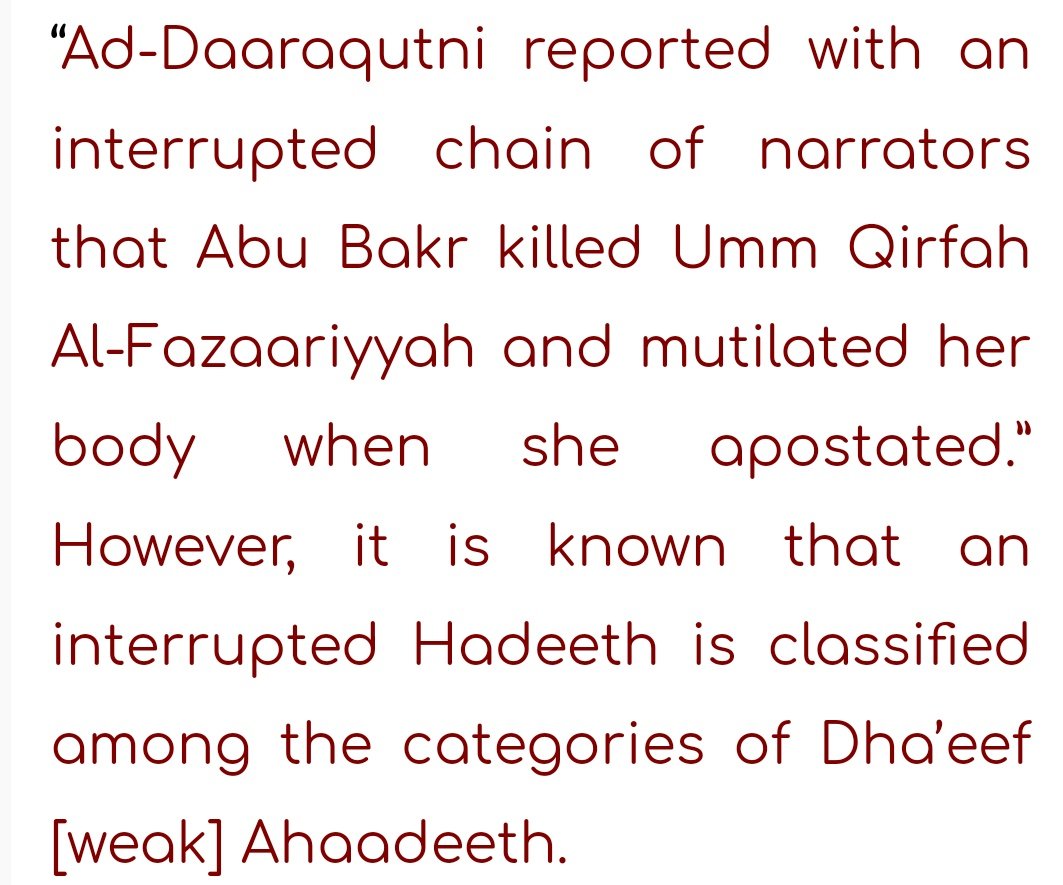
Al-Haafith Az-Zayla'i also classified it as Dha’eef in his book entitled Nasb Ar-Raayah Li Ahaadeeth Al-Hidaayah.
As regards why At-Tabari, Ibn Is-haaq and others narrated this Hadeeth, then the answer is that the followed approach in history books is that they (the historians)write everything that was reported......
.....but when providing a Hadeeth as evidence, they agreed that it is an obligation according to them to investigate it and make sure that the Hadeeth is authentic.
Over.
Loading suggestions...