
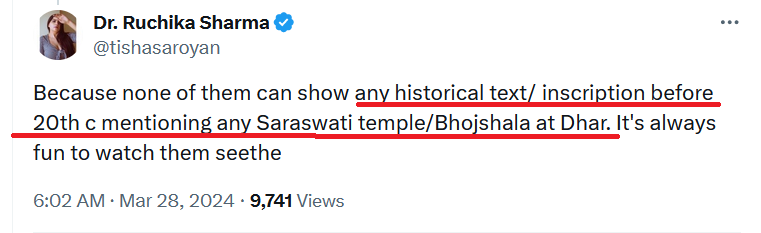
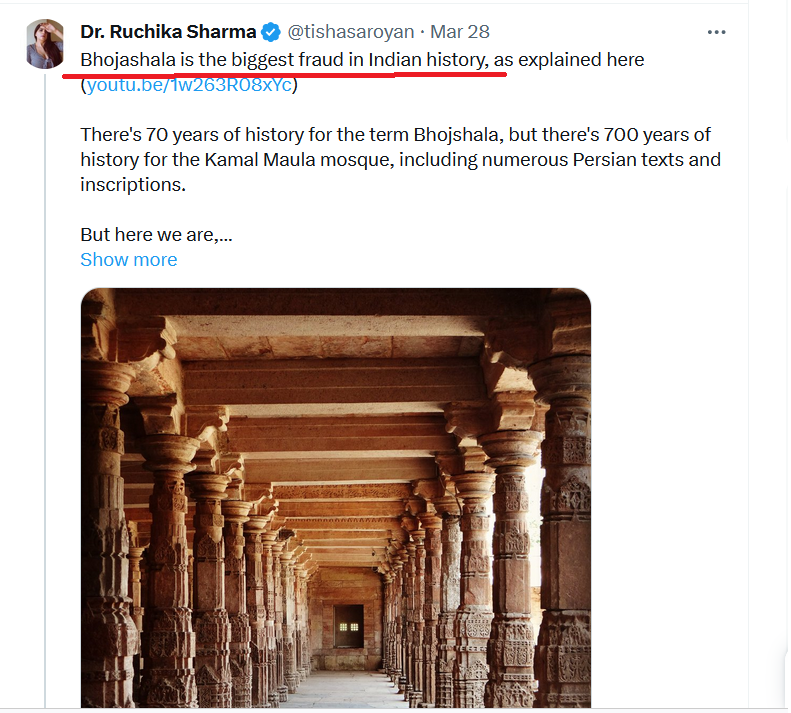
She further claims that 'Bhojashala' was coined only 70 years ago. That it had never existed before.
That there is no inscription or text predating 20th century that mentions any Sarasvati temple or Bhojashala at Dhar.
Is this really true?
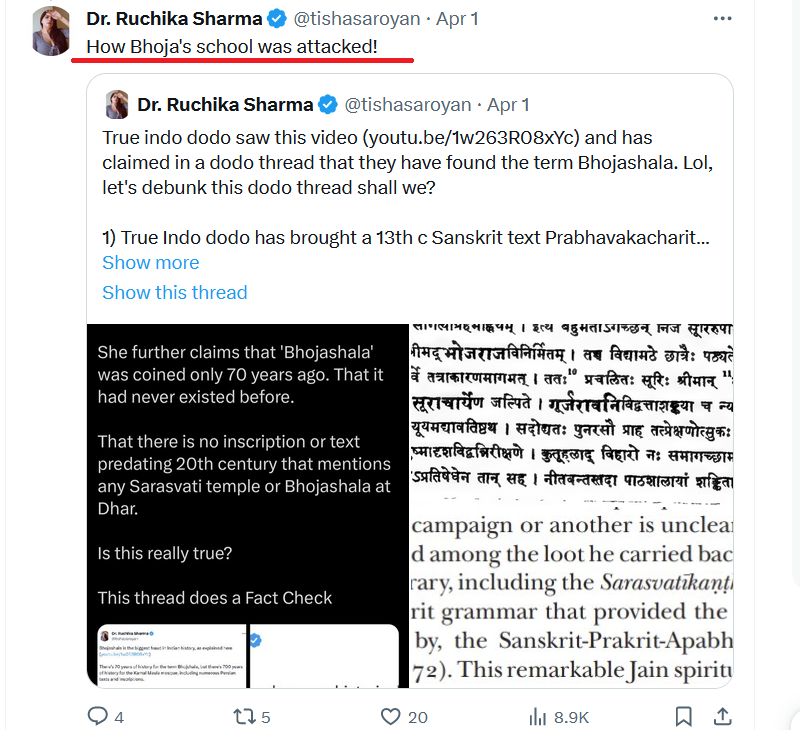
This thread does a Fact Check


It describes an incident which occurred around the year 1140.
The Chalukya king Siddharaja Jayasimha attacked Dharanagara (Dhar). There, he met a group of students studying in what the text calls 'Bhoja's Pathashala'
There is a rather elaborate description of Bhojashala.
The text says this school/university taught the grammar established by Bhoja himself (तत्र व्याकरणं श्रीमद् भोजराजविनिर्मितम्)
It must be remembered that the great Paramara king Bhoja wrote a treatise on Sanskrit grammar named Sarasvatīkaṇṭhābharaṇa
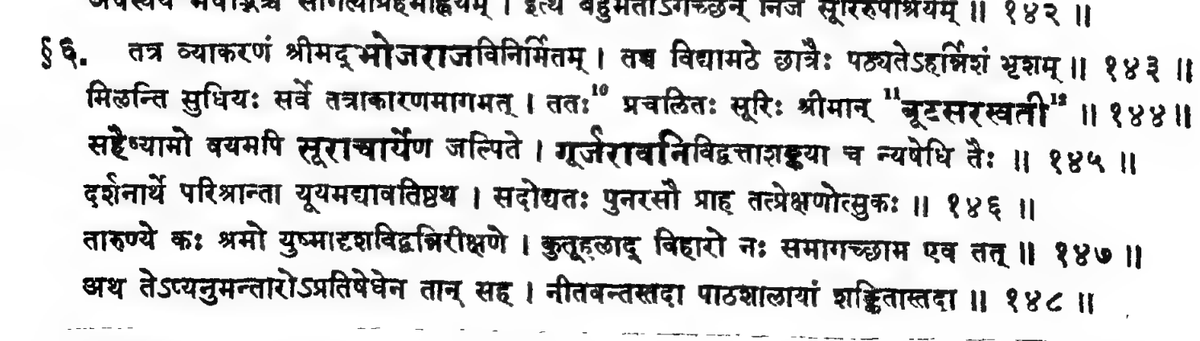
The text further tells us this institution had a learned man named 'Vutasarasvati'. The students say that they also join the discussion with this teacher.
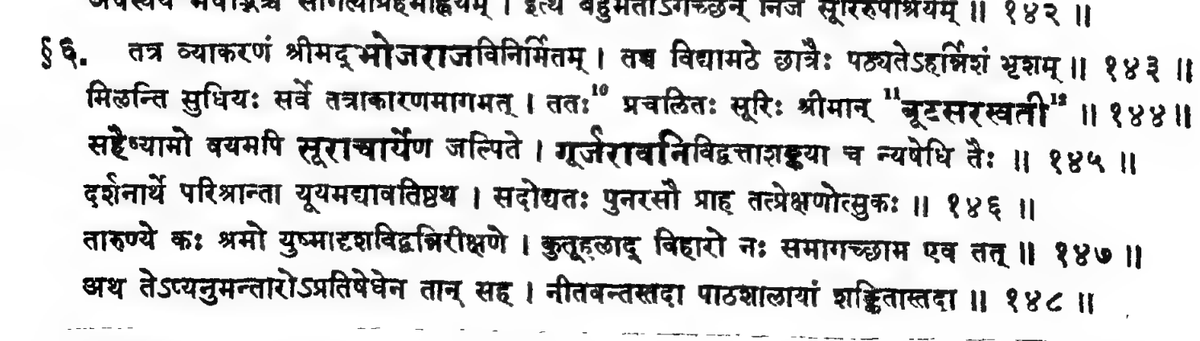
The words used to describe the institution are 'Vidyapeetha' and 'pathashala' leaving no doubt that we are talking about Bhojashala
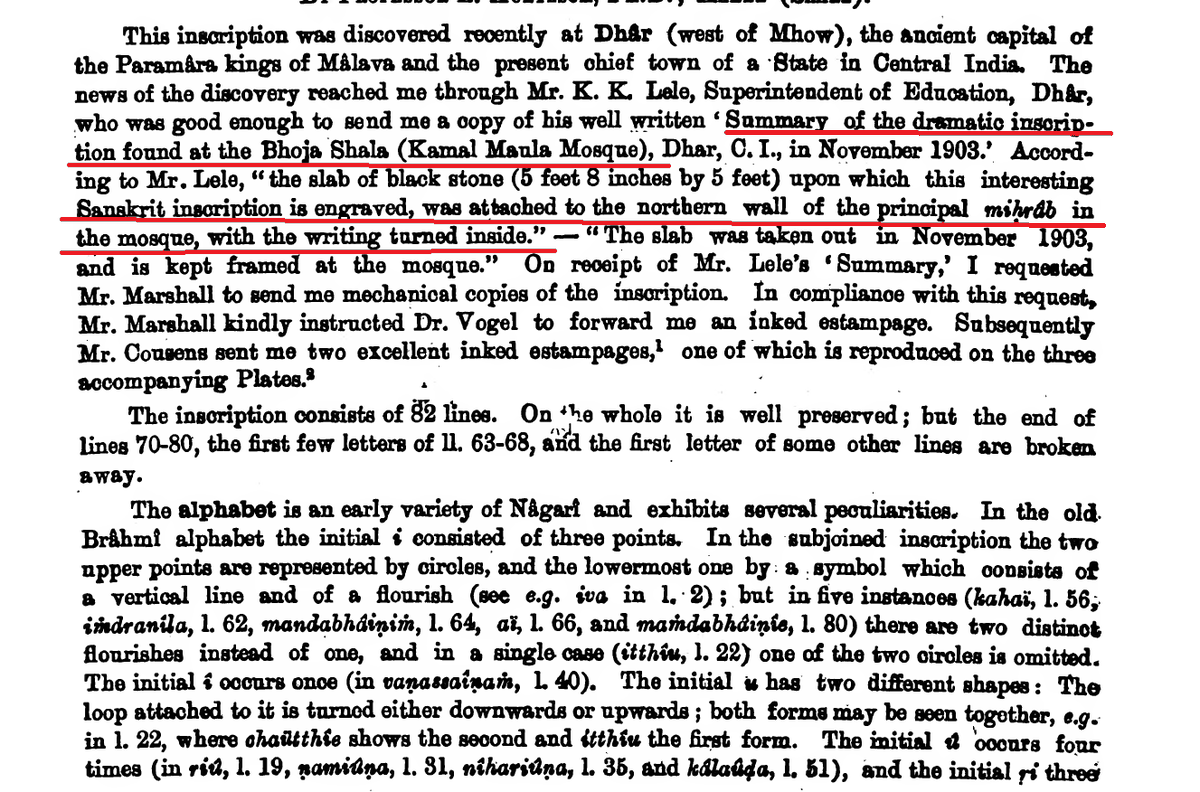
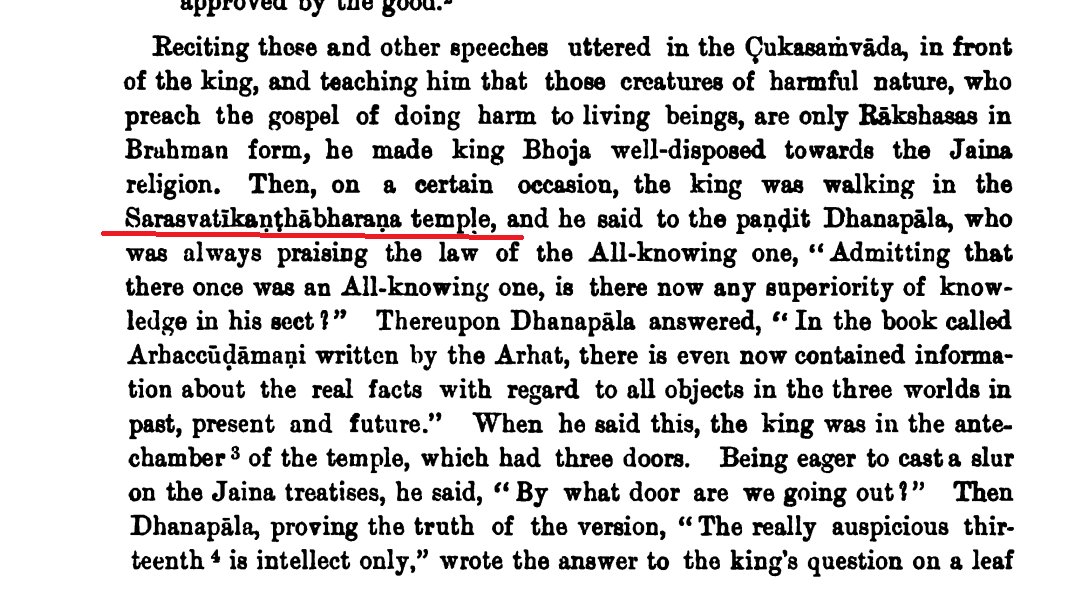
This inscription is published by ASI in Epigraphia Indica Volume 8. It was issued by Paramara King Arjunavarman (c. 1215 CE)
The text of this inscription is a Sanskrit drama named Parijatamanjari. The inscription says this drama was performed at 'Sarasvati temple' in Dharanagara (Dhar).
The temple is described as pearl necklace of Shringara of the damsel of the city of Dhar.
The Saraswati temple is described as the chief of all temples in the eight four squares of the city of Dhar.
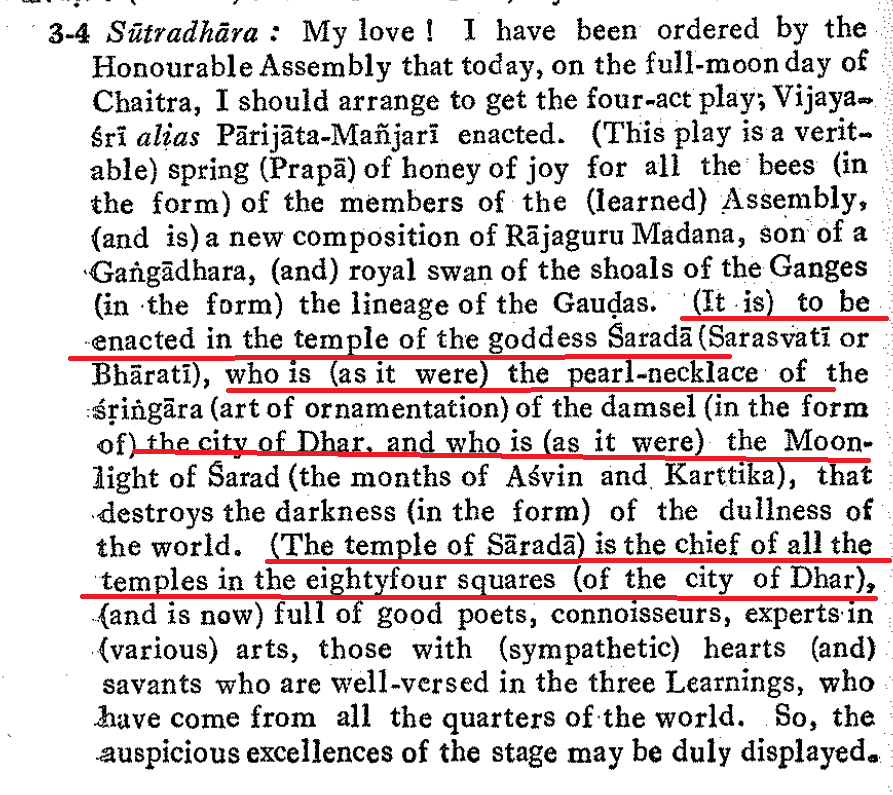
Typically, plays were inscribed on the temple walls so that the actors could read the dialogues while they performed.
As the inscription has been recovered in situ, it shows without doubt that Kamal Mosque Mosque was indeed the Sarasvati temple of the inscription found inside it.
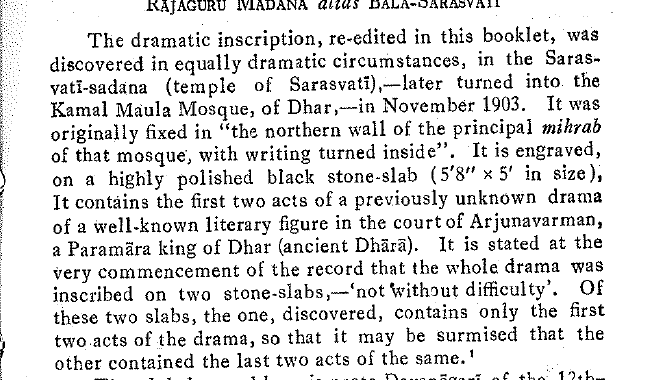
It was also mentioned in Prabandhacintāmaṇi of Merutunga (c. 1304)
Merutunga addresses the temple by its name 'Sarasvatīkaṇṭhābharaṇa'. The temple had taken the name of Bhoja's treatise.
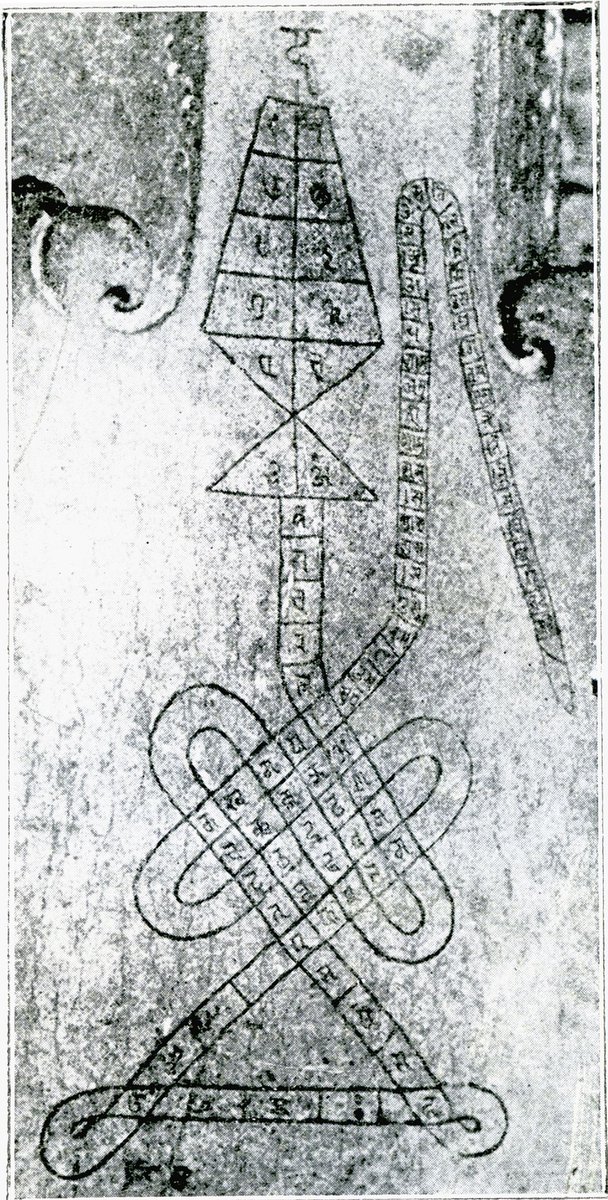
These inscriptions depict alphabets and grammatical rules in form of snakes. This was to enable students to easily memorize the grammatical rules.
This clearly shows that Kamal Maula mosque was earlier a Sanskrit college (which also housed a temple to Goddess of learning like most Sanskrit schools) before its conversion.
Thus, this claim is demonstrably wrong
Even he accepts the presence of Bhojashala. He says it functioned as a school and literary center in the Paramara capital city of Dhara.

To: "Bhoja's school existed and was attacked"
Happy to educate.
More from this author
What is common among: Taj Mahal Bet Dwaraka Charminar Ambani's house 77% of Delhi 42% of Hyderabad International school of Business Wipro Hyderabad o...
Not Gandhi. Not Nehru. Hindu King Krishnaraja Wadiyar was the pioneer of India's development. He pushed India towards modern development. The prosp...
A Bengali Hindu widow named Hotee established a School in Varanasi for ALL women. She taught Poetry, Law, Mathematics and Ayurveda. She was awarded th...
The film #RRR earned an Oscar. This film was inspired by a Hindu Sanyasi named Alluri Sitarama Raju. Alluri Sitarama Raju used to travel from villag...
Recent Threads
SA DULO, MAGTATAGPO. — a filo #taekookau a taekook au wherein taehyung is a famous vlogger who offered a stranger to do the 24 hours jowa challenge w...

I’m not allowed in social situations without supervision anymore https://t.co/qRXclKZQAi

yejisu au | fundamentals of me and you. where yeji was forced to face her past after yuna got her hired as a secretary to a CEO. the CEO? the same...

🚨Rollercoaster NIGHTMARE 8 students dangling 100ft on a stuck Galveston TX roller coaster! … Vertical track failure left them hanging for hours. Fi...

Green flags in friendships that are highly underrated:

otts 617 https://t.co/XpYfeE08YM

Popular Threads
These are the 41 most powerful tenants of Tateism for a man to live by. Wether you are Christian, Muslim; It doesn’t matter if you are strong, weak...

ICT’s 2022 Mentorship Summarized: https://t.co/zFJCgIfDAR

DON'T ARGUE WITH DONKEYS (Fable) The donkey said to the tiger: - "The grass is blue". The tiger replied: - "No, the grass is green." The discussion...

Here's 40 TikTok hooks that could make you go viral. (Not in any particular order) //THREAD//

The ICT Mentorship Core Content Month 1 Summarized: https://t.co/6tXJxPMDhm
Top 20 Players with the most goals + assists in football history, only players with assists available (following the Opta criteria for assists) Seaso...
