

The Azad Hind Sarkar was the first 'swadeshi' government of India. Netaji Subhas Chandra Bose had formed this government and taken oath as the Prime Minister on 21st October, 1943. This makes him the first PM of India.
The Azad Hind government was not a token government. This provisional government was recognised by Japan, Germany, Italy, Croatia, Burma, Thailand, Philippines, Manchuria, and the Republic of China (under Wang Jingwei), while a note of congratulations was sent by Eamon de Valera (the then PM of Ireland).
The Azad Hind Sarkar had presented policies-opinions on several important matters pertaining to Indian life. It also had its own postal stamps, bank, civil code, court, currency, territory (Andaman Nicobar islands), and intelligence service. Developing all these things in a short time frame, with limited resources, and with the British still in control was no mean feat.
The Azad Hind government started working from Singapore. It had 11 ministers and 8 representatives from the INA. This government was formed with the objective of freeing India from British rule, and it was necessary to bring together all political and military resources under one government for that purpose. The Azad Hind government also allowed Netaji to hold talks with various countries, while helping in mobilising NRIs to join and support the war of independence.
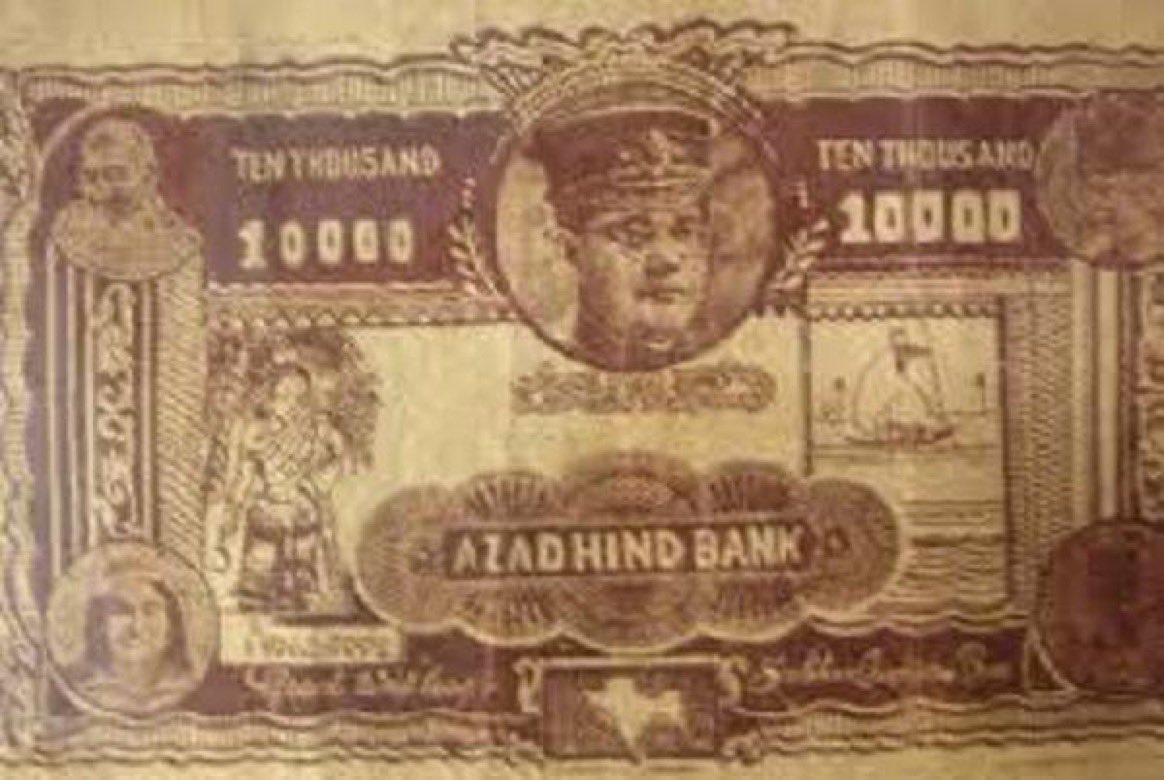
Image: 10000 Rupee Note issued by the Azad Hind Bank of Netaji Subhas Chandra Bose.
The Azad Hind government was not a token government. This provisional government was recognised by Japan, Germany, Italy, Croatia, Burma, Thailand, Philippines, Manchuria, and the Republic of China (under Wang Jingwei), while a note of congratulations was sent by Eamon de Valera (the then PM of Ireland).
The Azad Hind Sarkar had presented policies-opinions on several important matters pertaining to Indian life. It also had its own postal stamps, bank, civil code, court, currency, territory (Andaman Nicobar islands), and intelligence service. Developing all these things in a short time frame, with limited resources, and with the British still in control was no mean feat.
The Azad Hind government started working from Singapore. It had 11 ministers and 8 representatives from the INA. This government was formed with the objective of freeing India from British rule, and it was necessary to bring together all political and military resources under one government for that purpose. The Azad Hind government also allowed Netaji to hold talks with various countries, while helping in mobilising NRIs to join and support the war of independence.
Image: 10000 Rupee Note issued by the Azad Hind Bank of Netaji Subhas Chandra Bose.
FYI @INCIndia not accepting this basic truth, the history that had actually happened, is being a perfect British slave. Of course, it suits you that way. One must not forget that Allan Octavian Hume, a former British civil servant, was one of the founding members of the Indian National Congress.
@INCIndia Netaji at the Greater East Asia Conference in Japan, 1943.
The Azad Hind Sarkar facilitated Netaji to attend such conferences as a State head and mobilise global support for India against the British.
The Azad Hind Sarkar facilitated Netaji to attend such conferences as a State head and mobilise global support for India against the British.
@INCIndia “Subhas Bose did not take oath in the name of the British King. His Provisional Govt did not come into existence because of some shady transfer of power, whose details remain hidden till date.”
For any provisional government to be legitimate, it needs to be recognised by other sovereign States.
The government-in-exile formed by Raja Mahendra Pratap, Maulana Barkatullah, and Ubaidullah Sindhi in Afghanistan (1915), was not recognised by any sovereign States. Thus it was NOT a legitimate provisional government.
As a historian you should have known this.
The government-in-exile formed by Raja Mahendra Pratap, Maulana Barkatullah, and Ubaidullah Sindhi in Afghanistan (1915), was not recognised by any sovereign States. Thus it was NOT a legitimate provisional government.
As a historian you should have known this.
Loading suggestions...