

Toyota is betting its EV strategy on solid-state battery technology.
This is a repeat of its failed bet on fuel cells a decade ago.
And with the scale of the rise of EVs, this may be a company-breaking problem this time around.
electrek.co
This is a repeat of its failed bet on fuel cells a decade ago.
And with the scale of the rise of EVs, this may be a company-breaking problem this time around.
electrek.co

The problem is not that solid-state battery technology itself is unlikely to win over traditional liquid pouch designs.
I don’t know enough about the technical details to comment on the below from CATL, which seems negative on it (but could certainly be biased).
I don’t know enough about the technical details to comment on the below from CATL, which seems negative on it (but could certainly be biased).
It’s that if Toyota proves technical feasibility with solid-state batteries, it still loses because it doesn’t have scale to drive cost reduction.
Much larger incumbents like CATL or BYD will adopt those designs and use internally (BYD) or provide to existing customers (CATL).
Much larger incumbents like CATL or BYD will adopt those designs and use internally (BYD) or provide to existing customers (CATL).
The technology is not so radically different that scaled battery incumbents will be unable to figure out how to produce it.
The large incumbents are spreading their bets on all typical of battery designs and chemistries.
The large incumbents are spreading their bets on all typical of battery designs and chemistries.
What Toyota needs to prove to be credible is that it can design, produce and sell NEVs competitively as a start.
Not “hybrids”, which are basically ICE vehicles with a ~1 kWh regenerative battery.
But definitely at least PHEVs if not full BEVs.
Not “hybrids”, which are basically ICE vehicles with a ~1 kWh regenerative battery.
But definitely at least PHEVs if not full BEVs.
The critical factors required here are:
▪️ manufacturing (which I assume it can handle)
▪️ software integration (which I am not sure about)
▪️ distribution (which I am not sure about in its two largest markets 👇 including 🇺🇸 where dealers seem to be heavily against EVs).
▪️ manufacturing (which I assume it can handle)
▪️ software integration (which I am not sure about)
▪️ distribution (which I am not sure about in its two largest markets 👇 including 🇺🇸 where dealers seem to be heavily against EVs).
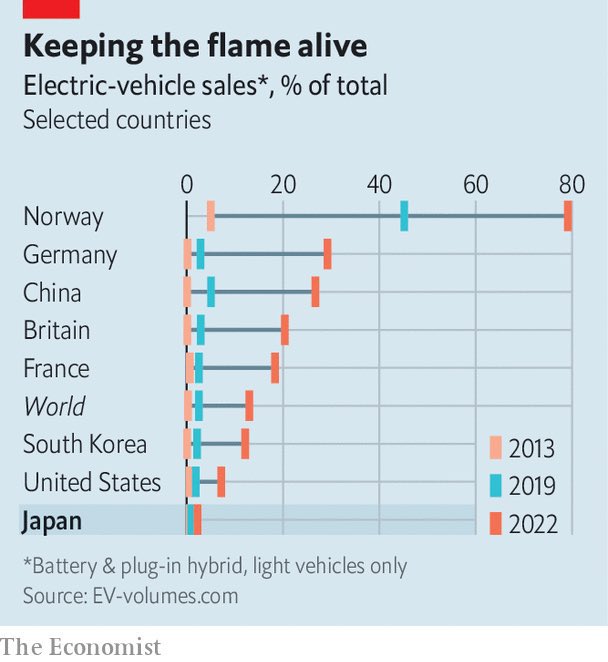
So far it is far behind on proving that out.
Toyota, the leading ICE seller, is nowhere to be found on Top auto lists for EVs or PHEVs. It is a relative nobody in the NEV space.
And its leadership is going around saying things like how investment in EVs are “a waste”.
Toyota, the leading ICE seller, is nowhere to be found on Top auto lists for EVs or PHEVs. It is a relative nobody in the NEV space.
And its leadership is going around saying things like how investment in EVs are “a waste”.
Or funding misinformation campaigns about traditional hybrids vs. PHEVs and EVs.
That says a lot more about how Toyota feels about NEVs than vague announcements about solid-state batteries years in the future.
That says a lot more about how Toyota feels about NEVs than vague announcements about solid-state batteries years in the future.
It’s hard to take Toyota’s EV strategy seriously when company leadership itself is actively 💩-ing on EVs.
And uncles you believe EVs are suddenly going away, Toyota is at risk of going from the #1 car seller to maybe a distant also ran over the next 10-15 years.
And uncles you believe EVs are suddenly going away, Toyota is at risk of going from the #1 car seller to maybe a distant also ran over the next 10-15 years.
Because it’s cars with long useful lives, this doesn’t disappear overnight like Nokia feature phones.
But there is a point of no return as well where it becomes a slow-motion crash a la Kmart.
I think we are close or have already hit that point despite Toyota’s seemingly healthy market capitalization.
But there is a point of no return as well where it becomes a slow-motion crash a la Kmart.
I think we are close or have already hit that point despite Toyota’s seemingly healthy market capitalization.
People like to point to the healthy market capitalization as a sign that things are fine.
While this seems very clear to me, you have to remember that there are strong opinions the other way (on the viability of ICE/traditional hybrids).
While this seems very clear to me, you have to remember that there are strong opinions the other way (on the viability of ICE/traditional hybrids).
Seemingly healthy market cap or sales/financials are one of the powerful forces that often prevent incumbents organizationally from making changes that seem obvious to outsiders.
The late Clayton Christensen talked about this in Innovator's Dilemma.
The late Clayton Christensen talked about this in Innovator's Dilemma.
For a long time, many Tesla bears (I was one of them!) argued that if electric vehicle technical and commercial feasibility were proven out, and adoption took off, the incumbents had the size and scale to catch up.
But if anything we are seeing how incumbents are even farther behind today than they were a decade ago.
That's because you are not trying to catch up to a static target. You are trying to catch up to one that is itself accelerating.
That's because you are not trying to catch up to a static target. You are trying to catch up to one that is itself accelerating.
There is a compounding effect in the accumulation of technology, capital and human capital that becomes very difficult for incumbents to react to once new entrants hit a certain critical mass.
Catching up actually becomes more difficult the longer you wait to really start catching up.
EU/German automakers were a tad late but started really investing in EVs around the mid-2010s. That's why they are in relatively strong positions compared to the Big Three.
EU/German automakers were a tad late but started really investing in EVs around the mid-2010s. That's why they are in relatively strong positions compared to the Big Three.
On cue. Toyota is getting crushed in China.
Fun fact: Toyota achieved all-time-high sales in China in 2021. It declined 1.7% from 2022 to '23.
Doesn't seem that bad right?
Now down 29% in Q1.
Fun fact: Toyota achieved all-time-high sales in China in 2021. It declined 1.7% from 2022 to '23.
Doesn't seem that bad right?
Now down 29% in Q1.
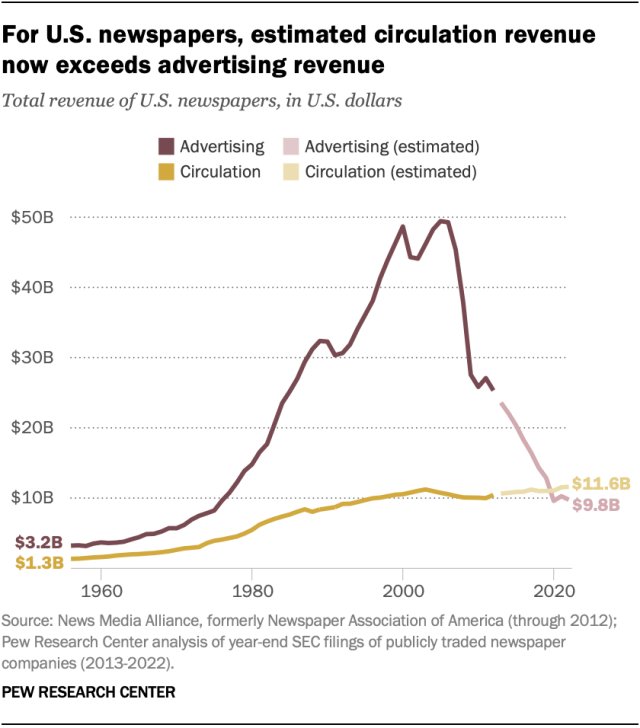
Check out newspaper revenue. It also seemed to be doing "okay" for a brief moment at the peak in 2002-03.
There was even a nice post-recession bump which I am sure gave the newspaper execs a brief moment of "renewed confidence" for a year or two.
There was even a nice post-recession bump which I am sure gave the newspaper execs a brief moment of "renewed confidence" for a year or two.
The China is the harbinger of the future in other geographies (excluding the US/Japan) for Japanese automakers.
They have something like 80% market share in many ASEAN markets. They have established dealer networks but limited NEV offerings.
They have something like 80% market share in many ASEAN markets. They have established dealer networks but limited NEV offerings.
Chinese EV makers are focusing their outbound FDI on developing markets like ASEAN and Latin America, which are 3-5 years behind China in terms of NEV adoption.
And if anything, large price reductions brought on by production efficiencies may accelerate adoption in price-conscious developing markets with lower vehicle penetration than developed economies.
I am not predicting Toyota is going to go the way of the newspapers.
The car business is a much sticker and slower-moving product and automakers have lots of critical mass that takes a long time to erode.
The car business is a much sticker and slower-moving product and automakers have lots of critical mass that takes a long time to erode.
It's more likely to be a slow-motion crash a la Kmart.
Or like US automakers in response to rising competition from Japanese and Korean automakers in the 80s and 90s.
Or like US automakers in response to rising competition from Japanese and Korean automakers in the 80s and 90s.
Japanese brands are peaking and falling like dominoes with the weakest franchisees first: Nissan peaking in 2017, Honda in 2020 and Toyota the last to peak in 2022.
The rates of decline once peaking are also quite consistent.
The rates of decline once peaking are also quite consistent.
Once you fall below a certain critical mass, it collapses very quickly.
Mitsubishi went from ~158K sales in 2019 to ~35K sales in 2022 and exited the market by the end of 2023.
Mitsubishi went from ~158K sales in 2019 to ~35K sales in 2022 and exited the market by the end of 2023.
One could even argue that the rate of market share decline even more rapidly.
EVs only reached cost-parity with ICE vehicles on a non-subsidized basis in the last 2 years with consumer subsidies ending in 2022.
And EV prices continue to decline on the back of production efficiencies.
EVs only reached cost-parity with ICE vehicles on a non-subsidized basis in the last 2 years with consumer subsidies ending in 2022.
And EV prices continue to decline on the back of production efficiencies.
If market share continues to decline at the same linear rate, Japanese automakers could be less than 5% of the market by 2028.
By then, I expect NEVs will make up ~80% of new passenger car sales.
Can Japanese carmakers develop viable NEV models by then? (from where things stand today, seems unlikely).
By then, I expect NEVs will make up ~80% of new passenger car sales.
Can Japanese carmakers develop viable NEV models by then? (from where things stand today, seems unlikely).
Loading suggestions...