

While Mewar had many great rulers, if I had to choose the greatest of them all, it would be Rana Kumbha, the ancestor of Rana Sanga and Maharana Pratap.
The 15th century had some formidable opponents to the Delhi Sultanate, Kapilendra Deva in Kalinga, Deva Raya II in Vijayanagar, Man Singh Tomar in Gwalior and above all Rana Kumbha, a giant of a personality, both physically and metaphorically.
The 15th century had some formidable opponents to the Delhi Sultanate, Kapilendra Deva in Kalinga, Deva Raya II in Vijayanagar, Man Singh Tomar in Gwalior and above all Rana Kumbha, a giant of a personality, both physically and metaphorically.
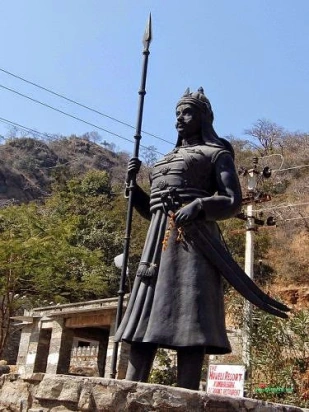
Kumbha initially had good support from Ranmal Rathore of Mandore. His main battles though would be against Mahmud Khilji the Malwa Sultan who laid siege to Chittorgarh, multiple times.
In Nov 1442, Khilji laid siege and captured Pangarh and Chaumuha and encamped there. In the summer of 1443, Rana Kumbha attacked the Sultan’s camp forcing him to retreat to Mandu.
In Nov 1442, Khilji laid siege and captured Pangarh and Chaumuha and encamped there. In the summer of 1443, Rana Kumbha attacked the Sultan’s camp forcing him to retreat to Mandu.
The Sultan again made an attempt to capture Chittorgarh in 1443 but was again forced to retreat, by a spirited counter attack from Rana Kumbha. The Sultan again made a final attempt in 1446 at Mandalgarh along with the Sultan of Gujarat, Ahmad Shah, but had to taste defeat again. For the next decade, the Malwa Sultan, did not attack Chittorgarh again.
In order to commemorate his victory over the combined forces of Malwa and Gujarat, Rana Kumbha ordered the construction of the Vijay Stambh at Chittorgarh fort. Built partly of red sandstone and white marble, the Vijay Stambh or the Tower of Victory is one of the most iconic structures in India.
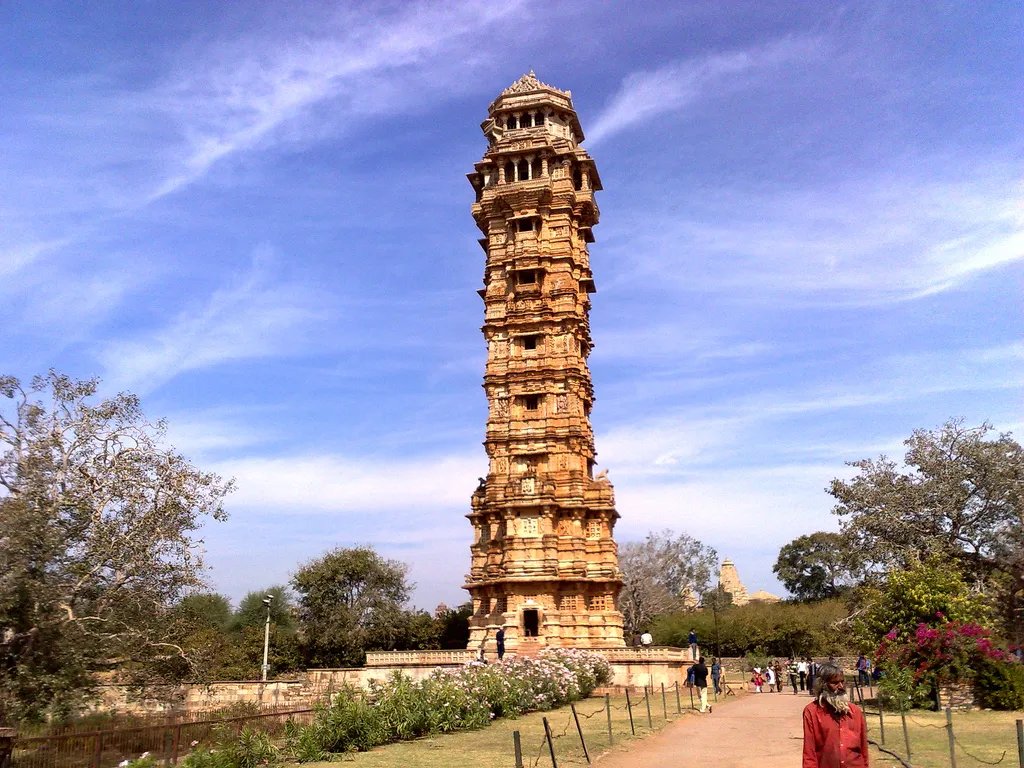
At a height of 37.19 m and 9 stories tall, the tower has numerous images of Hindu gods and goddesses engraved on it. Standing on a 10 feet high pedestal, each story has an opening and balconies, and a staircase inside winding through the central chamber.
Sutradhar Jaita assisted by his 3 sons Napa, Puja, and Poma was the main architect, of this imposing structure, and the sculpture was by Sompura Brahmins from Patan in Gujarat. There are around 157 narrow steps leading to the top, from where you get a great view of Chittorgarh fort, and the surrounding Arravalis.
Kumbha’s greatest achievement would be the fort of Kumbhalgarh. He was a ruler who recognized the importance of a strong network of forts that would prove to be a strategic advantage against the enemy.
During his reign, he built around 32 forts in Mewar, out of which Kumbalgarh would be the largest and also the most impregnable of the lot.
During his reign, he built around 32 forts in Mewar, out of which Kumbalgarh would be the largest and also the most impregnable of the lot.
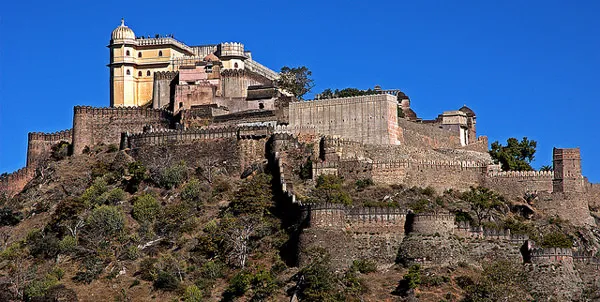
Only once in its history it fell that too to a huge combined force of Akbar, Man Singh and the Mirzas of Gujarat. The fort was built in the 15th century and is located in Rajsamand district of present day Rajasthan, nestled in the Aravalli hills. Second to Chittorgarh, this was the most valued fort in Mewar due to its great strategic importance.
Maharana Pratap was born in this fort, and it took a good 15 years to build. During the medieval period Kumbhalgarh was a refuge for Rajput rulers during battle, one of them being Prince Udai who hid here as a child when Chittorgarh was besieged in 1535.
The construction of the fort began in 1443, and legend goes that initially, the walls crumbled as soon as the sun set. A spiritual guru advised Kumbha that only a voluntary human sacrifice could remove the curse on it.
He advised that a temple should be built on the spot where the head fell, while the fort should be built at where the body fell. For a long time no one came forward, until one soldier volunteered to do so, and today the main gate of the fortress Hanuman Pol contains a shrine in memory of the sacrifice.
He advised that a temple should be built on the spot where the head fell, while the fort should be built at where the body fell. For a long time no one came forward, until one soldier volunteered to do so, and today the main gate of the fortress Hanuman Pol contains a shrine in memory of the sacrifice.
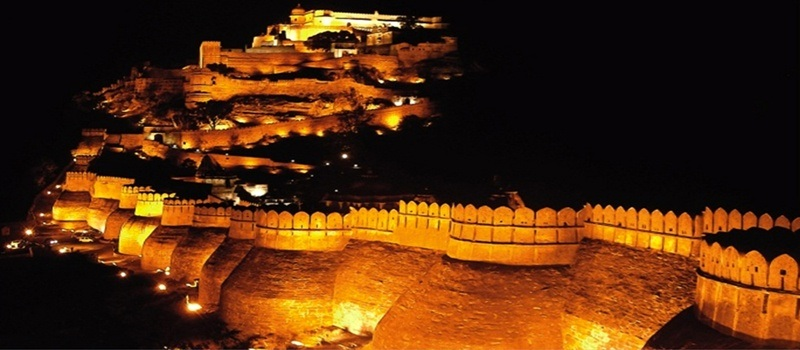
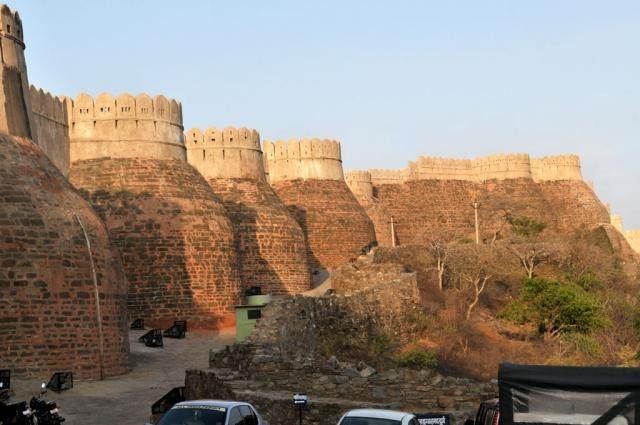
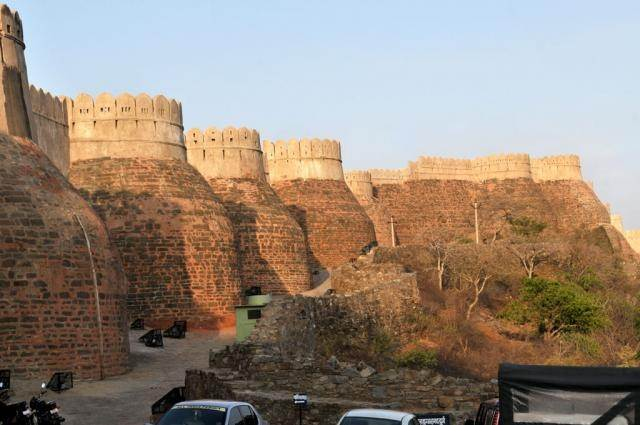
While its altitude and the towering Aravalli peaks make it invincible enough, what makes it virtually impregnable are the walls around the fort. Stretching 36 km, with a thickness of 15 km, the formidable walls around Kumbhalgarh constitute one of the toughest defenses ever to penetrate.
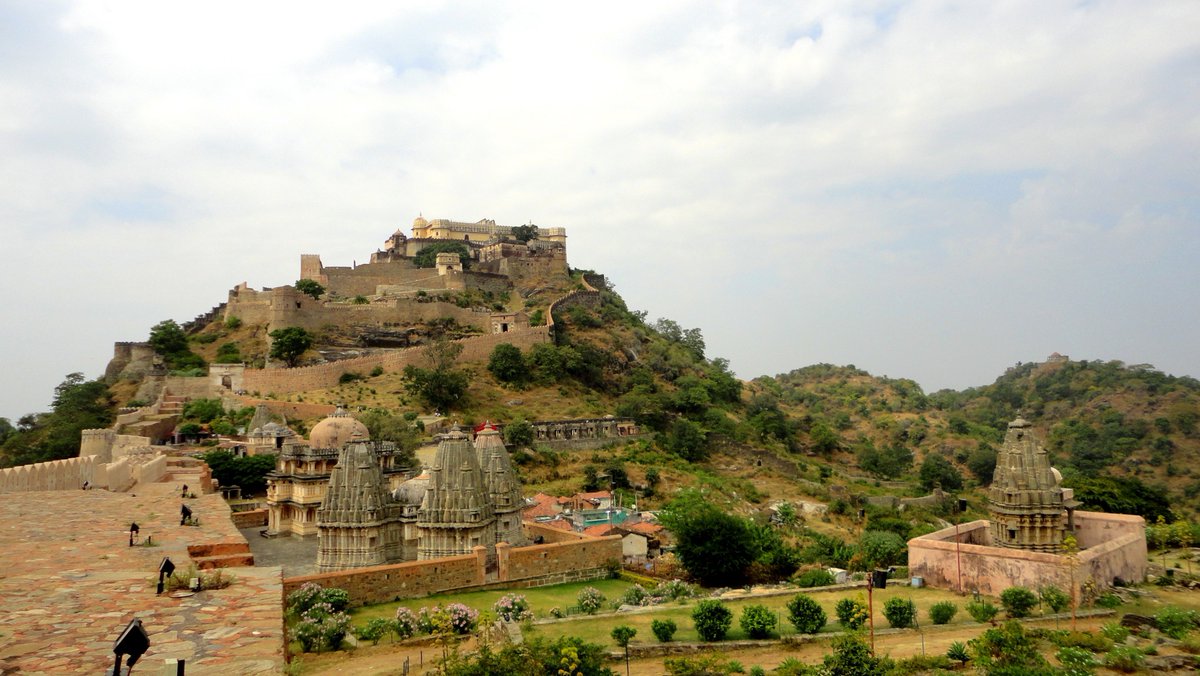
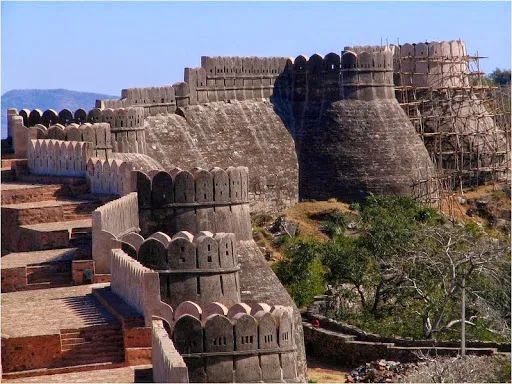
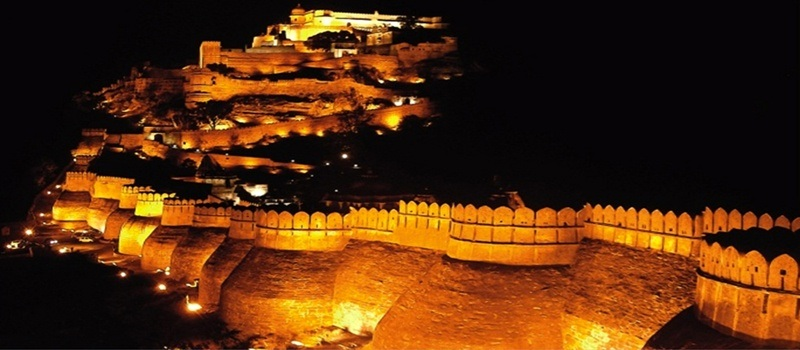
Unlike the Great Wall of China, the wall at Kumbalgarh is does not follow a straight pattern, but has steep ascents and descents at many points where it cuts through cliffs and valleys. Even after 700 years the walls at Kumbhalgarh still stand strong, a testimony to the architectural excellence of the Rajput era.
Seven huge imposing gates stand around the fort, named Pole-Aret, Hanuman (the main gate,) Ram, Vijay, Nimboo, and Bhairon. Within the fort there are around 300 Jain temples and 60 Hindu temples.
Another challenge Rana Kumbha faced was the kingdom of Nagaur, whose ruler Firoz Khan passed away around 1454. Firoz’s son Shams Khan sought the help of Kumbha against his uncle Mujahid Khan, who had usurped the throne.
However on becoming the ruler after overthrowing Mujahid with help of Kumbha, Shams took the help of Qutubuddin the Sultan of Gujarat to strengthen his own position.
However on becoming the ruler after overthrowing Mujahid with help of Kumbha, Shams took the help of Qutubuddin the Sultan of Gujarat to strengthen his own position.
This led to a conflict, in which Kumbha attacked Shams Khan, captured Nagaur, and also Khandela, Sakhambari. Shams Khan in alliance with Qutubuddin and the Malwa Sultan, Khilji, signed the treaty of Champaner, and launched an attack on Kumbha. Qutubuddin captured Sirohi, Mt.Abu and advanced to Kumbhalgarh.
However with Kumbalgarh holding out, he could not proceed till Chittorgarh. In the meantime Khilji captured Ajmer and Mandalgarh, and taking advantage of this, Rao Jodha, captured Mandore. Kumbha had to counter this multi-pronged assault and succeeded in recapturing most of the forts back.
Apart from being a great warrior, Kumbha was also a fine patron of arts, he himself was a great writer. His reign was known as Mewar’s Golden Age for the patronage he gave to writers, sculptors, artistes and poets.
Kumbha himself wrote Samgita Raja, Sangita Ratnakara, Rasika Priya a commentary on the Gita Govinda, Sudaprabandha and Kamaraja Ratisara.
Kumbha himself wrote Samgita Raja, Sangita Ratnakara, Rasika Priya a commentary on the Gita Govinda, Sudaprabandha and Kamaraja Ratisara.
. The scholars Atri and his son Mahesha, Kahana Vyasa who wrote the Ekalinga Mahatya were during his time. Apart from Kumbhalgarh and Vijay Stambha, he also built the Trailokya Jain temple at Ranakpur, Kumbhasvami, Adivarsha temples at Chittor and Shantinatha Jain temple. Sadly he was killed by his own son Uday Singh I, but his legacy would however to continue inspire Mewar.
Rana Kumbha, the greatest of all those who ruled over Mewar. A formidable warrior who never lost a battle, a writer, a patron of arts and literature. A brilliant strategist who knew the importance of forts. And the man who built the Great Wall of India. A hero who deserves to be celebrated more. #Naman
historyunderyourfeet.wordpress.com
historyunderyourfeet.wordpress.com
Loading suggestions...