
"Orlan" is one of the main Russian reconnaissance drones in the war against Ukraine
Among scientists and analysts studying changes within the russian army and their weapon systems during the military conflicts of recent decades, 2014 is considered a turning point. It can be argued that as early as 2008, after the invasion of Georgia, the russian invaders drew conclusions in preparation for further expansion against their neighbours. Alongside the adoption of the new military doctrine, they realised the opportunities of the intense use of aerial reconnaissance. 1/
Among scientists and analysts studying changes within the russian army and their weapon systems during the military conflicts of recent decades, 2014 is considered a turning point. It can be argued that as early as 2008, after the invasion of Georgia, the russian invaders drew conclusions in preparation for further expansion against their neighbours. Alongside the adoption of the new military doctrine, they realised the opportunities of the intense use of aerial reconnaissance. 1/
In 2013, the “Orlan-10” aircraft-type unmanned aerial system (UAS) was taken into service by the russian armed forces. Although it can hardly be called a technological crown in the industry, nevertheless, in 2014, during the active warfare in Donbas, the system allowed russians to achieve a striking advantage over Ukrainian forces, which, at a certain point, were close to eliminating the russian enclave in the territory of Donetsk and Luhansk regions. 2/
With the help of these systems, the russians constantly conducted reconnaissance of the Ukrainian territory and, most likely, corrected artillery that fired at our units. Later, “Orlan” became a mass solution for the russian army. Today, its various versions (such as "Orlan-10", "Orlan-30", "Mosquito", etc.) operate on a daily basis on the battlefields of russia's full-scale war against Ukraine. 3/
Despite that fact, one can often find quite strange technical solutions in devices that were shot down or captured by the AFU. For example, a Canon SLR camera or a plastic bottle used as a gas tank. (Yes, these things fly on gasoline). Because of this, "Orlans" became the object of many jokes, kind of, “look, the russians are feeding them with junk”. Looking ahead, I would say there are not so many reasons to laugh about. "Orlan" is a tool widely and often effectively used against us. 4/
Versatility of application
Let's skip the technical characteristics which can be easily found in the open source, except for specific modifications and what the military conveyor of the occupiers is supplying now. At least 5 km of flight altitude, 120 km of video signal transmission distance, and the ability to fly autonomously for hundreds of kilometres along a defined route (here, the Japanese SLR camera allows obtaining excellent reconnaissance material) make this, far from the most perfect in the world of UAVs thing, an effective and even formidable weapon against us. 5/
Let's skip the technical characteristics which can be easily found in the open source, except for specific modifications and what the military conveyor of the occupiers is supplying now. At least 5 km of flight altitude, 120 km of video signal transmission distance, and the ability to fly autonomously for hundreds of kilometres along a defined route (here, the Japanese SLR camera allows obtaining excellent reconnaissance material) make this, far from the most perfect in the world of UAVs thing, an effective and even formidable weapon against us. 5/
"Orlan" is a multi-purpose complex. It is used as a target designator, providing intelligence surveillance and reconnaissance, as an aerial photographer, and as EW/ES when needed. For instance, the Leer-3 EW system includes up to three “Orlan” UAVs which carry reconnaissance and GSM jamming equipment on board. 6/
Many missile attacks and shelling of Kyiv during the battle for the capital were carried out based on the results of reconnaissance, conducted by these UAVs. According to various estimations, at the beginning of the full-scale invasion, the number of these UAVs, owned by the russians, ranged from 1500 to several thousand vehicles. 7/
Production and UAV special features
There is no doubt that the production of “Orlans” continues today. That is because, firstly, "Orlans" are being lost. Sometimes, they are being shot down, captured, as was in the case of the Kharkiv offensive operation. In other cases, they fall due to technical reasons. There is nothing new or surprising here, as in this war, UAVs are nothing more than consumables. So they are needed in large quantities and literally everywhere. 8/
There is no doubt that the production of “Orlans” continues today. That is because, firstly, "Orlans" are being lost. Sometimes, they are being shot down, captured, as was in the case of the Kharkiv offensive operation. In other cases, they fall due to technical reasons. There is nothing new or surprising here, as in this war, UAVs are nothing more than consumables. So they are needed in large quantities and literally everywhere. 8/
Secondly, the russians are exporting “Orlans” which may also indicate that production has been running in one way or another.
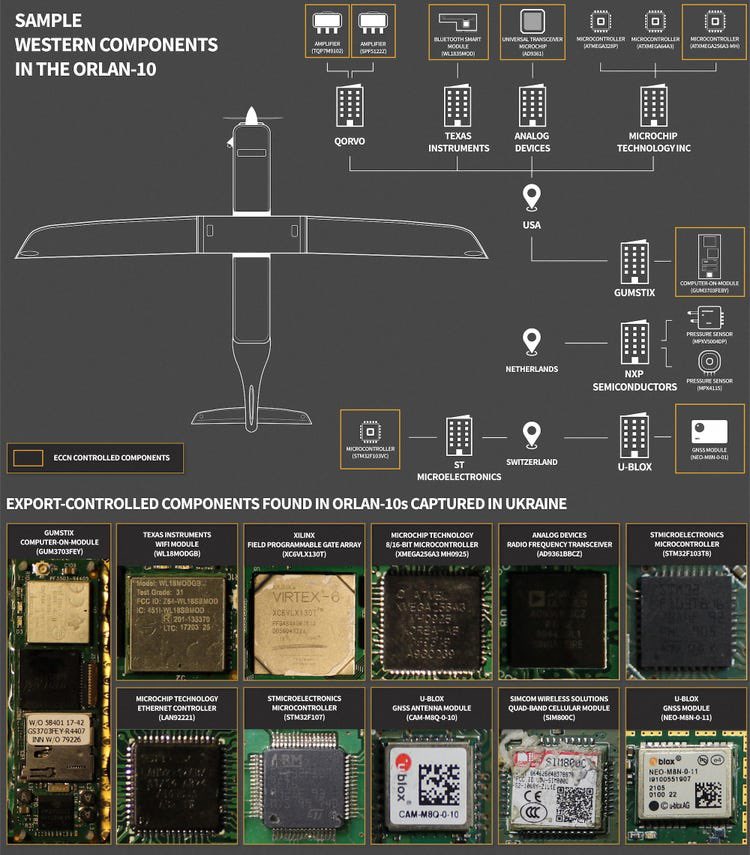
As for the production itself, today, it is known that the russians are able to produce an aerodynamic body without any problems. (Like us, by the way.) Another issue is its “filling” with the components, such as electronics, chips, communication, payload (camera modules, etc.), anti-jamming, and more. Despite Western sanctions, the russians somehow continue receiving components on which this equipment depends. From the open sources, one can learn that the UAVs contain components from the U.S., Japan, China, and a number of European countries. However, it is necessary to understand that the crucial thing is the possibility of using this equipment for its intended purpose. 9/
As for the production itself, today, it is known that the russians are able to produce an aerodynamic body without any problems. (Like us, by the way.) Another issue is its “filling” with the components, such as electronics, chips, communication, payload (camera modules, etc.), anti-jamming, and more. Despite Western sanctions, the russians somehow continue receiving components on which this equipment depends. From the open sources, one can learn that the UAVs contain components from the U.S., Japan, China, and a number of European countries. However, it is necessary to understand that the crucial thing is the possibility of using this equipment for its intended purpose. 9/
"Kometa", an invention of the russian engineers, can serve as a simple example. One of its modifications is installed on the UAV’s board. It is known that "Kometa" has the details designed by U.S. and Taiwanese companies. This so-called CRPA (controlled radiation pattern antenna) has a clearly defined and very important function - to protect the device from the effects of EW measures, which, in turn, attempt to jam the drone's navigation signal and knock the drone off the course. 10/

Imagine you are the operator of such a UAV. To control it from a long distance, you need to have both navigation and video signal. When one of these things is jammed, you still can return the drone (the mode known as RTL, or Return to Launch mode). But if there is neither one nor the other, you are dealing with a big problem. In case you need to work out a UAV mission for a distance of hundreds of kilometres deep into the enemy's rear, where it has to work in autonomous mode, the lack of navigation simply makes it impossible to conduct the mission. 11/
That is why russians seek to gear up their equipment with modules to protect this signal. This allows "Orlan" to perform the function of an aerial photographer for hundreds of kilometres deep into our territory, bringing back the data that the enemy uses, among all, for the conduction of missile strikes. 12/
Proven by years of experience
A lot can be said about the pros and cons of this UAS. However, a few facts are indisputable:
● "Orlan-10" and its other modifications should be considered a massive and fairly effective solution which, at various stages of the confrontation between the russian federation and Ukraine, either gave the russians a complete advantage in the aerial reconnaissance component, or did not allow to lose it.
● The enemy has a significant number of the “Orlan” UAVs and vast opportunities for their use both at the frontline and in Ukraine’s rear.
● The use of “Orlan” type UAVs by the russians in Ukraine (since 2014) and in Syria allowed them to gain a lot of practical experience in such application which was significantly expanded during the full-scale war against Ukraine. This enables russians to make not only military but also engineering decisions. This is especially important given the fact that the enemy possesses large resources and an extensive system of companies and design bureaus that implement and improve these solutions, often quite quickly.
● There are still no sufficiently effective solutions to protect Ukraine against the activity of these UAVs and the consequences of this activity. 13/
A lot can be said about the pros and cons of this UAS. However, a few facts are indisputable:
● "Orlan-10" and its other modifications should be considered a massive and fairly effective solution which, at various stages of the confrontation between the russian federation and Ukraine, either gave the russians a complete advantage in the aerial reconnaissance component, or did not allow to lose it.
● The enemy has a significant number of the “Orlan” UAVs and vast opportunities for their use both at the frontline and in Ukraine’s rear.
● The use of “Orlan” type UAVs by the russians in Ukraine (since 2014) and in Syria allowed them to gain a lot of practical experience in such application which was significantly expanded during the full-scale war against Ukraine. This enables russians to make not only military but also engineering decisions. This is especially important given the fact that the enemy possesses large resources and an extensive system of companies and design bureaus that implement and improve these solutions, often quite quickly.
● There are still no sufficiently effective solutions to protect Ukraine against the activity of these UAVs and the consequences of this activity. 13/
What to oppose?
Despite anything, as of today, we have no analogues of even such an imperfect UAS. It refers to both the technical specifications of this technical solution and the scale, that is, the number of UAVs produced. The point here is that it is not enough to just create a working sample that would bring results. The functioning of mass production and the ability to supply troops and carry out standardisation are necessary. The latter is specifically needed to make it a rather pleasant bonus out of the existing "zoo" of various UAS within the AFU than a problem. 14/
Despite anything, as of today, we have no analogues of even such an imperfect UAS. It refers to both the technical specifications of this technical solution and the scale, that is, the number of UAVs produced. The point here is that it is not enough to just create a working sample that would bring results. The functioning of mass production and the ability to supply troops and carry out standardisation are necessary. The latter is specifically needed to make it a rather pleasant bonus out of the existing "zoo" of various UAS within the AFU than a problem. 14/
All this should encourage the Ukrainian Defence forces, designers, manufacturers, and state bodies to intensify their work in the direction of design, deployment, and production of their own mass technical solution which would be competitive and able to properly cover the needs of the AFU and other Defence forces participating in the repulsion of russian aggression. In addition, there is a need to speed up the development of tools that would be capable of systematically countering the penetration of enemy UAVs deep into our territory, to our airfields, enterprises, etc. 15/
So, it can be said we are rather dealing with the "working horse" of the aggressor's army, not with an object for jokes. Despite the certain obsolescence and dependence of "Orlan" on Western-made components, it continues performing significant work on the frontline and in the rear, posing a great danger to us. It is a multi-purpose product, capable of correcting the enemy’s artillery on the battlefield, directing missiles and drones at our infrastructure, logistics and military facilities in the rear, as well as carrying out EW/ES tasks. The mass character allows the russians to keep “Orlan” in their arsenal as a "staff" UAS that fits into the system and forms the system itself. This enables maintenance standardisation, operators training, and, at the same time, prevents shortages in UAVs. No UAV of this kind in Ukraine is so massive in numbers. 16/
For ASTERO ANALYTICS.
linkedin.com
Translated by Kate Kistol
Join me in Facebook
m.facebook.com
And Telegram
t.me
Support here
buymeacoffee.com
linkedin.com
Translated by Kate Kistol
Join me in Facebook
m.facebook.com
And Telegram
t.me
Support here
buymeacoffee.com

buymeacoffee.com/solonko1648
Olexandr is photos and texts
Military of the Armed Forces of Ukraine. Photos, texts, about life and war
t.me/silukr/323
Сіль
Напередодні російського вторгнення США показали, що вміють в інформаційні операції. Зокрема і можуть...

m.facebook.com/osolonko
Олександр Солонько
Олександр Солонько is on Facebook. Join Facebook to connect with Олександр Солонько and others you m...

linkedin.com/pulse/orlan-un…
“Orlan”: An unmanned surrogate or a mass and effective tool?
Written by Olexandr Solonko Among scientists and analysts studying changes within the russian army a...
Loading suggestions...