

Lajja Gauri - Devi Swarupa of creation and Fertility demonized by Western Indologists as "Shameless Woman" 🧵
🔎
Did you ever pay attention to the plagiarism of Vedic scriptures, symbols, icons by Western Indologists?
🎭
They could translate almost everything they could lay their hands on, but they could not create the context.
So, they demonized or distorted some of the most iconic symbols and deities of Vedic era.
🎭
Devi Lajja Gauri's renaming as "Shameless Woman" is one such classic example of Western appropriation of Hinduism.
🔎
Lets explore the mystic world of Devi Lajja Gauri.
🔎
Did you ever pay attention to the plagiarism of Vedic scriptures, symbols, icons by Western Indologists?
🎭
They could translate almost everything they could lay their hands on, but they could not create the context.
So, they demonized or distorted some of the most iconic symbols and deities of Vedic era.
🎭
Devi Lajja Gauri's renaming as "Shameless Woman" is one such classic example of Western appropriation of Hinduism.
🔎
Lets explore the mystic world of Devi Lajja Gauri.
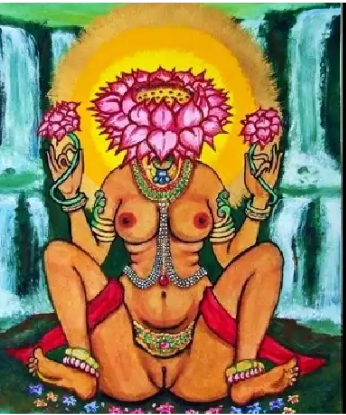
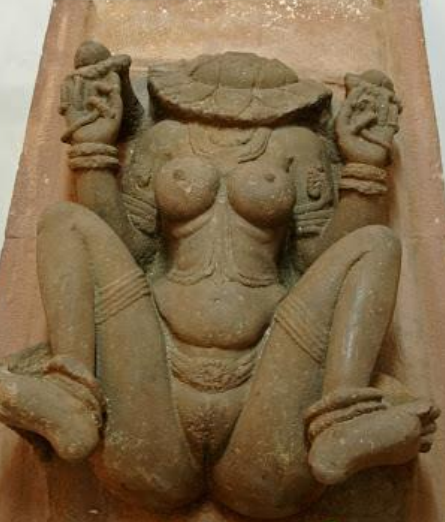
1. The Maa Devi of creation - Aditi as Lajja Gauri
Devi, the Great Mother Goddess of creation of ancient Vedic times, in Her form as Lajja Gauri, is also known as Aditi, AdyaShakti, Renuka wife of sage Jamadagni, who is worshipped for fertility as Matangi and Yallamma(everybody's mother), Kotari, Kotavi (a nude folk goddess), KottaMahika, Kotmai, and many other names.She is the most ancient Goddess form in the religious complex that is today referred to as Sanatan Dharma.
Rig Veda, I.89.10 says that:
अदितिरद्यौर आदितिरन्तरिक्षहं आदितिर्मता स पिता स पुत्र .
विश्वे देव आदितिः पञ्च जन आदितिर्जतं आदितिर्जनित्वम् .
Meaning:
Aditi is the sky - Aditi is the air - Aditi is all the gods - Aditi is the Mother, the Father, and Son - Aditi is whatever shall be born.
Devi, the Great Mother Goddess of creation of ancient Vedic times, in Her form as Lajja Gauri, is also known as Aditi, AdyaShakti, Renuka wife of sage Jamadagni, who is worshipped for fertility as Matangi and Yallamma(everybody's mother), Kotari, Kotavi (a nude folk goddess), KottaMahika, Kotmai, and many other names.She is the most ancient Goddess form in the religious complex that is today referred to as Sanatan Dharma.
Rig Veda, I.89.10 says that:
अदितिरद्यौर आदितिरन्तरिक्षहं आदितिर्मता स पिता स पुत्र .
विश्वे देव आदितिः पञ्च जन आदितिर्जतं आदितिर्जनित्वम् .
Meaning:
Aditi is the sky - Aditi is the air - Aditi is all the gods - Aditi is the Mother, the Father, and Son - Aditi is whatever shall be born.
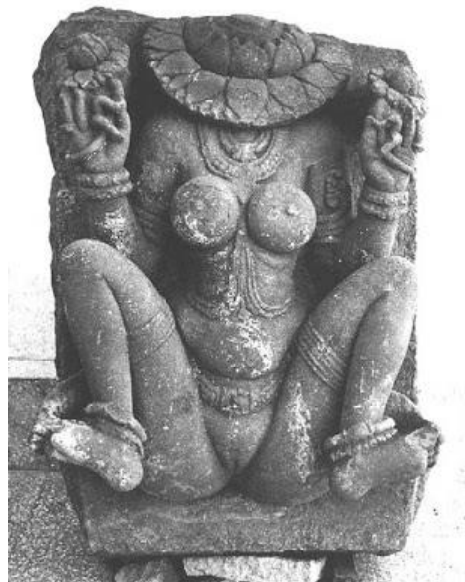
2. Aditi Uttanapada - The Devi maa of fertility and
creation and most ancient form of Lajja Gauri
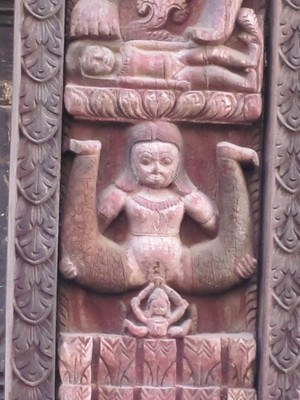
The most elemental and symbolically potent Lajja Gauri representation is the birth giving (uttanapad) pot goddess. This imagery is characterized by human legs in uttanapad pose with a shape above the legs that resembles both a pot and a female’s lower torso. The figure has no upper torso and there are no breasts, arms, or head. The pot torso resembles a brimming vase, or purna kumbha.
Rig Veda, X.72.3-4 says this about Devi Aditi:
देवअं युगे प्रथमे.असतह सदाजयायत
अदास अन्वजयन्ता तदुत्तनपदस परि
भउर्जजना उत्थानपदो भुव असा अजाय
न्तादितेर्दक्षोअजायता दक्षद् वदितिः परि
Meaning:
In the first age of the gods, existence was born from nonexistence. The quarters of the sky were born from Her who crouched with legs spread. The Earth was born from Her who crouched with legs spread, and from the Earth the quarters of the sky were born.
creation and most ancient form of Lajja Gauri
The most elemental and symbolically potent Lajja Gauri representation is the birth giving (uttanapad) pot goddess. This imagery is characterized by human legs in uttanapad pose with a shape above the legs that resembles both a pot and a female’s lower torso. The figure has no upper torso and there are no breasts, arms, or head. The pot torso resembles a brimming vase, or purna kumbha.
Rig Veda, X.72.3-4 says this about Devi Aditi:
देवअं युगे प्रथमे.असतह सदाजयायत
अदास अन्वजयन्ता तदुत्तनपदस परि
भउर्जजना उत्थानपदो भुव असा अजाय
न्तादितेर्दक्षोअजायता दक्षद् वदितिः परि
Meaning:
In the first age of the gods, existence was born from nonexistence. The quarters of the sky were born from Her who crouched with legs spread. The Earth was born from Her who crouched with legs spread, and from the Earth the quarters of the sky were born.
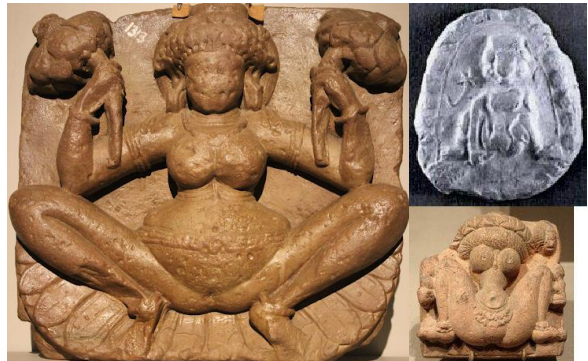
3. Lajja Gauri Lotus-headed without arms
These are like those of uttanapad pot form except that the torso extends up to the shoulders and includes breasts. There are no arms or head in images in this group, but the lotus is elevated to sit atop the shoulders.
The uttanapad legs in this form are on a torso that is more human in form than pot-like. The abdominal area has a carefully indicated navel, breasts, often a necklace, and a lotus in the place of a head. The lotus rosettes are placed to the sides of the shoulders joined to the figure.
These are like those of uttanapad pot form except that the torso extends up to the shoulders and includes breasts. There are no arms or head in images in this group, but the lotus is elevated to sit atop the shoulders.
The uttanapad legs in this form are on a torso that is more human in form than pot-like. The abdominal area has a carefully indicated navel, breasts, often a necklace, and a lotus in the place of a head. The lotus rosettes are placed to the sides of the shoulders joined to the figure.
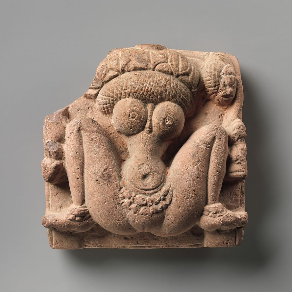
4. Lajja Gauri Lotus-Headed with Arms
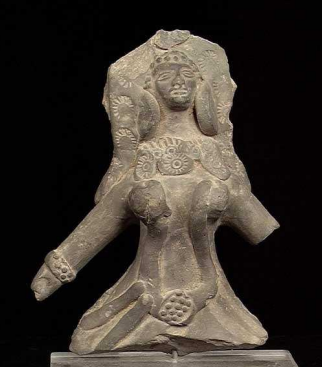
This form is lotus headed but with anthropomorphic female body with breasts and two upraised arms on the full torso with each hand holding a lotus bud, and legs in the uttanapad pose. The lotus buds in hand express pure generation.
This form is lotus headed but with anthropomorphic female body with breasts and two upraised arms on the full torso with each hand holding a lotus bud, and legs in the uttanapad pose. The lotus buds in hand express pure generation.
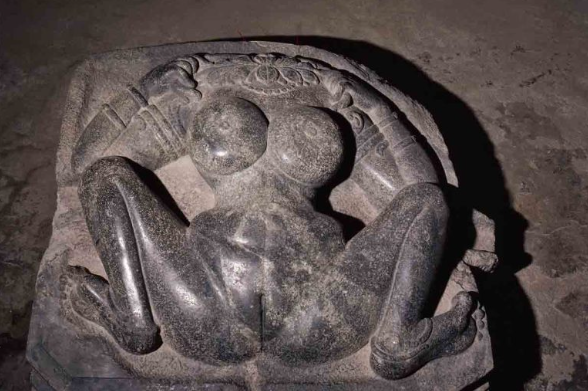
5. Lajja Gauri in Complete Avatara
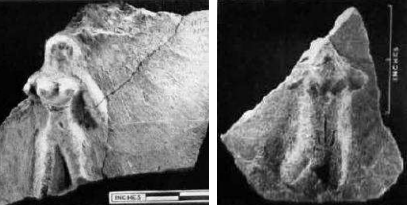
This anthropomorphic form of Lajja Gauri is a figure with a human head, full natural female torso, with raised arms, each hand holding a lotus bud as in Form III, and with legs in the birth giving pose.
This anthropomorphic form of Lajja Gauri is a figure with a human head, full natural female torso, with raised arms, each hand holding a lotus bud as in Form III, and with legs in the birth giving pose.
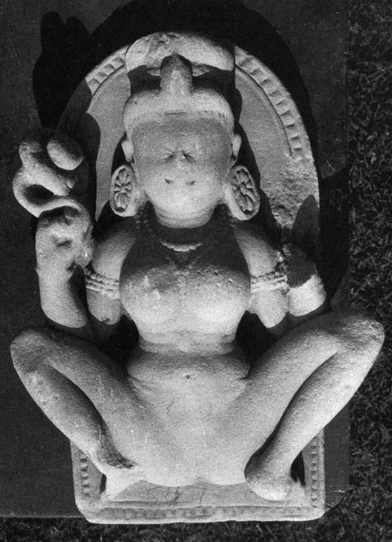
6. Meaning of Maa Lajja Gauri's symbols
All the four forms of Lajja Gauri illustrate that the artists creating images of the goddess drew on various ancient symbols of fortune and fertility to communicate her power through their rich heritage of meanings. They used these symbols in combinations crouched within the female form in a birth like position. The three paramount symbols are:
Lotus
In Indian art the lotus is the symbol par excellence of fortune, fertility, and reproduction. The lotus is seen as a plant carrying the potential for future generations and is given meanings of cyclic renewal of life, of regeneration of life, or reincarnations.
Brimming pot
Like the lotus, the pot symbolizes well-being, fertility, and the power of water as the source of life. The pot also suggests the womb (yoni). The extension of the torso to include breasts, flanking buds, and a full flowering lotus in the location of the head may have taken inspiration from a purna kumbha association.
Srivasta
Srivatsa is a mark or sign of fortune; in art, it is represented with a whorl of hair, a triangle, or a cruciform flower and in its early form srivatsa has four upwardly curved 'limbs". There is also a relationship in the meaning of Lajja Gauri and srivasta, and thereby kinship with Sri, Sri Lakshmi, and Gaja Lakshmi-all goddesses of well-being.
All the four forms of Lajja Gauri illustrate that the artists creating images of the goddess drew on various ancient symbols of fortune and fertility to communicate her power through their rich heritage of meanings. They used these symbols in combinations crouched within the female form in a birth like position. The three paramount symbols are:
Lotus
In Indian art the lotus is the symbol par excellence of fortune, fertility, and reproduction. The lotus is seen as a plant carrying the potential for future generations and is given meanings of cyclic renewal of life, of regeneration of life, or reincarnations.
Brimming pot
Like the lotus, the pot symbolizes well-being, fertility, and the power of water as the source of life. The pot also suggests the womb (yoni). The extension of the torso to include breasts, flanking buds, and a full flowering lotus in the location of the head may have taken inspiration from a purna kumbha association.
Srivasta
Srivatsa is a mark or sign of fortune; in art, it is represented with a whorl of hair, a triangle, or a cruciform flower and in its early form srivatsa has four upwardly curved 'limbs". There is also a relationship in the meaning of Lajja Gauri and srivasta, and thereby kinship with Sri, Sri Lakshmi, and Gaja Lakshmi-all goddesses of well-being.
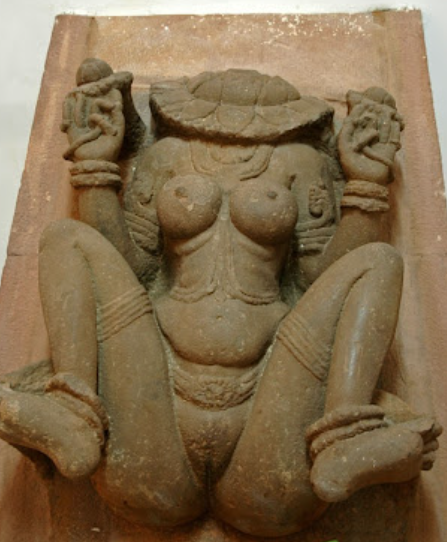
7. The Appropriation of the Sanatan Symbol of creation
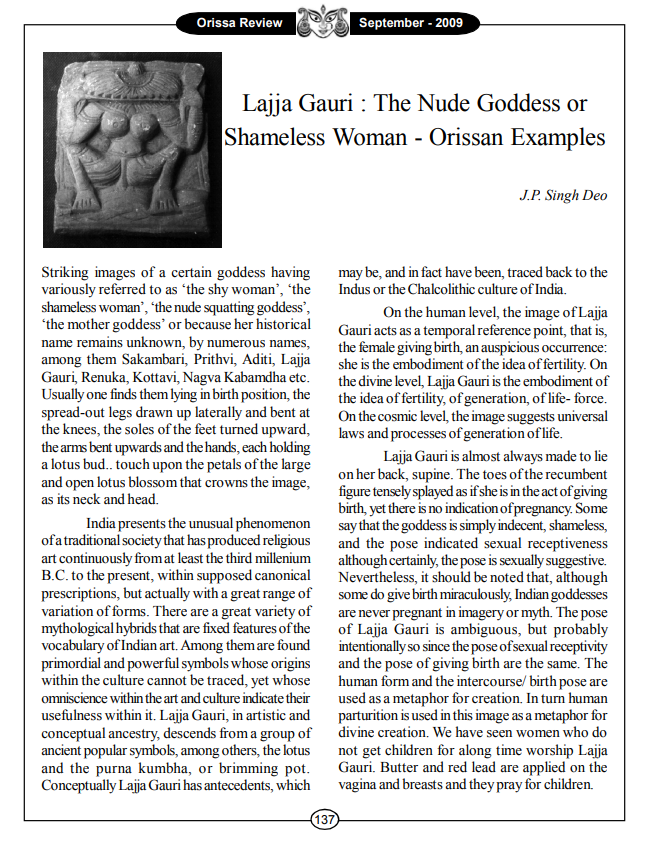
This articles published by the Govt of Odisha titled "Lajja Gauri : The Nude Goddess or Shameless Woman - Orissan Examples" mentiones Maa Lajja Gauri as Shameless woman.
Do we need to look out of India for the appropriation!!
Link for the article:
(magazines.odisha.gov.in)
This articles published by the Govt of Odisha titled "Lajja Gauri : The Nude Goddess or Shameless Woman - Orissan Examples" mentiones Maa Lajja Gauri as Shameless woman.
Do we need to look out of India for the appropriation!!
Link for the article:
(magazines.odisha.gov.in)
8. Maa Lajja Gauri was much revered in Budhism also.
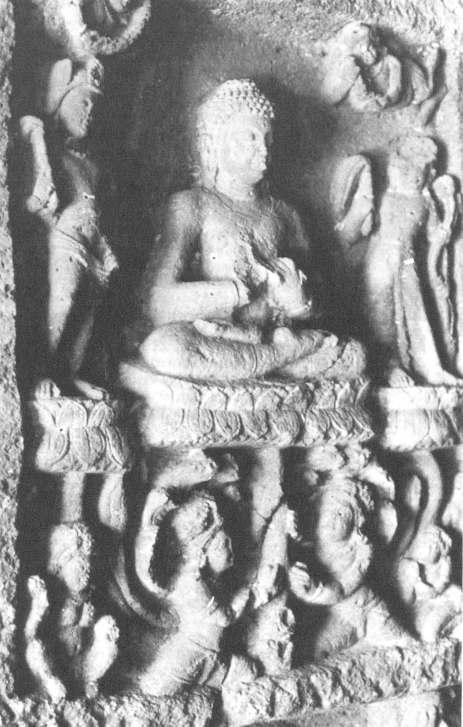
Here is a Lord Budhha statue found in near Aurangabad, Maharashtra, India which shows Lajja Gauri Sitting next to Lord Budhha.
Here is a Lord Budhha statue found in near Aurangabad, Maharashtra, India which shows Lajja Gauri Sitting next to Lord Budhha.
9. The Metaphysical Meaning
Lajja Gauri's fertility aspect is emphasized by symbolic representation of the genitals, Yoni or the Womb, as blooming Lotus flower denoting blooming youth in some cases and in others through a simple yet detailed depiction of an exposed vulva.
Added to the fact that she is sitting in a squatting position (uttanpada) with legs open, as in during childbirth, in some cases, the right foot is placed on a platform to facilitate full opening.
She is invoked for abundant crops (vegetative fertility) and good progeny. A blossoming lotus replaces her head and neck, an icon often used in Tantra. The seven Chakras of human energy anatomy are often depicted as blossoming lotuses, and the Goddess is often depicted in her Sri Yantra as a Yoni, shown as a simplified triangle at the center.
Further, most fertility goddesses of the ancient world are similarly shown headless, while giving prominent focus to the genitals. The arms of the goddess are bent upwards, each holding a lotus stem, held at the level of the head again depicted by the matured lotus flower which is one of the most powerful symbols of spiritual and material progress since the age of Vedas.
Lajja Gauri's fertility aspect is emphasized by symbolic representation of the genitals, Yoni or the Womb, as blooming Lotus flower denoting blooming youth in some cases and in others through a simple yet detailed depiction of an exposed vulva.
Added to the fact that she is sitting in a squatting position (uttanpada) with legs open, as in during childbirth, in some cases, the right foot is placed on a platform to facilitate full opening.
She is invoked for abundant crops (vegetative fertility) and good progeny. A blossoming lotus replaces her head and neck, an icon often used in Tantra. The seven Chakras of human energy anatomy are often depicted as blossoming lotuses, and the Goddess is often depicted in her Sri Yantra as a Yoni, shown as a simplified triangle at the center.
Further, most fertility goddesses of the ancient world are similarly shown headless, while giving prominent focus to the genitals. The arms of the goddess are bent upwards, each holding a lotus stem, held at the level of the head again depicted by the matured lotus flower which is one of the most powerful symbols of spiritual and material progress since the age of Vedas.
10. Lajja Gauri as depicted in Indus Valley seals
11. Lajja Gauri counterparts in other civilizations - 1
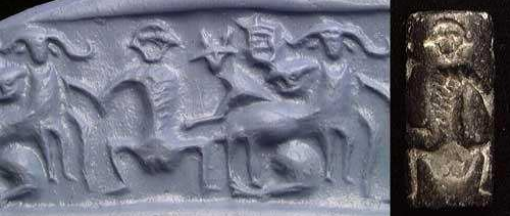
Urs ruled mesopotamian region from 3100 BC to 2700 BC. They were who extended an empire on all the Near East with Akkad for capital. The Sumerians from Ur were the main civilization of this period. They worshiped Inanna, their divine fertility goddess and her avatars, as the goddess Lamashtu, Lilitu (Ardat-Lili for the Akkadians), dedicated for causing erotic dreams, simply represented nude, spreading her legs, showing her vulva for well make understand that it is the way of procreation and birth. She is surrounded with scorpions which are the Sumerian symbol of the sexual intercourse.
Below is a link for Hymns of Inana to understand how Urs worshipped Goddess of fertility:
(worldhistory.org)
Urs ruled mesopotamian region from 3100 BC to 2700 BC. They were who extended an empire on all the Near East with Akkad for capital. The Sumerians from Ur were the main civilization of this period. They worshiped Inanna, their divine fertility goddess and her avatars, as the goddess Lamashtu, Lilitu (Ardat-Lili for the Akkadians), dedicated for causing erotic dreams, simply represented nude, spreading her legs, showing her vulva for well make understand that it is the way of procreation and birth. She is surrounded with scorpions which are the Sumerian symbol of the sexual intercourse.
Below is a link for Hymns of Inana to understand how Urs worshipped Goddess of fertility:
(worldhistory.org)
12. Lajja Gauri counterparts in other civilizations - 2
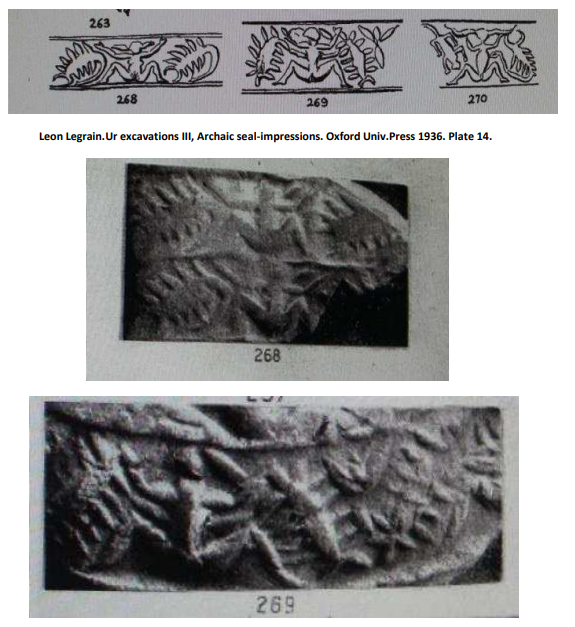
Seals and statues of fertility Goddess Ninegala of ancient Syria.
Seals and statues of fertility Goddess Ninegala of ancient Syria.
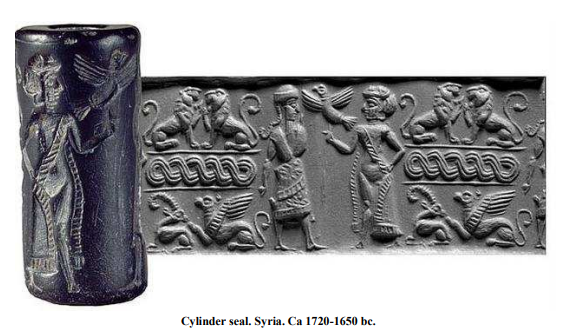
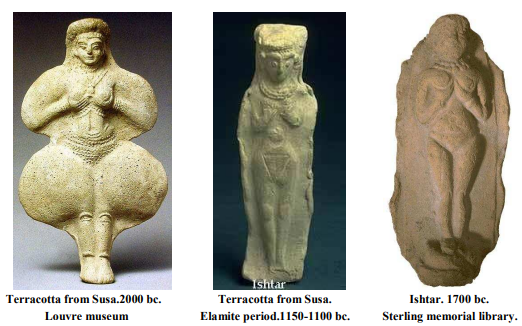
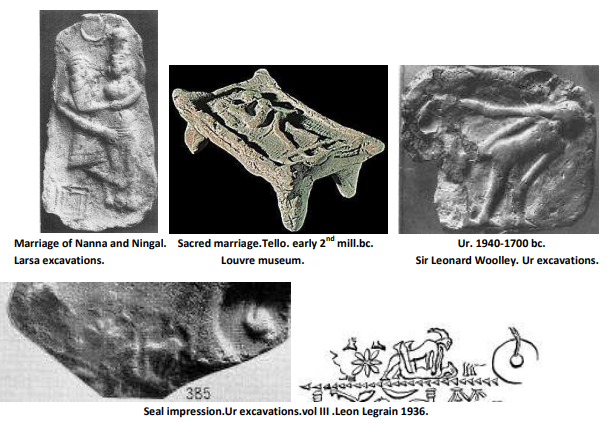
13. Lajja Gauri counterparts in other civilizations - 3
Ancient Sumerian Goddess of Night Ishtar
Ancient Sumerian Goddess of Night Ishtar
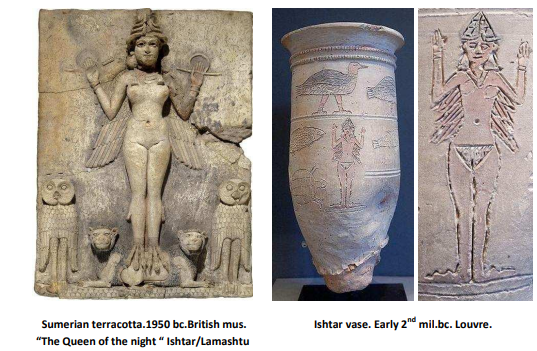
14. Lajja Gauri counterparts in other civilizations - 4
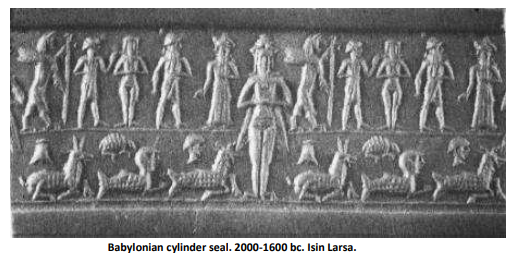
A Babylonian seal depicting Inana, the fertility goddess
A Babylonian seal depicting Inana, the fertility goddess
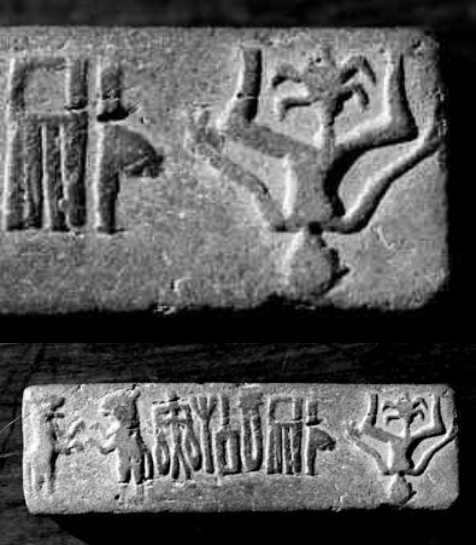
15. Harappa valley seals depicting Lajja Gauri symbolism of fertility
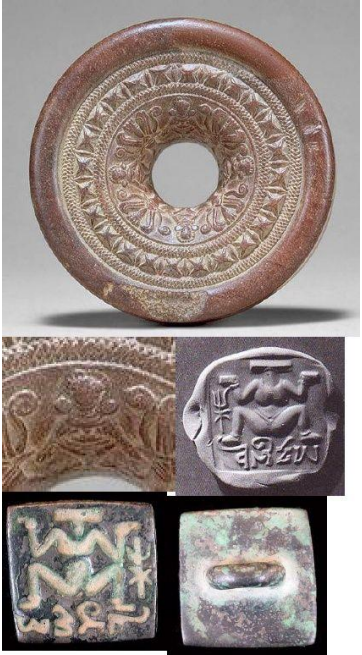
16. Lajja Gauri as depicted on ring stone of ancient Maurya Kingdom of India
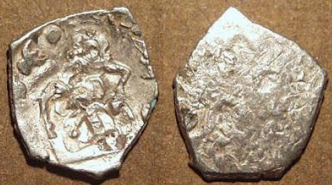
17. Lajja Guari as depicted on the coins of ancient Saurashtra Janapada
18. Lajja Gauri excavated at Navdatoli, Madhya Pradesh (1000-800 BC)
19. Lajja Gauri from Mathura (300-400 BC)
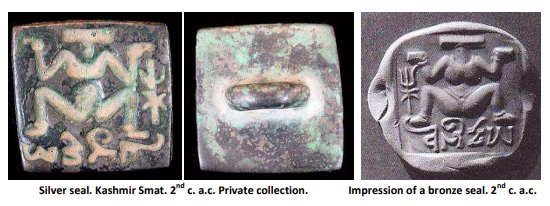
20. The seals of the Kashmir Smat consecrate the goddess Lajja Gauri in the 2nd AD.
21. Lajja Gauri from ancient Kushana period of Noth India
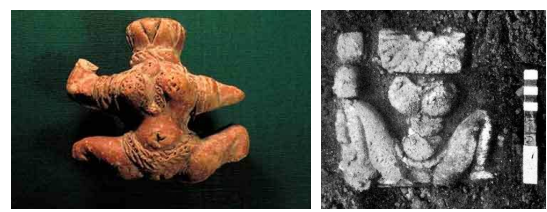
22. Lajja Gauri from Chalukya kingdom architecture
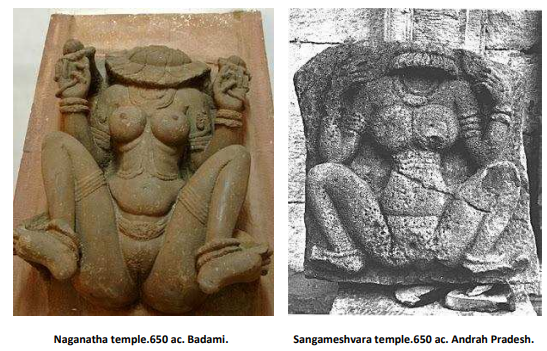
23. Lajja Gauri and Vedic Symbolism of medical
science - Female Mensuration
A number of deities are associated directly or indirectly with menstruation in the hindu tradition: Parvati, Lajja Gowri, Brahmacharini, Durga, Bhuvaneshwari, Kamakhya, harchandi, and Bhoomi Devi to name a few. these deities, though independent in name and form, are considered to be
different aspects or manifestations of the primordial Shakti (power) or adya (the First), who is considered to be the mother or the originator of the entire
universe. thus, menstruation is associated with the sacred feminine, and is celebrated through the worship of these deities and the festivities associated
with such worship.
Lajja Gowri, for example, is specifically associated with sexuality, fertility and childbirth. She is iconographically depicted in a sitting position with the
legs open and an exposed vulva. thus, through fertility and childbirth, she is also indirectly linked to menstruation. a more direct connection can be found
in Shakti as Durga. Goddess Durga manifests herself in nine forms and these nine forms are offered special worship during the famous hindu festival of
navaratri or the festival of ninenights. the nine forms of Durga are:
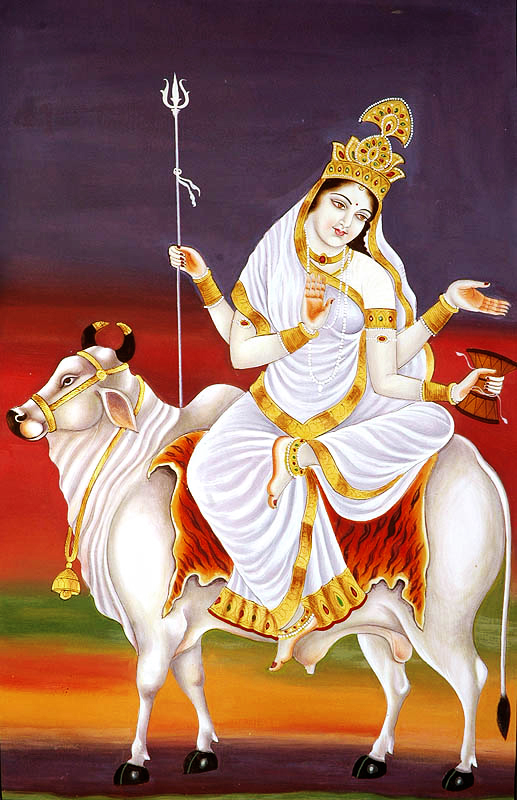
Shailaputri, Brahmacharini, Chandraghanta, Kushmanda, Skandamata, Katyayini, Kaalratri, mahagauri and Siddhidhatri. among the nine, the first
five forms are specially associated with different phases in a woman’s life.
Shailaputri corresponds to childhood, Brahmacharini corresponds to puberty, Chandragantha indicates marriage, Kushmanda and Skandamata correspond
to pregnancy and childbirth, respectively. thus, Brahmacharini Durga presides over puberty and menarche and this form of the deity is worshipped
during the second night of navaratri.
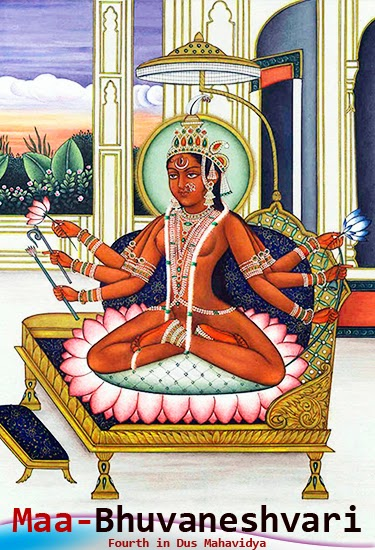
a more intimate correlation with menstruation is found in Goddess Bhuvaneshwari, who is considered as the presiding deity of menstruation of females in India.
science - Female Mensuration
A number of deities are associated directly or indirectly with menstruation in the hindu tradition: Parvati, Lajja Gowri, Brahmacharini, Durga, Bhuvaneshwari, Kamakhya, harchandi, and Bhoomi Devi to name a few. these deities, though independent in name and form, are considered to be
different aspects or manifestations of the primordial Shakti (power) or adya (the First), who is considered to be the mother or the originator of the entire
universe. thus, menstruation is associated with the sacred feminine, and is celebrated through the worship of these deities and the festivities associated
with such worship.
Lajja Gowri, for example, is specifically associated with sexuality, fertility and childbirth. She is iconographically depicted in a sitting position with the
legs open and an exposed vulva. thus, through fertility and childbirth, she is also indirectly linked to menstruation. a more direct connection can be found
in Shakti as Durga. Goddess Durga manifests herself in nine forms and these nine forms are offered special worship during the famous hindu festival of
navaratri or the festival of ninenights. the nine forms of Durga are:
Shailaputri, Brahmacharini, Chandraghanta, Kushmanda, Skandamata, Katyayini, Kaalratri, mahagauri and Siddhidhatri. among the nine, the first
five forms are specially associated with different phases in a woman’s life.
Shailaputri corresponds to childhood, Brahmacharini corresponds to puberty, Chandragantha indicates marriage, Kushmanda and Skandamata correspond
to pregnancy and childbirth, respectively. thus, Brahmacharini Durga presides over puberty and menarche and this form of the deity is worshipped
during the second night of navaratri.
a more intimate correlation with menstruation is found in Goddess Bhuvaneshwari, who is considered as the presiding deity of menstruation of females in India.
24. In the Dharmashastra tradition. Dharmasindhu,22 a medieval Dharmashastric text written by Kashinatha Upadhyaya, for example, observes that if the
menarche commences in certain months, during certain lunar days, or under certain stars, then it is inauspicious. that is, the onset of menstruation during
such durations is considered as an indication of some future obstacles, troubles, or disabilities that the girl may face in the future. months which are
considered inauspicious for having menarche includes the hindu months of Chaitra, Jyeshta, aashada, Bhadrapada, Kaarthika, and Pushya. Similarly,
Dharmasindhu considers Pratipada, Chaturthi, amavasya, and six other lunar days as inauspicious. Sunday, tuesday, and Saturday are considered
inauspicious. menarche under ten stars is considered inauspicious. to offset these effects, and to ensure that the indicated future trouble is removed,
Dharmasindhu suggests that a particular ritual called ‘Bhuvaneshwari Shanti’ be performed after marriage but before Garbhadhana Samskara (the rite for
conceiving a child). the deity of this ritual is Goddess Bhuvaneshwari, who is worshipped, and whose blessings are sought.
(Dharma Sindhu By Kashinath Upadhyaya 1888 Nirnay Sagar Press)
menarche commences in certain months, during certain lunar days, or under certain stars, then it is inauspicious. that is, the onset of menstruation during
such durations is considered as an indication of some future obstacles, troubles, or disabilities that the girl may face in the future. months which are
considered inauspicious for having menarche includes the hindu months of Chaitra, Jyeshta, aashada, Bhadrapada, Kaarthika, and Pushya. Similarly,
Dharmasindhu considers Pratipada, Chaturthi, amavasya, and six other lunar days as inauspicious. Sunday, tuesday, and Saturday are considered
inauspicious. menarche under ten stars is considered inauspicious. to offset these effects, and to ensure that the indicated future trouble is removed,
Dharmasindhu suggests that a particular ritual called ‘Bhuvaneshwari Shanti’ be performed after marriage but before Garbhadhana Samskara (the rite for
conceiving a child). the deity of this ritual is Goddess Bhuvaneshwari, who is worshipped, and whose blessings are sought.
(Dharma Sindhu By Kashinath Upadhyaya 1888 Nirnay Sagar Press)
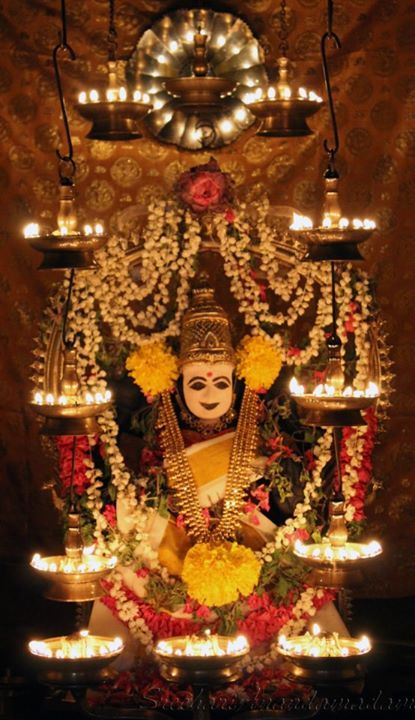

25. The famous Goddess Kamakhya and her ambubachi festival celebrated in assam. Goddess Kamakhya is believed to undergo menstruation for three days every year and the temple is closed for the period to give her rest. the festival is celebrated during the monsoon, in the assamese month of ahaar, which falls in June. For three days, the Goddess takes rest. People in
the region do not perform any farming activity so as to be able to give mother Kamakhya, who is also mother Earth, rest. Daily worship and religious performances are also halted. During this period, Goddess Kamakhya, who exists as a naturally formed Yoni in stone, is covered with a red cloth. On the fourth day, after the Yoni is bathed and ritually worshipped, the temple doors are opened and devotees are given special Prasada – a piece of the red cloth, which was used to cover the Yoni, and which has become moist due to the
mother’s bleeding (in the form of natural springs). the special Prasada is considered highly auspicious and purifying in nature and hence thousands of
devotees from faraway places come every year to pray to the mother and partake of her Special Prasada.
the four-day festival is accompanied by huge celebrations in the form of a four-day mela (fair) called ameti, wherein tantric Sadhus and Babas from
across India visit, and where rural crafts are exhibited. the ambubachi festival serves as a practical illustration of how hinduism harmoniously integrates
different nuances associated with various aspects of menstruation – ashaucha, austerity, rest, and celebration – into one integral festival that is beneficial to everyone.
the region do not perform any farming activity so as to be able to give mother Kamakhya, who is also mother Earth, rest. Daily worship and religious performances are also halted. During this period, Goddess Kamakhya, who exists as a naturally formed Yoni in stone, is covered with a red cloth. On the fourth day, after the Yoni is bathed and ritually worshipped, the temple doors are opened and devotees are given special Prasada – a piece of the red cloth, which was used to cover the Yoni, and which has become moist due to the
mother’s bleeding (in the form of natural springs). the special Prasada is considered highly auspicious and purifying in nature and hence thousands of
devotees from faraway places come every year to pray to the mother and partake of her Special Prasada.
the four-day festival is accompanied by huge celebrations in the form of a four-day mela (fair) called ameti, wherein tantric Sadhus and Babas from
across India visit, and where rural crafts are exhibited. the ambubachi festival serves as a practical illustration of how hinduism harmoniously integrates
different nuances associated with various aspects of menstruation – ashaucha, austerity, rest, and celebration – into one integral festival that is beneficial to everyone.
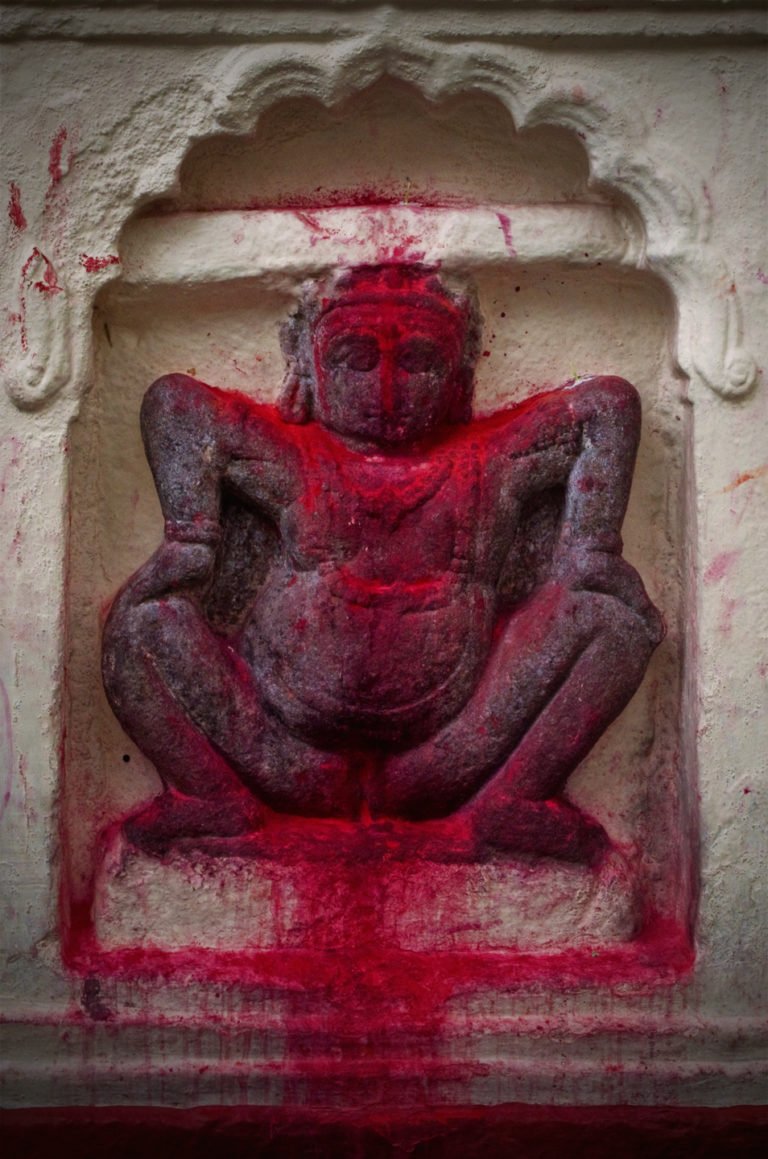
26. Another example that illustrates the notion of menstruation as a celebration is the festival of raja in Odisha, which is also celebrated during June. The menstruating Goddess (Bhu-devi/ Earth Goddess) who is worshipped here is variously known as harchandi, Prithibt, thakurant, Basudha, Draupadi. the festival is celebrated by both men and women. But women consider themselves amsha (parts) of the Goddess.therefore, the entire celebration happens around women.
27. Chengannur mahadeva Kshetram in the Southern State of Kerala is yet another place where the Goddess menstruates and her menstruation is celebrated. Every few months, the murti of Goddess Parvati (Bhagavati), which is present at the temple is believed to menstruate, and during that period, for three days, her murti is shifted to a separate room and is given rest. Whether the Goddess is menstruating or not is determined by the wife of the Supreme priest of Sabarimala, who regularly inspects the Udayada (the
inner skirt) of the Goddess for any blood stains. If any stains of menstrual blood are found, then the temple announces the celebration of the festival –
‘thriputharattu’. For the first three days, the murti of the Goddess is secluded from the murti of her husband, Lord Shiva, and is allowed to rest. She
undergoes all menstrual practices that women undergo, and temple women sleep outside her room during the night to give her company. On the fourth
day, the Goddess is taken on a female elephant to the Pamba river for a ritual bath. She is then dressed in grand clothes and jewelry, and several ceremonies and elaborate rituals are performed. thousands of people from across Kerala visit the temple to participate in this festival.
inner skirt) of the Goddess for any blood stains. If any stains of menstrual blood are found, then the temple announces the celebration of the festival –
‘thriputharattu’. For the first three days, the murti of the Goddess is secluded from the murti of her husband, Lord Shiva, and is allowed to rest. She
undergoes all menstrual practices that women undergo, and temple women sleep outside her room during the night to give her company. On the fourth
day, the Goddess is taken on a female elephant to the Pamba river for a ritual bath. She is then dressed in grand clothes and jewelry, and several ceremonies and elaborate rituals are performed. thousands of people from across Kerala visit the temple to participate in this festival.
References:
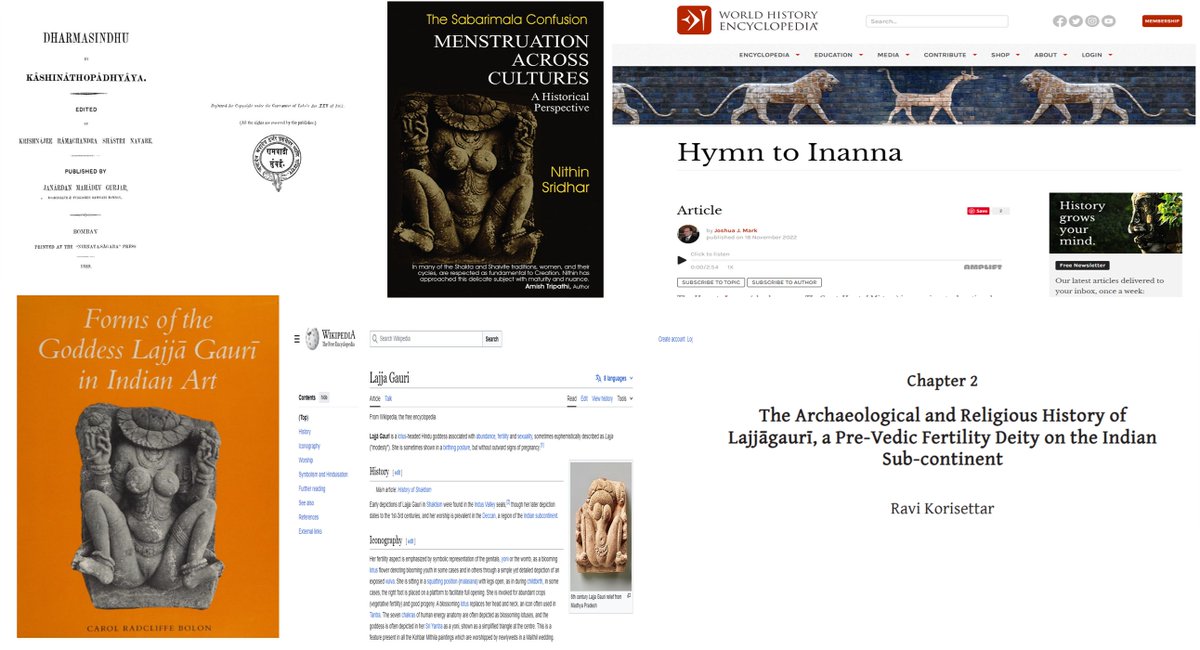
1. Goddess Lajja Gauri in Indian Art – CA&A Exhibitions (vmis.in)
2. Collections-Virtual Museum of Images and Sounds (vmis.in)
3. Devi Lajja Gauri .. - Goddess Vidya (weebly.com)
4. Hymn to Inanna - World History Encyclopedia
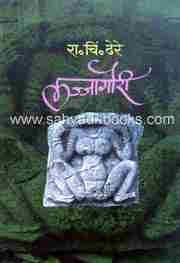
5. LajjaGauri - Sahyadri Books , Author R.C. Dhere,
6. Many Forms, Many Lives: Lajja Gauri in Indian Art - MAP Academy
1. Goddess Lajja Gauri in Indian Art – CA&A Exhibitions (vmis.in)
2. Collections-Virtual Museum of Images and Sounds (vmis.in)
3. Devi Lajja Gauri .. - Goddess Vidya (weebly.com)
4. Hymn to Inanna - World History Encyclopedia
5. LajjaGauri - Sahyadri Books , Author R.C. Dhere,
6. Many Forms, Many Lives: Lajja Gauri in Indian Art - MAP Academy
Sanatan is the light
Dharma is the path.
Please be very proud of your Sanatan lineage.
Spead the light of Sanatan and share it further.
Blessings from Shri Krishna
Radhe Radhe
Dharma is the path.
Please be very proud of your Sanatan lineage.
Spead the light of Sanatan and share it further.
Blessings from Shri Krishna
Radhe Radhe
Loading suggestions...