

Traditional texts like Dharmaśāstras need to be understood through the traditional methods of interpretation.
Why? Take a look at this:
In Manusmṛti (chapter 4), it's been told to not practise Ṛgveda & Yajurveda while Sāmaveda is being recited.
Why?
+
Why? Take a look at this:
In Manusmṛti (chapter 4), it's been told to not practise Ṛgveda & Yajurveda while Sāmaveda is being recited.
Why?
+
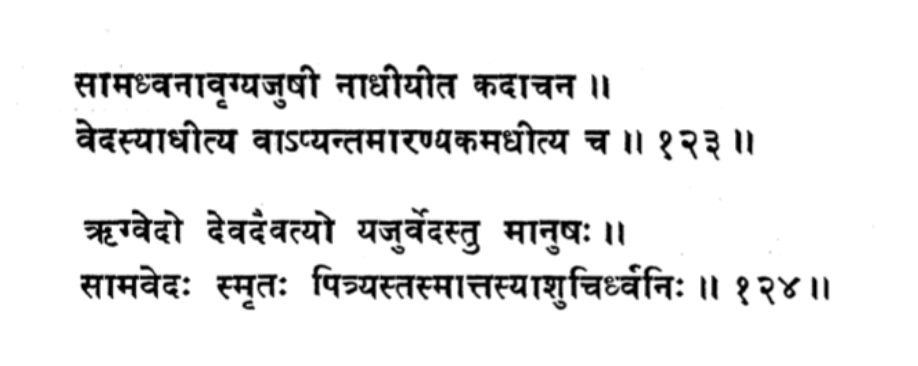
The verse says, "the sound of Sāmaveda is impure".
Why is it so? It says that Ṛgveda is related to Devas, Yajurveda to humans and Sāmaveda to Pitṛ-s.
The question is; is Manusmṛti saying that the sound of Sāmaveda is impure? Is it censuring Sāmaveda?
+
Why is it so? It says that Ṛgveda is related to Devas, Yajurveda to humans and Sāmaveda to Pitṛ-s.
The question is; is Manusmṛti saying that the sound of Sāmaveda is impure? Is it censuring Sāmaveda?
+
Someone who interprets the verse literally would answer both questions with a 'yes'.
But is it so? No.
It is a traditional method of discouraging an action, called ' nindā-arthavāda', which may sound like censure, but it is not.
One who censures the Veda, is a Nāstika. +
But is it so? No.
It is a traditional method of discouraging an action, called ' nindā-arthavāda', which may sound like censure, but it is not.
One who censures the Veda, is a Nāstika. +
Can Manu be a Nāstika? No.
Hence all that the verse (no. 124) says is that when Sāmaveda is being recited, Ṛgveda and Yajurveda should not be practised by recitation. That is it.
The one who does not know the 'arthavāda' before reading the text, will take it literally. +
Hence all that the verse (no. 124) says is that when Sāmaveda is being recited, Ṛgveda and Yajurveda should not be practised by recitation. That is it.
The one who does not know the 'arthavāda' before reading the text, will take it literally. +
This is why we should interpret traditional texts of Sanātana Dharma through the traditional methods of interpretation.
Loading suggestions...