

1/ The problem with mood/affect is that if you trace the history of how the terms have been used, there's been considerable inconsistency and contradiction.
(see Ketai 1975, Owens et al 1979, Berner 1988, and Alpert et al. 1990 for the "semantic confusion" around the topic)
(see Ketai 1975, Owens et al 1979, Berner 1988, and Alpert et al. 1990 for the "semantic confusion" around the topic)
2/ Many have distinguished the terms based on duration/chronicity (e.g., mood is pervasive/enduring while affect is moment-to-moment) and subjective (mood)/objective(affect), but depending on the source, opposite claims have also been made about each.
pubmed.ncbi.nlm.nih.gov
pubmed.ncbi.nlm.nih.gov

3/ Owens makes a strong case for both terms depending on objective observation/inference so that accordingly, including "mood and affect side by side in a MSE amounts to a categorical mistake b/c it implies that there are 2 separate sets of observations."
psychiatryonline.org
psychiatryonline.org

4/ This incoherence has been reflected in inconsistent responses to surveys of psychiatric residents when asked about the topic.
For example, this US survey...
psychiatryonline.org
For example, this US survey...
psychiatryonline.org


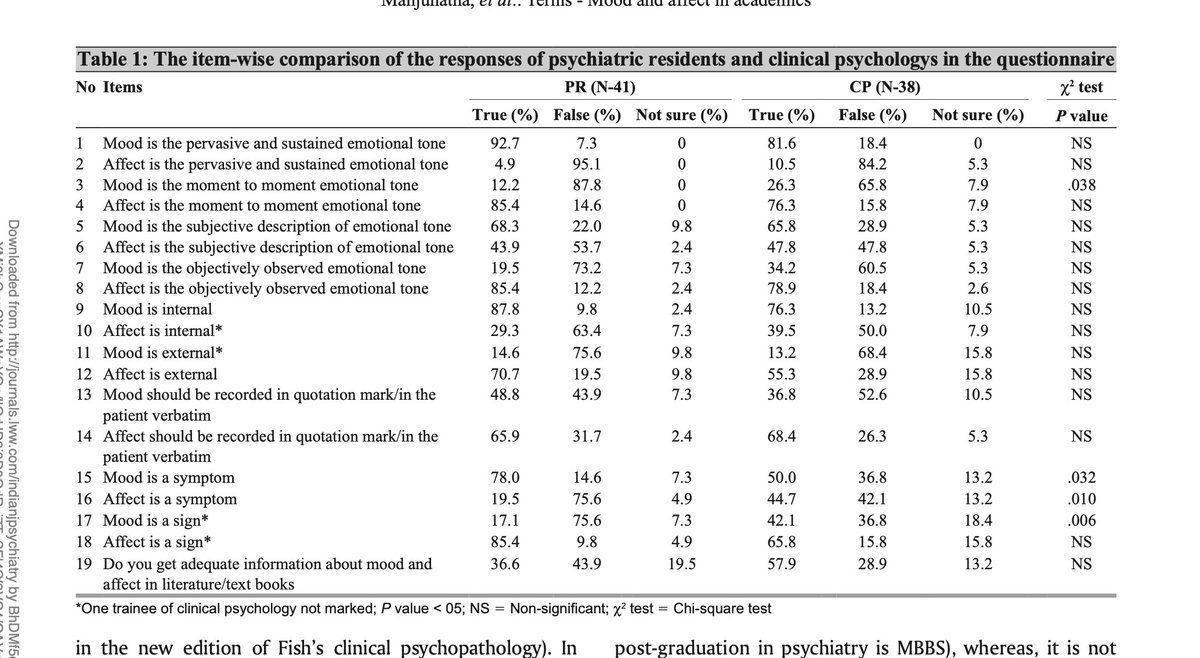
5/ ...is contrasted to this one from India (where trainees are exposed to both US and UK texts):
journals.lww.com
journals.lww.com

6/ While the DSM used to claim that "mood is to climate as affect is to the weather," other sources have made the reverse claim, and the DSM has since abandoned the analogy altogether.
karger.com
karger.com

7/ Personally, I like to say that it's mood that's like the weather (mood observed/endorsed during an exam).
Accordingly, I use emotion words—elation, despondency, anger—to describe mood whether or not it's endorsed by the patient while noting any incongruencies in that regard.
Accordingly, I use emotion words—elation, despondency, anger—to describe mood whether or not it's endorsed by the patient while noting any incongruencies in that regard.
8/ I then conceptualize affect as like the climate (the overall picture) while describing it using modifiers that characterize stable/labile and range/amplitude (flat→blunted→restricted/constricted→normal/full→expansive) and avoiding emotion words that overlap with mood.
9/ This way of defining/distinguishing the terms brings it close to this table, minus the confusing redundancy of both "labile affect" and "labile mood" and the inclusion of "expansive" as a descriptor of mood vs. affect.
journals.sagepub.com
journals.sagepub.com


10/ No doubt some will disagree based on their own training/preferences, but the point is that there is sadly no consistent or coherent distinction between the terms and they're often applied in confusing/redundant manner that's not particularly helpful.
11/ Note that if it made sense to distinguish mood/affect solely based on subjective/objective as many now do, we would just call them subjective mood/objective mood, without bothering to use a different word altogether to describe the latter.
12/ In any case, looking back at the history of the terms, pretty much no one has ever recommended putting mood is quotation marks based solely on what the patient says when they are asked to describe their mood.
So let's stop and let's stop teaching trainees to do so!
So let's stop and let's stop teaching trainees to do so!
Loading suggestions...