



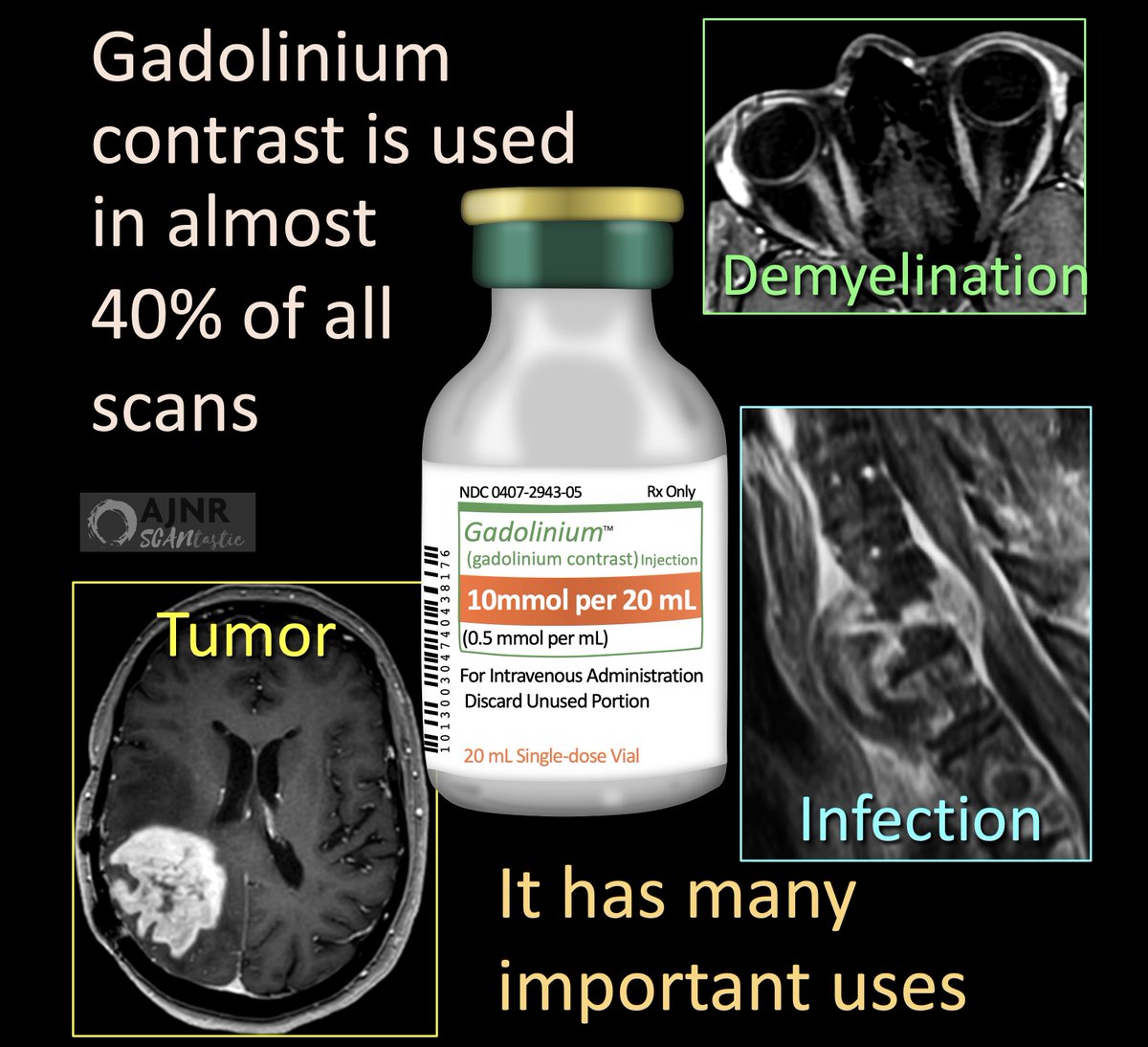
2/Whether or not to give gadolinium is a common question, as almost 1/2 of all MRI studies use gadolinium contrast.
Contrast-enhanced imaging can help elucidate many different pathologies, including tumors, demyelinating disease, & infection
Contrast-enhanced imaging can help elucidate many different pathologies, including tumors, demyelinating disease, & infection
3/What is gadolinium, that we're injecting into so many people?
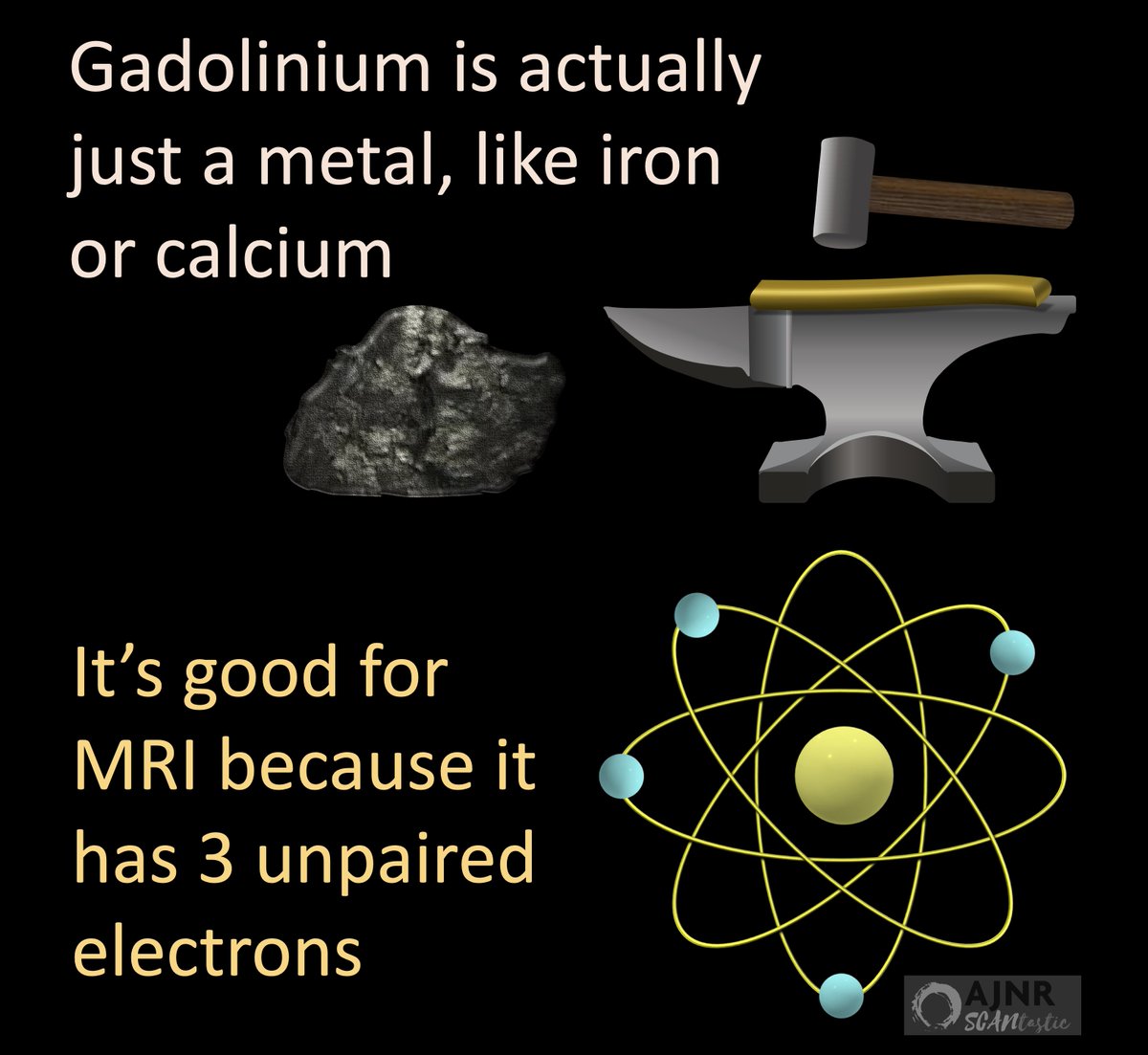
It’s actually a metal, like iron or calcium. Pure gadolinium looks just like a shiny rock that you would find in a mine
But what makes gadolinium special for MRI is that it has 3 unpaired electrons
It’s actually a metal, like iron or calcium. Pure gadolinium looks just like a shiny rock that you would find in a mine
But what makes gadolinium special for MRI is that it has 3 unpaired electrons
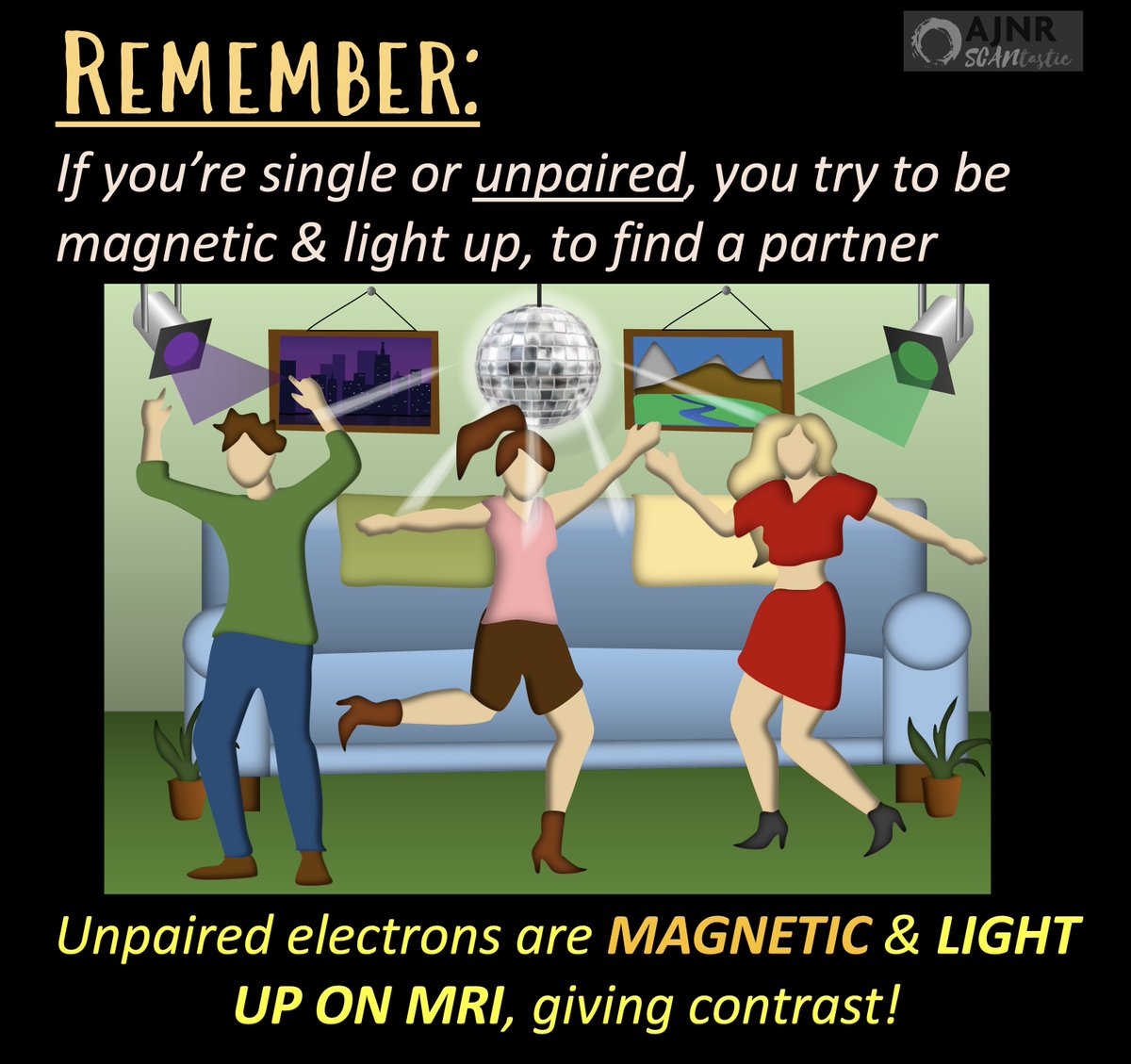
4/Unpaired electrons have high signal on T1 weighted images on MRI
Remember this bc if you are unpaired or single, you will try to be magnetic & light up to find a partner!
Similarly, the unpaired electrons in gadolinium cause structures that take them up to be bright on T1
Remember this bc if you are unpaired or single, you will try to be magnetic & light up to find a partner!
Similarly, the unpaired electrons in gadolinium cause structures that take them up to be bright on T1
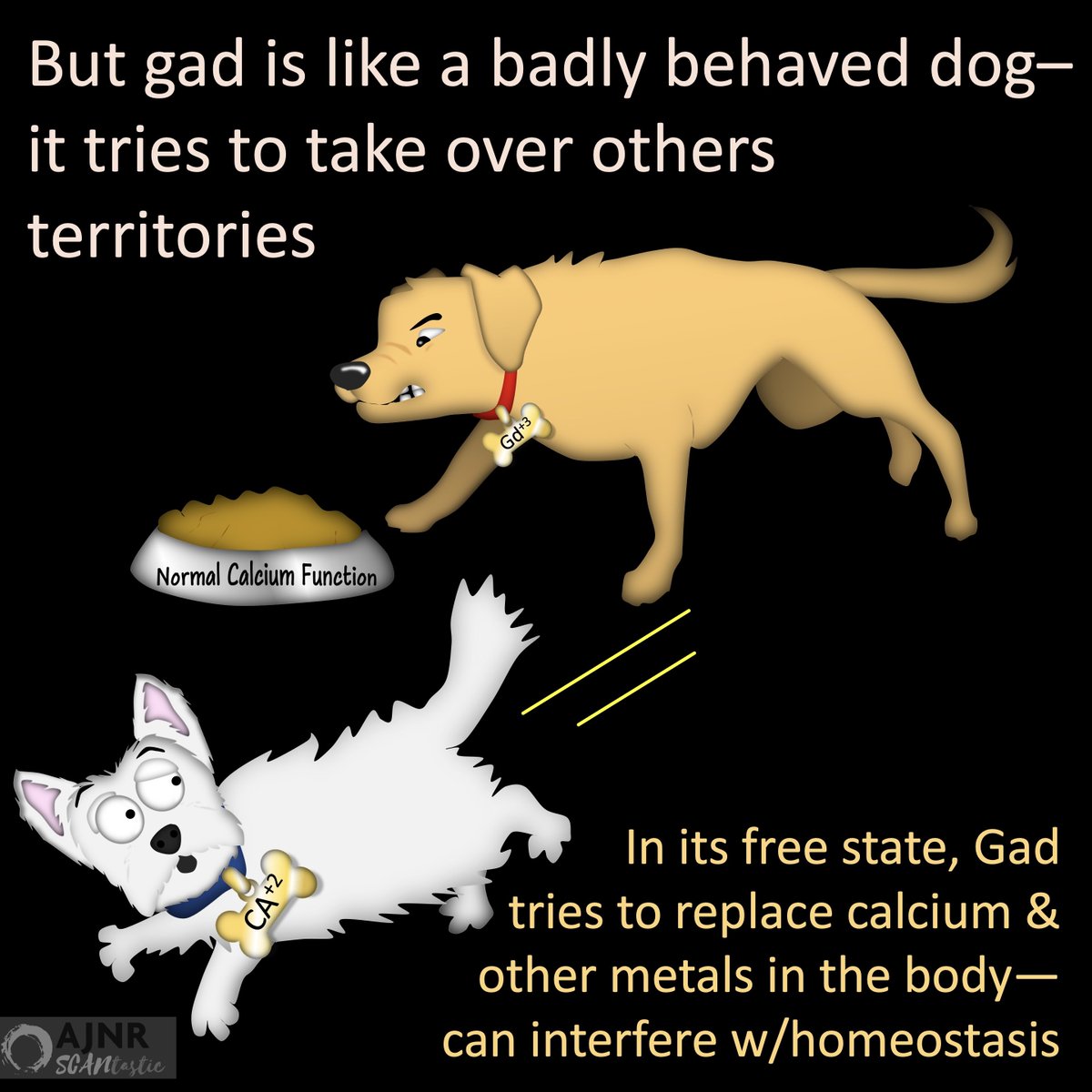
5/Unfortunately, gad acts like a bad dog. If let free, it tries to take over other’s territories
Free gadolinium tries to replace normal metals in your body, like calcium, resulting in disruption normal homeostasis.
So what do we do so we can give it w/o issues?
Free gadolinium tries to replace normal metals in your body, like calcium, resulting in disruption normal homeostasis.
So what do we do so we can give it w/o issues?
6/ We do the same thing we would do for a bad dog! We restrain it!
We bind w/other compounds so it can’t roam free & cause trouble
First we can put it on a leash--linear agents
Linear agents are like leashes—they bind gad like leash, holding on to it, but not surrounding it
We bind w/other compounds so it can’t roam free & cause trouble
First we can put it on a leash--linear agents
Linear agents are like leashes—they bind gad like leash, holding on to it, but not surrounding it

7/Or we can put it in a cage—cyclic agents
Cyclic agents surround gad like a cage surrounds a dog, so there is no way to get out
You can remember this bc Cyclic & Cage both start w/C!
Cyclic agents surround gad like a cage surrounds a dog, so there is no way to get out
You can remember this bc Cyclic & Cage both start w/C!

8/Cyclic agents do a better job keeping gad bound & out of trouble
Like a leash, linear agents are more likely to break & let gad go, causing toxicity—unlike hard cages
A feared complication is deposition of gad in connective tissues (nephrogenic systemic fibrosis or NSF)
Like a leash, linear agents are more likely to break & let gad go, causing toxicity—unlike hard cages
A feared complication is deposition of gad in connective tissues (nephrogenic systemic fibrosis or NSF)

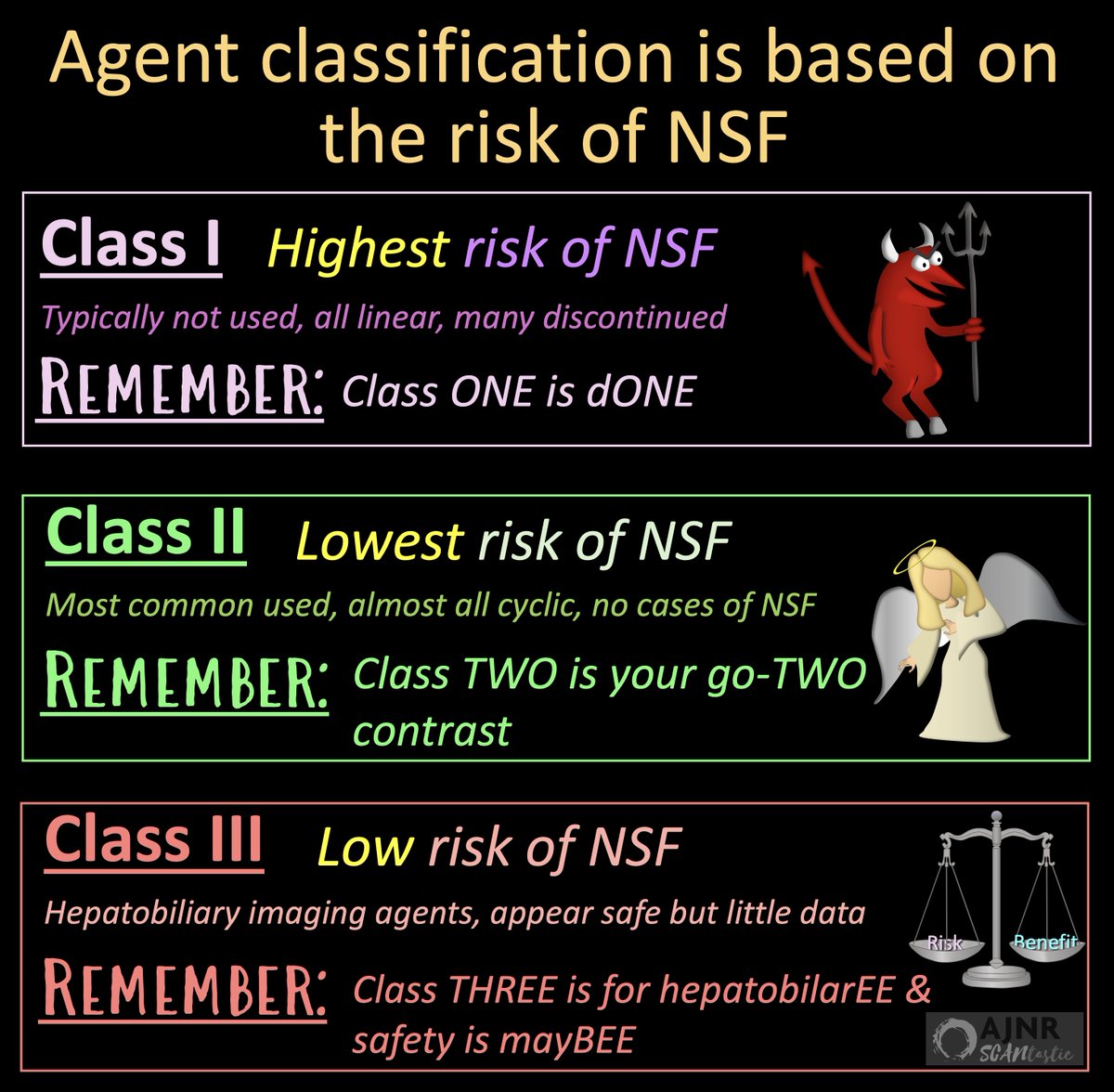
9/Agent class is based on the risk of NSF
Class 1: High risk, linear agents
Remember 1 is done!
Class 2: Safe, no NSF cases, mainly cyclic
Remember 2 is the go to agent!
Class 3: Liver agents, no NSF cases, but small numbers
Remember 3 is for biliaree & safety is maybe
Class 1: High risk, linear agents
Remember 1 is done!
Class 2: Safe, no NSF cases, mainly cyclic
Remember 2 is the go to agent!
Class 3: Liver agents, no NSF cases, but small numbers
Remember 3 is for biliaree & safety is maybe
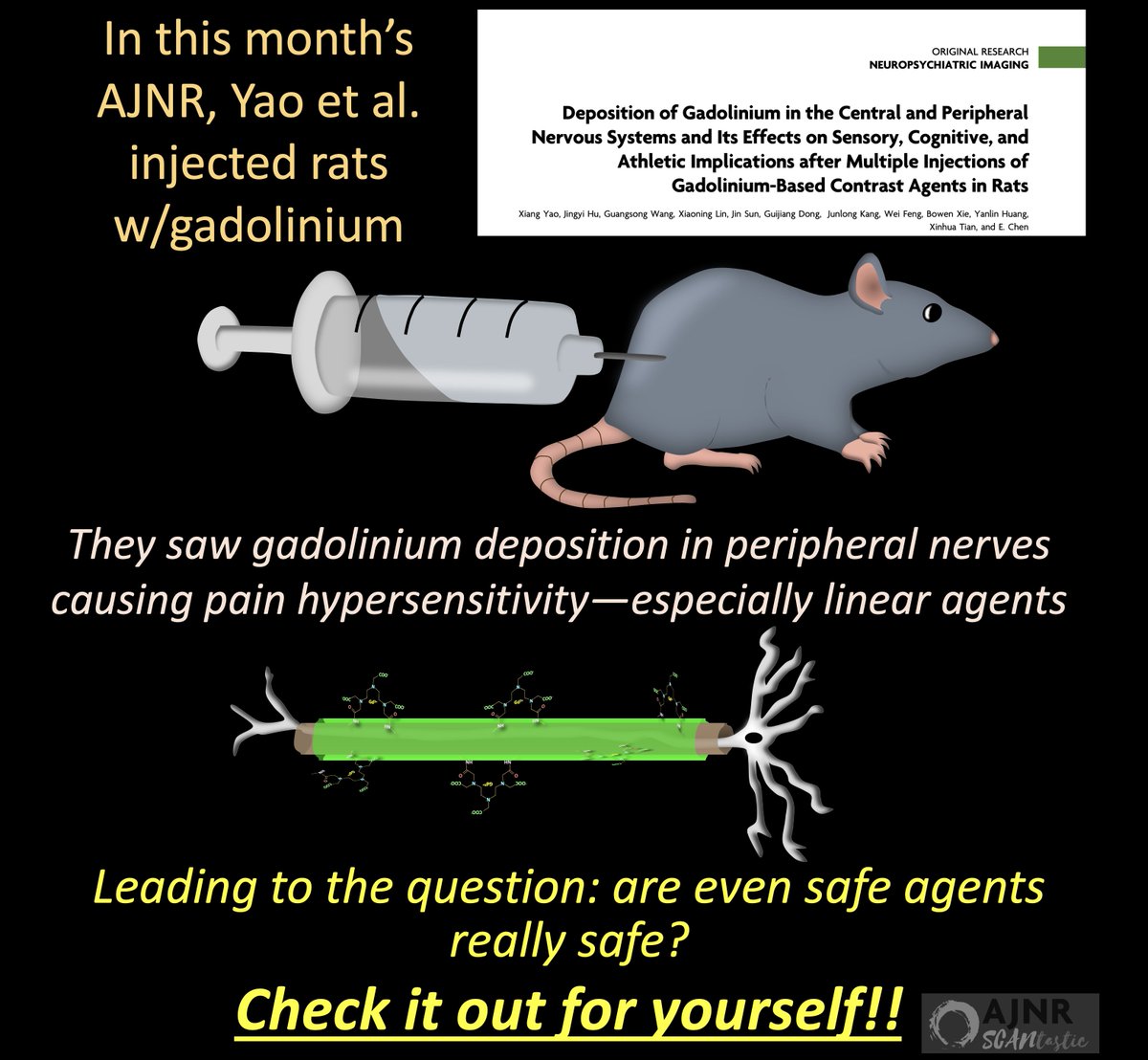
10/In this month's @theAJNR, Yao et al. injected rats w/various agents & look for gad in peripheral nerves
They found gad in peripheral nerves leading to pain hypersensitivity, most in linear agents.
This raises the question if there are more problems w/gad than we know!
They found gad in peripheral nerves leading to pain hypersensitivity, most in linear agents.
This raises the question if there are more problems w/gad than we know!
Loading suggestions...