

I'm sorry to be insisting on that one, but it is so illustrative of how insanely wrong the Western press can be on China, even allegedly prestigious business newspaper like the Financial Times.
This one is literally incredible.
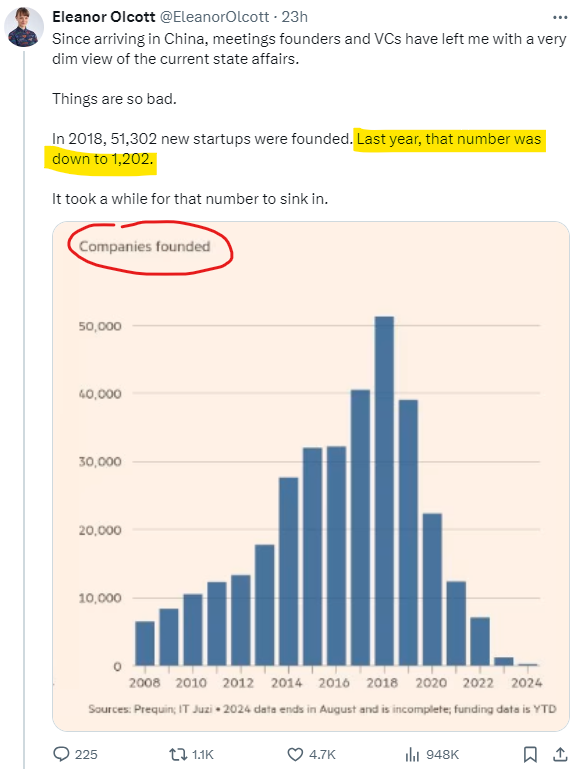
So the @FT published an article yesterday by Beijing-based @EleanorOlcott that claims that only 1,202 companies in total were founded in China in 2023. Not 1,202 thousand companies, no... just 1,202 companies, in the whole of China. The claim is that out of 1,4 billion people, in an economy that grew 5.2% last year, only 1,202 people (the equivalent of the population in an average building in China) created a business.
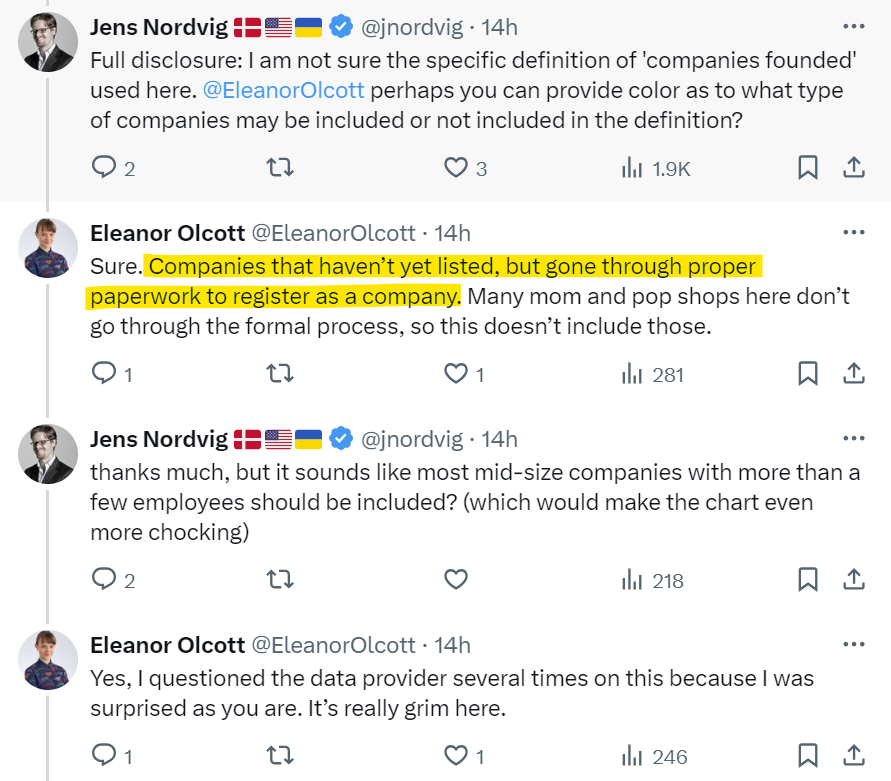
When asked to precise what she meant by "companies founded", the journalist replied that it was indeed just that: "companies that have gone through proper paperwork to register as a company". So we're sure that's what she meant.
Of course the article went viral, you've likely already seen the graph being shared on Twitter... And most people, depressingly, didn't even bother to question the claims. I myself commented under the article (x.com), telling the journalist her numbers were simply impossible, and was accused of the usual absolutely dimwitted insults: I am a "wumao", "paid by the CCP", bla bla bla...
But her numbers ARE impossible. Anyone with an ounce of common sense can see that. And the journalist herself, if she'd reflected a tiny bit could see it too. For instance, how many new independent restaurants has she seen pop up in Beijing last year? My guess is hundreds of them, at the very least. Well each of those is a company created under her definition since to open an independent restaurant in China you have to open a business, file paperwork, go through a health inspection, etc. Extrapolate this to the whole of China and you have thousands and thousands of new businesses created in the restaurant industry alone.
Or she could have asked herself the question: how many business were created in the US last year (the answer is 5.5 million: #table-results" target="_blank" rel="noopener" onclick="event.stopPropagation()">census.gov) and given that China grew at more than twice the rate of the US, and has over 4 times the population, does it make sense that 5,000 times (!!!) less businesses would have been created in China than in the US in 2023? Obviously no, it doesn't make any sense.
Or she could have checked official Chinese statistics that show that, actually, 32.73 million new businesses were created in China in 2023 (stats.gov.cn), an insane 30,000 times more than what she claims!!! Which by the way roughly corresponds to the US number of 5.5 million if one accounts for the fact we're speaking about a country of 4 times the population with an economy growing at twice the speed...
Some people will say: "wait a minute 32.73M new companies would mean one of out 44 people in China created a business in 2023, that doesn't pass the sniff test". But yes it does, because we know that the vast majority of these new businesses (72% to be exact: english.news.cn) are "individually owned businesses", i.e. sole proprietorships. In China (as in the US) to be self-employed as say a Didi driver (the equivalent of Uber) or a Meituan delivery driver - all the so-called "gig economy" workers - you need to register yourself as self-employed via an "individually owned business".
And even if one discards those "individually owned businesses" as not "real businesses", that leaves us with 10.1M businesses created in China in 2023, 8,400 times more than the 1,202 claimed in the FT article...
And it's not only about the journalist herself. She has editors, supervisors. Did no-one along the chain stop to think: "wait a minute, we're about to print that only 1,202 businesses were created in China in 2023, that sounds insanely low, maybe we should double check that number"?
I'm not sure what's the conclusion here besides reiterating my oft-repeated complaint that Western media get China completely wrong, and aren't even bothering to use basic common sense to question themselves.
This one is literally incredible.
So the @FT published an article yesterday by Beijing-based @EleanorOlcott that claims that only 1,202 companies in total were founded in China in 2023. Not 1,202 thousand companies, no... just 1,202 companies, in the whole of China. The claim is that out of 1,4 billion people, in an economy that grew 5.2% last year, only 1,202 people (the equivalent of the population in an average building in China) created a business.
When asked to precise what she meant by "companies founded", the journalist replied that it was indeed just that: "companies that have gone through proper paperwork to register as a company". So we're sure that's what she meant.
Of course the article went viral, you've likely already seen the graph being shared on Twitter... And most people, depressingly, didn't even bother to question the claims. I myself commented under the article (x.com), telling the journalist her numbers were simply impossible, and was accused of the usual absolutely dimwitted insults: I am a "wumao", "paid by the CCP", bla bla bla...
But her numbers ARE impossible. Anyone with an ounce of common sense can see that. And the journalist herself, if she'd reflected a tiny bit could see it too. For instance, how many new independent restaurants has she seen pop up in Beijing last year? My guess is hundreds of them, at the very least. Well each of those is a company created under her definition since to open an independent restaurant in China you have to open a business, file paperwork, go through a health inspection, etc. Extrapolate this to the whole of China and you have thousands and thousands of new businesses created in the restaurant industry alone.
Or she could have asked herself the question: how many business were created in the US last year (the answer is 5.5 million: #table-results" target="_blank" rel="noopener" onclick="event.stopPropagation()">census.gov) and given that China grew at more than twice the rate of the US, and has over 4 times the population, does it make sense that 5,000 times (!!!) less businesses would have been created in China than in the US in 2023? Obviously no, it doesn't make any sense.
Or she could have checked official Chinese statistics that show that, actually, 32.73 million new businesses were created in China in 2023 (stats.gov.cn), an insane 30,000 times more than what she claims!!! Which by the way roughly corresponds to the US number of 5.5 million if one accounts for the fact we're speaking about a country of 4 times the population with an economy growing at twice the speed...
Some people will say: "wait a minute 32.73M new companies would mean one of out 44 people in China created a business in 2023, that doesn't pass the sniff test". But yes it does, because we know that the vast majority of these new businesses (72% to be exact: english.news.cn) are "individually owned businesses", i.e. sole proprietorships. In China (as in the US) to be self-employed as say a Didi driver (the equivalent of Uber) or a Meituan delivery driver - all the so-called "gig economy" workers - you need to register yourself as self-employed via an "individually owned business".
And even if one discards those "individually owned businesses" as not "real businesses", that leaves us with 10.1M businesses created in China in 2023, 8,400 times more than the 1,202 claimed in the FT article...
And it's not only about the journalist herself. She has editors, supervisors. Did no-one along the chain stop to think: "wait a minute, we're about to print that only 1,202 businesses were created in China in 2023, that sounds insanely low, maybe we should double check that number"?
I'm not sure what's the conclusion here besides reiterating my oft-repeated complaint that Western media get China completely wrong, and aren't even bothering to use basic common sense to question themselves.
Excellent take by @GlennLuk that explains what the numbers actually are: x.com
He says that the numbers shown aren't all "companies founded" in China like the author claims but specially companies which have received funding from VCs and that have been identified by IT Juzi, the data source here. He adds two points:
1) There is typically a big lag between the moment the company creation occurs and the moment they show up in the IT Juzi database, which explains in large part why there are less and less companies the shorter the time frame. To register in 2023 for instance, a company needs to have been created that year AND have received VC funding since then AND for that VC funding to have been picked up by IT Juzi. And the overwhelming majority of startups do not receive VC funding in their first year (I know that for my own startup HouseTrip, we only managed to raise money with VCs in year 3). Which means that probably the immense majority of startups created in 2023 that will eventually do receive VC funding aren't on the graph yet.
2) Obviously VC-backed companies only capture a tiny sliver of the total pie of entrepreneurialism. So many companies getting created that will have other sources of funding, particularly in China: funding from private individuals, from corporations, bank debt, from the government, etc.
He says that the numbers shown aren't all "companies founded" in China like the author claims but specially companies which have received funding from VCs and that have been identified by IT Juzi, the data source here. He adds two points:
1) There is typically a big lag between the moment the company creation occurs and the moment they show up in the IT Juzi database, which explains in large part why there are less and less companies the shorter the time frame. To register in 2023 for instance, a company needs to have been created that year AND have received VC funding since then AND for that VC funding to have been picked up by IT Juzi. And the overwhelming majority of startups do not receive VC funding in their first year (I know that for my own startup HouseTrip, we only managed to raise money with VCs in year 3). Which means that probably the immense majority of startups created in 2023 that will eventually do receive VC funding aren't on the graph yet.
2) Obviously VC-backed companies only capture a tiny sliver of the total pie of entrepreneurialism. So many companies getting created that will have other sources of funding, particularly in China: funding from private individuals, from corporations, bank debt, from the government, etc.
Loading suggestions...