
Srila Jiva Goswami is an important figure in the Indian Philosophical world. He appeared in the 16th century. He studied almost all the major indian philosophies. All of his knowledge is visible in his works. He authored works on philosophy, poetry, linguistics etc. x.com
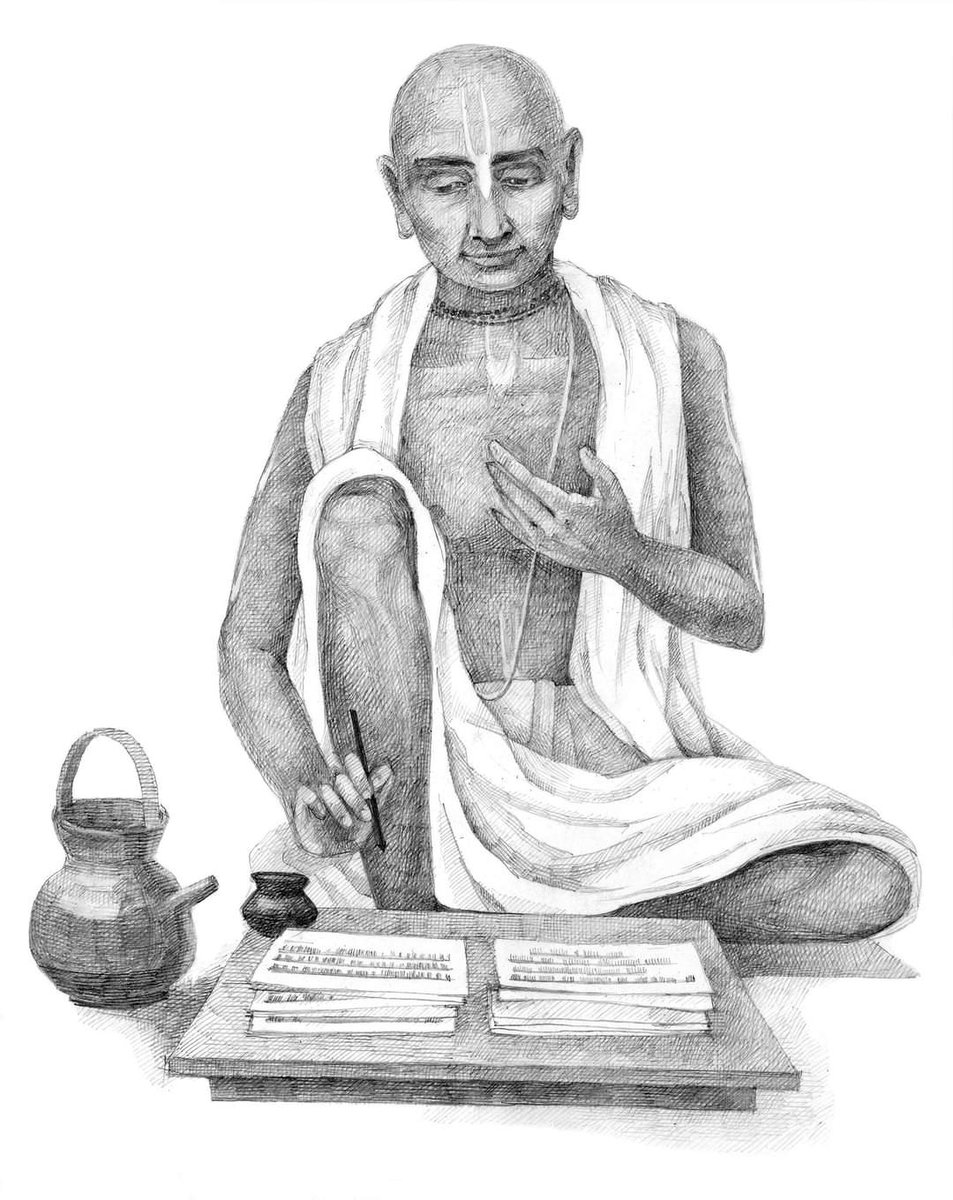
He was an expert in sanskrit grammar. He studied almost all grammars that were present at that time and composed his own sanskrit grammar named Harinamamrit Vyakran which is a novel contribution to the realm of sanskrit grammar. He has made his unique prakriya to form words.
He has authored a total of 3 works related to sanskrit grammar. Śrī Harināmāmṛta-vyākaraṇa, Sūtra-mālikā, Dhātu-saṅgraha are those three works. Regarding his scholarship on vedas he has authored two books Gāyatrī-vivritti and Gopāla-tāpanī-ṭīkā.
Gāyatrī-vivritti is a commentary on Gayatri Mantra based on a passage from agni puran and in Gopāla-tāpanī-ṭīkā he has explained the Vedic basis of Gaudiya Vaishnav Theology.
His scholarship in pure philosophy is seen in works like ṢaṭSandarbha ,
Sarva-saṁvādinī etc. Through these works he established Caitanya Vaishnavism as a proper philosophical school. He discussed all aspects of philosophy in these works using the language of navya nyaya.
Sarva-saṁvādinī etc. Through these works he established Caitanya Vaishnavism as a proper philosophical school. He discussed all aspects of philosophy in these works using the language of navya nyaya.
All other vedantic schools were established by commenting on Brahman Sutras. But Jiva Goswami took a different approach. He brought Srimad Bhagvatam as the centre of discussion of vedantic philosophy.
Srimad Bhagvatam is not just a text that should be used by commentators to just quote it when needed like other puranas etc. But as per him it should be the central text of our philosophical discussion. As per him it is the most important text in the entire vedic corpus.
But it doesn't mean he doesn't consider other scriptures as praman or inauthentic. His basic premise is that Srimad Bhagvatam contains the essence of all scriptures hence we should all study that and then try to study all those scriptures from the lens of Srimad Bhagvatam
He is the first Gaudiya Vaishnav Acharya to comment on Brahma Sutras and show the connection of Srimad Bhagvatam and Brahman Sutras. He commented on the first five sutras in paramatma sandarbh and later this was expanded by Srila Baldev Vidyabhushan in govind bhasya.
Catuh Sutri Vichar of Brahma Sutra is a very old tradition. Bhamati is the outcome of that only where the first four sutras are discussed in depth and he followed that only in his commentary and similarly he explained important verses of gita and important passages of vedas.
In sarva samvadini he has discussed major philosophies, purva paksh did samanvaya of different scriptures etc which shows his command over all those systems. In krama sandarbh he commented on entire Srimad Bhagvatam.
He also composed laghu vaishnav toshini specifically dealing with tenth canto only. He has done more service of Srimad Bhagvatam than those people who just take the name of Srimad Bhagvatam but doesn't follow it and compose phalgu tikas on it.
He is also the first acharya to systemize the worship of Radha with Krsna through his work Rādhā-kṛṣṇa-arcana-dīpikā. There is no work before this that deals with radha krishna worship. He has provided systematic arguments based on scriptures in his work.
He is also an accomplished poet and composed great Kavyas such as Gopāla-campū, Bhāvārtha-sūcaka-campū, Gopāla-virudāvalī, Mādhava-mahotsava and other small works as well. These texts are considered one of best Kavyas on related to krsna that are filled with unique themes
He also composed commentaries on the works of predecessors to preserve the correct meaning of their works and pass it down to the next generation. Apart from this he was an excellent leader and administrator. He prepared Srinivas Acharya, Narottam Das Thakur, shyamanand prabhu
He expanded the teachings of Caitanya Vaishnavism and systemized different branches of Caitanya Vaishnavism through his students. He played a very strategic role in Caitanya Vaishnavism in the 16th century. He served as head of vishva vaishnav raj sabha established by his uncles.
During his time Akbar was ruling in the mughal empire. He established a strategic partnership with his regime to develop a spiritual retreat in vrindavan. He used todarmal and maan singh and the result of this is the magnificent Govind Dev Temple.
When temples were razed in north India he was leading construction of an architectural beauty using the mughal money which shows his leadership qualities. The Mughal regime also donated land to him and paper from the Lahore factory to write books.
He was totally a visionary man ahead of his time. He maintained a large library in vrindavan and maintained a catalogue of books. He envisioned a hub for learning bhakti in vrindavan. He also recorded his last will in sanskrit where he has expressed all his desires.
There is so much to talk about him but at the end we should try to follow his teachings. In Caitanya Vaishnavism one who has not studied his works especially sandarbhas cannot be considered a real scholar. Everyone who wrote after him followed sandarbhas only. Read more here 👇
Loading suggestions...