

Stock splits and bonus issues both increase the number of shares you own.
But why does a company choose one over the other?
And what does it mean for investors?
We break it down. A🧵
But why does a company choose one over the other?
And what does it mean for investors?
We break it down. A🧵
Let’s start with stock splits.
A stock split is when a company divides its existing shares into smaller units.
Mathematically, this should lower the price of each share but keep the total value of your holdings unchanged.
A stock split is when a company divides its existing shares into smaller units.
Mathematically, this should lower the price of each share but keep the total value of your holdings unchanged.
It is like taking a ₹200 note and exchanging it for two ₹100 notes.
You still have the same amount of money, but now in smaller denominations.
Let’s break it down with an example.
You still have the same amount of money, but now in smaller denominations.
Let’s break it down with an example.
On October 19, 2023, Nestlé India announced a 1:10 stock split.
This means every existing share was split into 10 new shares.
The record date was set for January 5.
If you held shares in your demat account on this date, you were eligible for the split shares.
This means every existing share was split into 10 new shares.
The record date was set for January 5.
If you held shares in your demat account on this date, you were eligible for the split shares.
Before the split: 1 share = ₹27,150
Post splitting, the share price decreased by 10 times.
1 share = ₹2,700 (approx)
If you had invested ₹54,300 in Nestlé India, you would have:
Before: 2 shares
After: 20 shares
Your investment value? Still ₹54,300.
Post splitting, the share price decreased by 10 times.
1 share = ₹2,700 (approx)
If you had invested ₹54,300 in Nestlé India, you would have:
Before: 2 shares
After: 20 shares
Your investment value? Still ₹54,300.
So, when a stock split occurs:
-The no of shares increases
-Share price and face value fall
-Your investment value remains the same
See the table below for a better understanding. x.com
-The no of shares increases
-Share price and face value fall
-Your investment value remains the same
See the table below for a better understanding. x.com

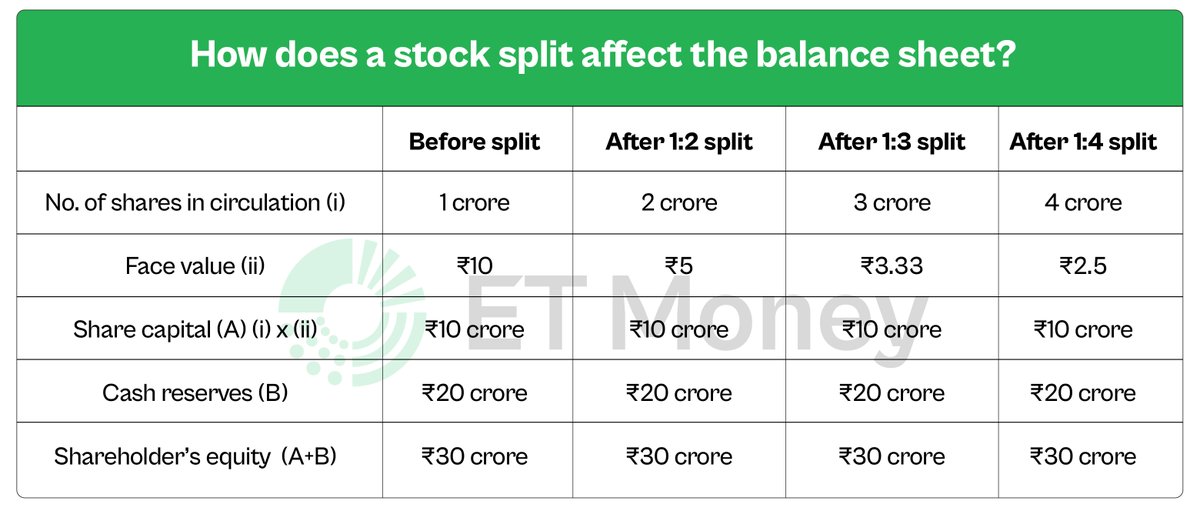
How does it impact the balance sheet?
The balance sheet of any company contains 3 parts - Assets, liabilities and shareholders’ equity.
The shareholder’s equity consists:
-Share capital (value of all the shares in the market)
-Cash reserves
A stock split does not affect the reserves or the share capital, keeping the total equity unchanged. (See table)
The balance sheet of any company contains 3 parts - Assets, liabilities and shareholders’ equity.
The shareholder’s equity consists:
-Share capital (value of all the shares in the market)
-Cash reserves
A stock split does not affect the reserves or the share capital, keeping the total equity unchanged. (See table)
Why do companies do stock splits?
To make shares more affordable and improve liquidity.
If a stock’s price gets too high, small investors might struggle to buy in.
Lowering the price encourages more participation and increases trading volume.
To make shares more affordable and improve liquidity.
If a stock’s price gets too high, small investors might struggle to buy in.
Lowering the price encourages more participation and increases trading volume.
How are they taxed?
A stock split is not a taxable event.
However, when you sell the new shares, capital gains tax applies.
The cost of acquisition is adjusted by dividing the original price by the new share count.
And gains are taxed based on your holding period.
Now, let’s talk about bonus shares.
A stock split is not a taxable event.
However, when you sell the new shares, capital gains tax applies.
The cost of acquisition is adjusted by dividing the original price by the new share count.
And gains are taxed based on your holding period.
Now, let’s talk about bonus shares.
Companies sometimes reward shareholders by paying dividends in cash.
Another way is through a bonus issue—giving additional shares instead of cash.
Bonus shares increase the number of shares you own without requiring you to invest more money.
Let’s see how it works.
Another way is through a bonus issue—giving additional shares instead of cash.
Bonus shares increase the number of shares you own without requiring you to invest more money.
Let’s see how it works.
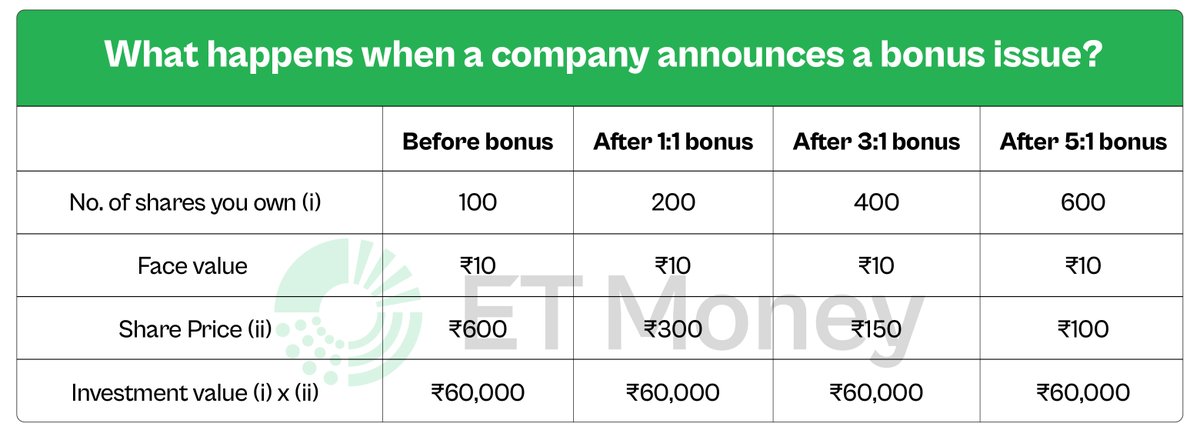
Say a company announces a 2:1 bonus issue.
For every share you hold, you get 2 additional shares.
If you had 100 shares, you now have 300 (100 original + 200 bonus).
And, the share price adjusts according to the bonus ratio.
Initially, if it was Rs 300, the price will reduce to Rs 100 after the issue.
For every share you hold, you get 2 additional shares.
If you had 100 shares, you now have 300 (100 original + 200 bonus).
And, the share price adjusts according to the bonus ratio.
Initially, if it was Rs 300, the price will reduce to Rs 100 after the issue.
How does a bonus issue affect the company’s balance sheet?
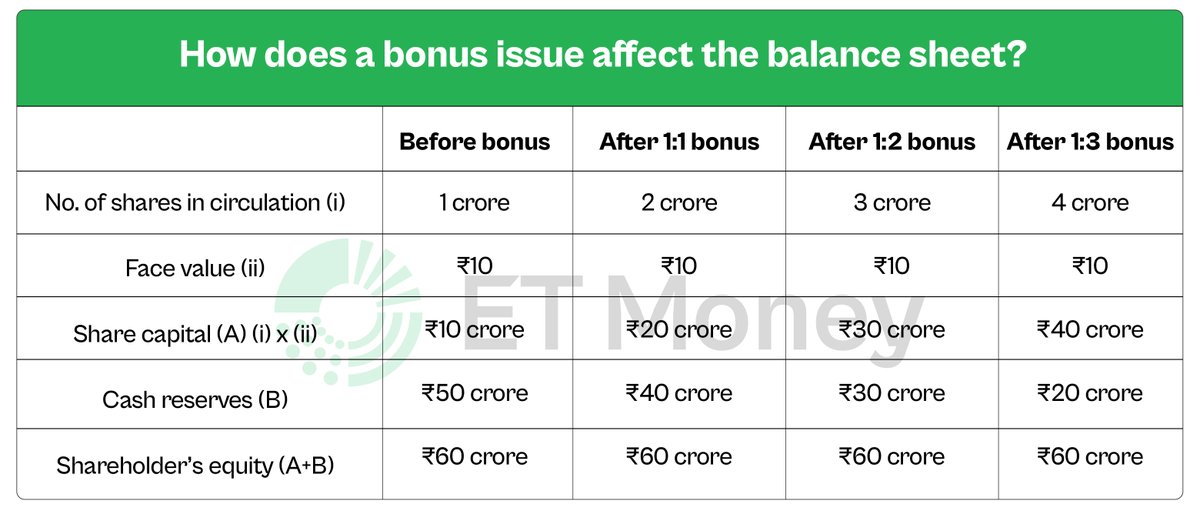
Unlike a stock split, bonus shares reduce the company’s reserves because the money for the extra shares comes from those reserves.
Here’s how the numbers change. ( See table) x.com
Unlike a stock split, bonus shares reduce the company’s reserves because the money for the extra shares comes from those reserves.
Here’s how the numbers change. ( See table) x.com
A recent example:
Reliance Industries announced a 1:1 bonus issue in 2024.
If you held 100 shares at ₹2,600 each (total ₹2,60,000), you would now have 200 shares at ₹1,300 each.
Your investment value? Still ₹2,60,000.
Reliance Industries announced a 1:1 bonus issue in 2024.
If you held 100 shares at ₹2,600 each (total ₹2,60,000), you would now have 200 shares at ₹1,300 each.
Your investment value? Still ₹2,60,000.
Companies that regularly issue bonus shares usually have strong financials and confidence in future earnings.
Infosys, Reliance, and Wipro are well-known for rewarding long-term investors with bonus issues over the years.
Infosys, Reliance, and Wipro are well-known for rewarding long-term investors with bonus issues over the years.
How are they taxed?
Receiving bonus shares is not taxable when issued.
However, when sold, capital gains tax applies.
The cost of acquisition for bonus shares is considered zero, meaning the entire sale proceeds are treated as a capital gain.
Receiving bonus shares is not taxable when issued.
However, when sold, capital gains tax applies.
The cost of acquisition for bonus shares is considered zero, meaning the entire sale proceeds are treated as a capital gain.
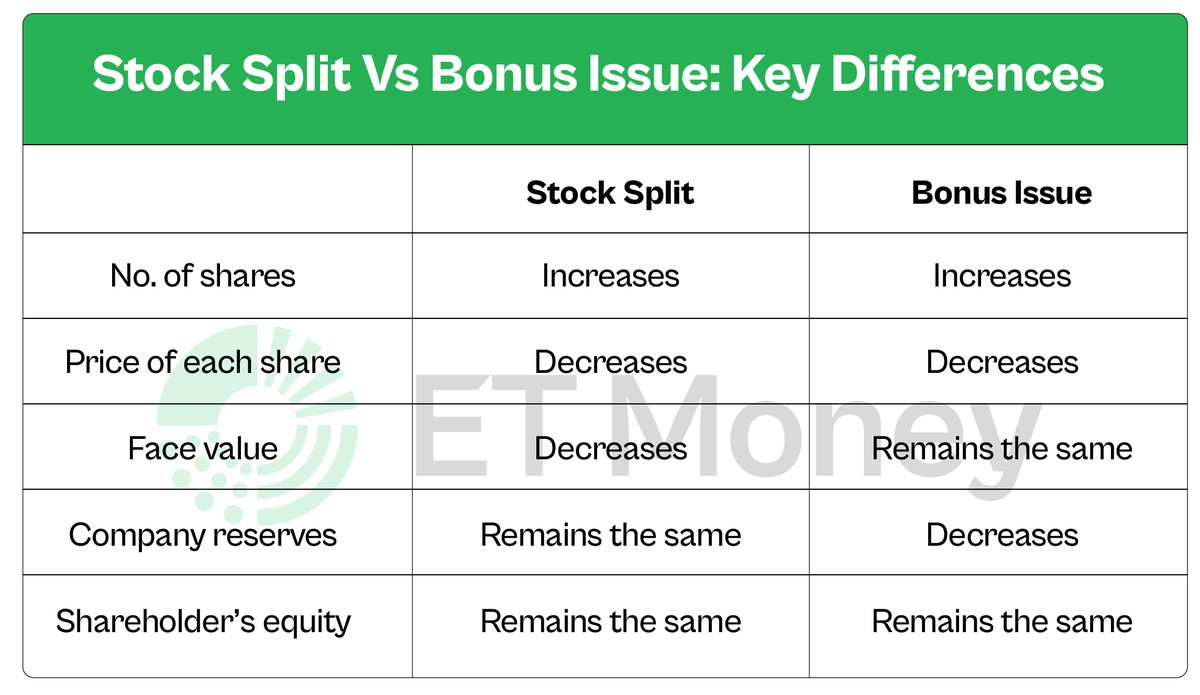
What is the key difference?
-Stock split: No new shares are created; existing shares are just divided into smaller units.
-Bonus issue: New shares are created and given to shareholders from the company’s reserves.
We have summarised their impact in the table below. x.com
-Stock split: No new shares are created; existing shares are just divided into smaller units.
-Bonus issue: New shares are created and given to shareholders from the company’s reserves.
We have summarised their impact in the table below. x.com
When do companies use these corporate actions?
A stock split makes the share more affordable and increases liquidity.
This can be a great move if the price is too high.
A bonus issue signals strong profitability and management confidence in future earnings.
It’s often a reward for long-term investors.
A stock split makes the share more affordable and increases liquidity.
This can be a great move if the price is too high.
A bonus issue signals strong profitability and management confidence in future earnings.
It’s often a reward for long-term investors.
Do you consider stock splits or bonus issues before investing in a company?
Loading suggestions...