

Usual suspects caught me on the wrong foot when indevertently I made mistake. Here is the apology and correction.
This thread will address economics, biochemistry, food security, compassion, Ayurveda, medicine and simple habits.
I will update this with all the responses. It is a living thread with highest scientific arguments.
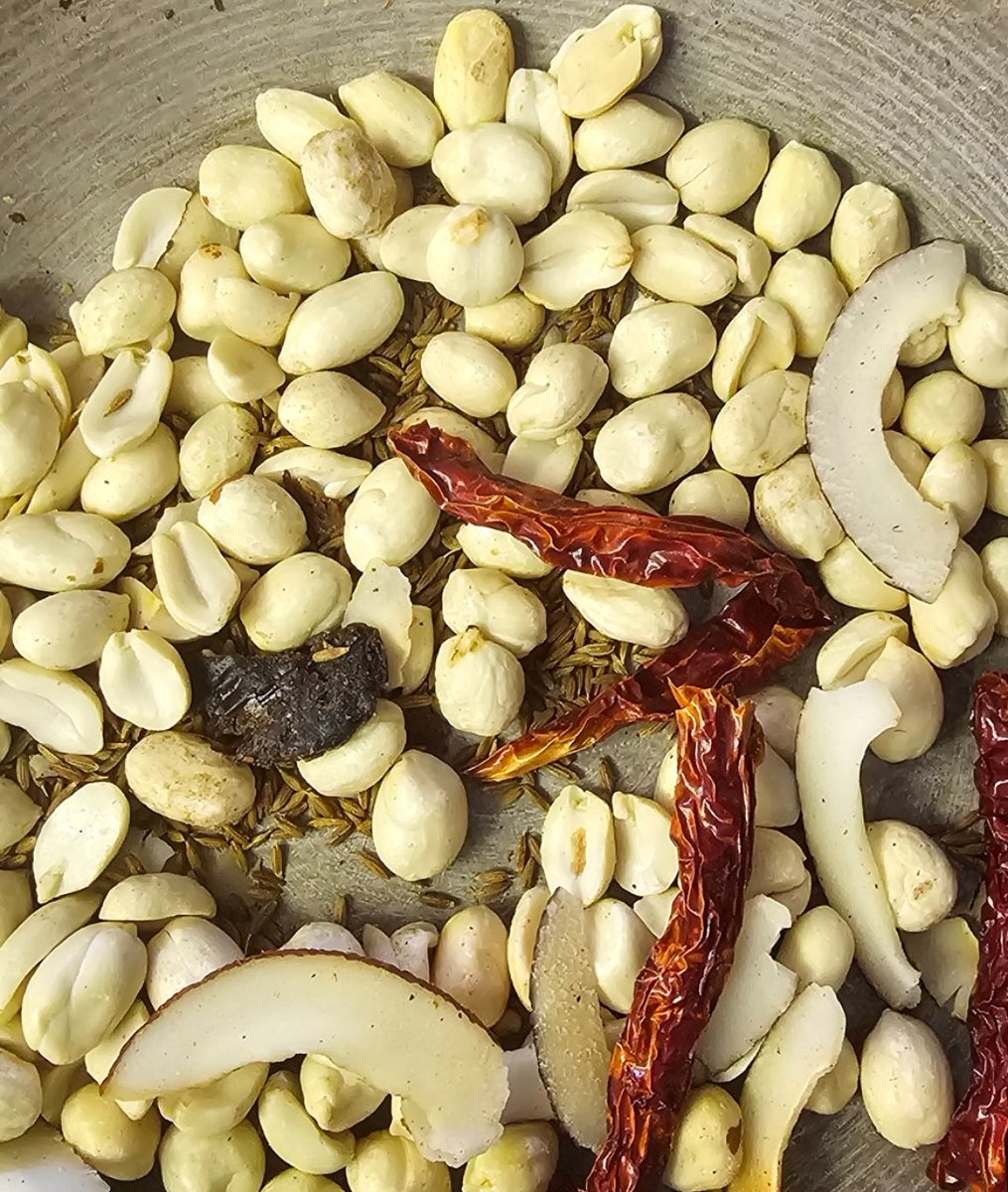
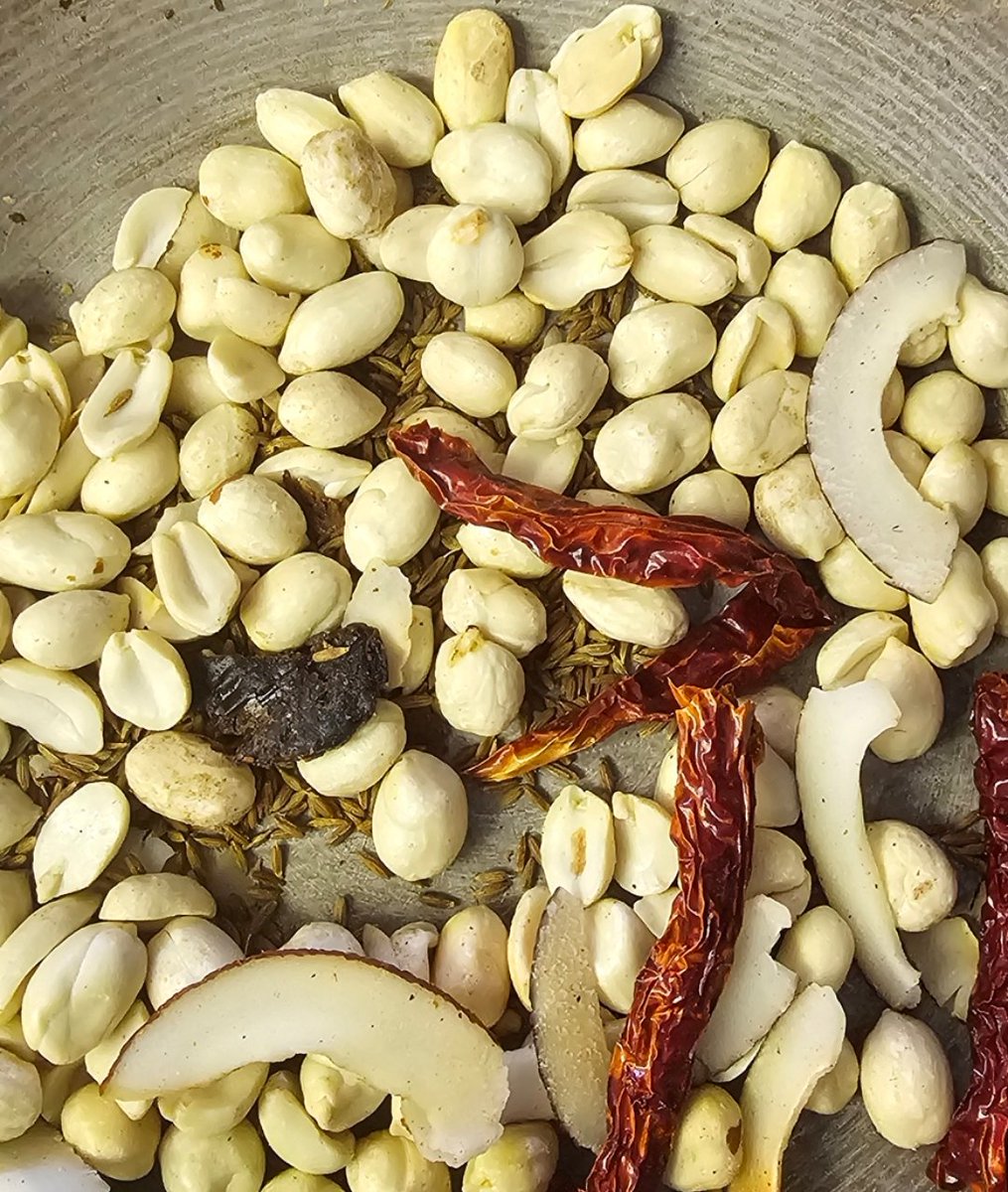
Ingredients for the chutney.
Peanuts: 100 gm
Tamarind: 15 gm
Chili: 5 gm
Cumin (Jeera): 20 gm
Curry leaves: 3 gm
Coconut: 5 gm
Total weight: 148 gm
Peanuts: 100 gm
Tamarind: 15 gm
Chili: 5 gm
Cumin (Jeera): 20 gm
Curry leaves: 3 gm
Coconut: 5 gm
Total weight: 148 gm
This chutney is then paired with rice Panna polo. literally it means leaf dosa in Konkani.
It is the artwork of Saraswati who get the Maillard to the max.
See the gif to enjoy my art getting ready. x.com
It is the artwork of Saraswati who get the Maillard to the max.
See the gif to enjoy my art getting ready. x.com

The combination of roasted peanut chutney and rice dosa (panna polo) demonstrates fascinating food science principles, from Maillard reactions to protein complementarity. Let's analyze the chemistry, nutrition, and synergistic pairing:
Chemical Reactions in Chutney Preparation
1. Maillard Reaction & Lipid Oxidation:
Peanuts: Roasting at 170°C triggers Maillard reactions between amino acids (e.g., lysine) and reducing sugars, producing pyrazines (nutty aroma) and melanoidins (browning)Concurrently, lipid oxidation increases antioxidant phenolic compounds by 42% compared to raw peanuts!
1. Maillard Reaction & Lipid Oxidation:
Peanuts: Roasting at 170°C triggers Maillard reactions between amino acids (e.g., lysine) and reducing sugars, producing pyrazines (nutty aroma) and melanoidins (browning)Concurrently, lipid oxidation increases antioxidant phenolic compounds by 42% compared to raw peanuts!
Cumin (Jeera): Toasting releases cuminaldehyde (earthy aroma) via volatile oil activation. Heat transforms terpenes into more bioactive forms, enhancing antioxidant capacity.
Chili & Curry Leaves: Capsaicin in chili undergoes isomerization, intensifying heat, while curry leaves release α-pinene and β-caryophyllene (citrusy notes)
Ayurveda is about balance. Here acid(pitta) is being balanced.
2. Acid-Base Balance:
Tamarind’s tartaric acid (pH ~2.8) neutralizes alkaline compounds formed during roasting, balancing flavor and improving mineral bioavailability
2. Acid-Base Balance:
Tamarind’s tartaric acid (pH ~2.8) neutralizes alkaline compounds formed during roasting, balancing flavor and improving mineral bioavailability
And the third part is
3. Volatile Compound Synergy:
Roasted peanut’s 2,3-pentanedione (buttery) combines with cumin’s cuminaldehyde and chili’s capsaicin, creating a layered flavor profile.
3. Volatile Compound Synergy:
Roasted peanut’s 2,3-pentanedione (buttery) combines with cumin’s cuminaldehyde and chili’s capsaicin, creating a layered flavor profile.
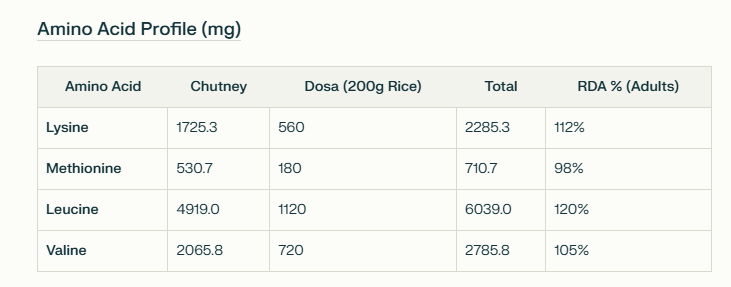
1. Protein Complementarity: The chutney’s lysine compensates for rice’s deficiency, while rice provides methionine lacking in peanuts, forming a complete protein.
2. Digestive Enhancement:
Fermented dosa batter contains lactic acid bacteria, improving gut microbiota.
Cumin in chutney stimulates pancreatic enzyme secretion, aiding starch/protein digestion
Fermented dosa batter contains lactic acid bacteria, improving gut microbiota.
Cumin in chutney stimulates pancreatic enzyme secretion, aiding starch/protein digestion
Now the favorite part of Proteinjits. Bioavailability
3. Nutrient Bioavailability:
Peanut fat (54.4g/100g) solubilizes fat-soluble vitamins (A/D/E/K) from rice.
Tamarind’s acetic acid enhances iron absorption from curry leaves
3. Nutrient Bioavailability:
Peanut fat (54.4g/100g) solubilizes fat-soluble vitamins (A/D/E/K) from rice.
Tamarind’s acetic acid enhances iron absorption from curry leaves

Now the nutrition profile.
two family members each got same amount of protein as though they ate four eggs for breakfast! And it was all complete profile! x.com
two family members each got same amount of protein as though they ate four eggs for breakfast! And it was all complete profile! x.com
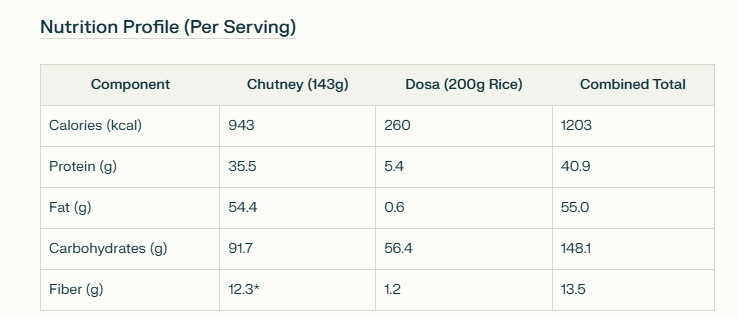
In one just breakfast we also exceeded RDA for many Amino acids because of the way Indian cooking works. x.com
Scientific Pairing Rationale
Texture Contrast: Crispy dosa (from rice amylose) complements creamy chutney.
Flavor Layering: Umami from fermented dosa balances chili heat and tamarind acidity.
Metabolic Efficiency: Rice’s high glycemic index is offset by peanut’s fat/fiber, reducing glucose spikes
Texture Contrast: Crispy dosa (from rice amylose) complements creamy chutney.
Flavor Layering: Umami from fermented dosa balances chili heat and tamarind acidity.
Metabolic Efficiency: Rice’s high glycemic index is offset by peanut’s fat/fiber, reducing glucose spikes
Next is what about price (when I used sunflower seeds or pumpkin seeds to illustrate this point) I got beaten earlier. Peanuts provide significantly more protein per rupee compared to eggs in India.
My earlier post used price in America (pumpkin seeds at Costco) are at $9 per pound. Eggs these days cost almost 75 cents per each. I was told that eggs cost Rs. 6 in India and Sunflower seeds are expensive. My apologies.
Peanuts provide significantly more protein per rupee compared to eggs in India, making them a more cost-effective source of dietary protein. Here's the detailed breakdown: x.com
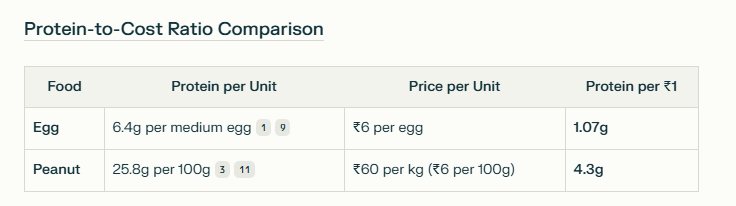
Peanuts deliver 4.3g of protein per ₹1, outperforming eggs (1.07g/₹1) by 4x.
To get 25g of protein:
Eggs: ~4 eggs needed → ₹24
Peanuts: ~97g needed → ₹5.82
To get 25g of protein:
Eggs: ~4 eggs needed → ₹24
Peanuts: ~97g needed → ₹5.82
Panna polo also has another secret!
Coconut!
Enhanced Fat Profile:
Coconut adds beneficial medium-chain triglycerides (MCTs), which are metabolized differently from long-chain fatty acids, potentially offering quick energy and supporting ketone production.
Fiber Boost:
Coconut contributes additional dietary fiber, further complementing the fiber from peanuts and potentially improving the chutney's glycemic impact when paired with the rice dosa.
Enhanced Fat Profile:
Coconut adds beneficial medium-chain triglycerides (MCTs), which are metabolized differently from long-chain fatty acids, potentially offering quick energy and supporting ketone production.
Fiber Boost:
Coconut contributes additional dietary fiber, further complementing the fiber from peanuts and potentially improving the chutney's glycemic impact when paired with the rice dosa.
So dosa's glycemic index is improved by adding coconut!
Only when you start home cooking using Ayurvedic principles you realize how deep these principles are!
Let me know if you have any questions. Once again apologizing for the faux pas on pumpkin seeds. I have deleted that thread.
Let me know if you have any questions. Once again apologizing for the faux pas on pumpkin seeds. I have deleted that thread.
Enjoy your weekend. Spend time with your family and loved ones, happy and content.
Sarve Jana Sukhino Bhavantu. (TBC)
Sarve Jana Sukhino Bhavantu. (TBC)
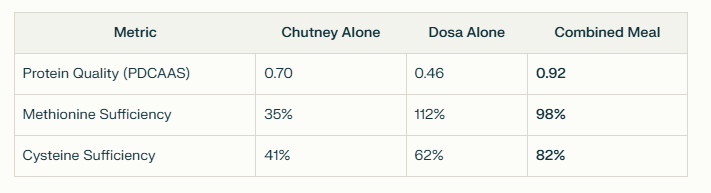
While peanuts aren't devoid of methionine/cysteine, their low levels make these limiting amino acids.
The chutney-dosa combination demonstrates evolutionary nutritional wisdom – rice compensates for peanut's methionine deficiency, while peanuts address rice's lysine limitations.
This pairing achieves:
94% of essential amino acid requirements
22% higher protein utilization than separate consumption.
Complete protein profile meeting WHO/FAO standards.
Traditional food pairings often inherently solve nutritional challenges through complementary amino acid profiles.
Here is the PDCAAS scores individual as well as paired.
The chutney-dosa combination demonstrates evolutionary nutritional wisdom – rice compensates for peanut's methionine deficiency, while peanuts address rice's lysine limitations.
This pairing achieves:
94% of essential amino acid requirements
22% higher protein utilization than separate consumption.
Complete protein profile meeting WHO/FAO standards.
Traditional food pairings often inherently solve nutritional challenges through complementary amino acid profiles.
Here is the PDCAAS scores individual as well as paired.
Loading suggestions...