


@a16z @stuffyokodraws @Mascobot @GEVS94 @kirbyman01 1/ To start: why is there so much buzz?
Thousands of users - from consumers to experienced developers - are sharing what they've made with these tools.
The growth is impressive: @boltdotnew reportedly grew to $20M ARR and @lovable_dev to $10M in 2 months of monetization. x.com
Thousands of users - from consumers to experienced developers - are sharing what they've made with these tools.
The growth is impressive: @boltdotnew reportedly grew to $20M ARR and @lovable_dev to $10M in 2 months of monetization. x.com

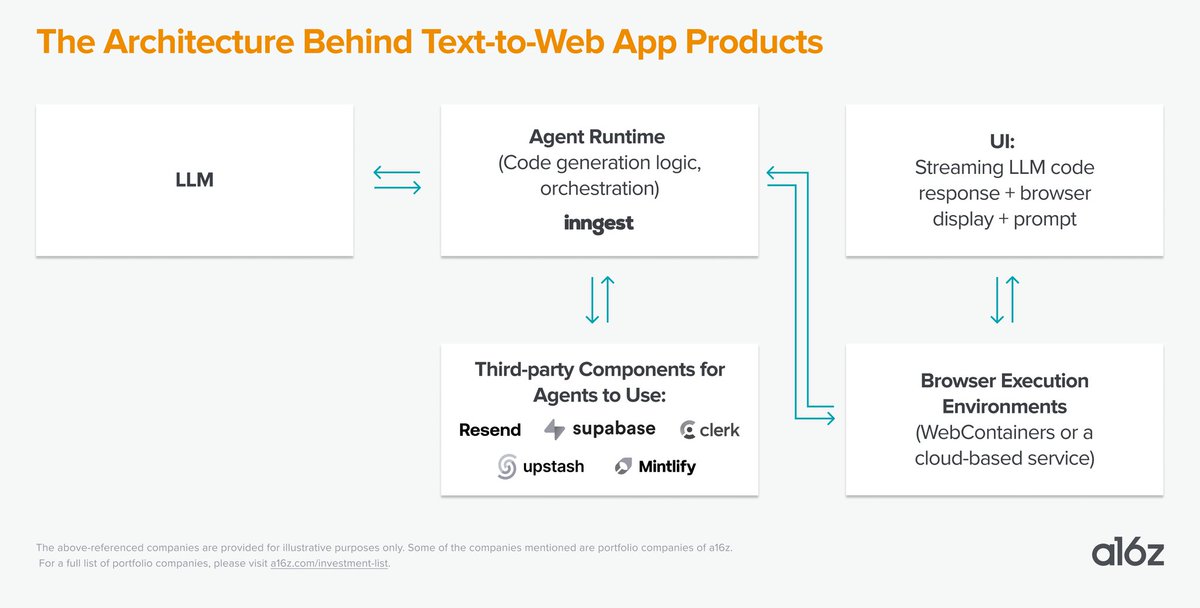
2/ How do these products work?
Most use an LLM to generate code based on the prompt, and then run it through middleware logic for things like tracking files and API calls.
The agents then push the code to a browser execution environment that streams the display to the user. x.com
Most use an LLM to generate code based on the prompt, and then run it through middleware logic for things like tracking files and API calls.
The agents then push the code to a browser execution environment that streams the display to the user. x.com
3/ ...but do they really work?
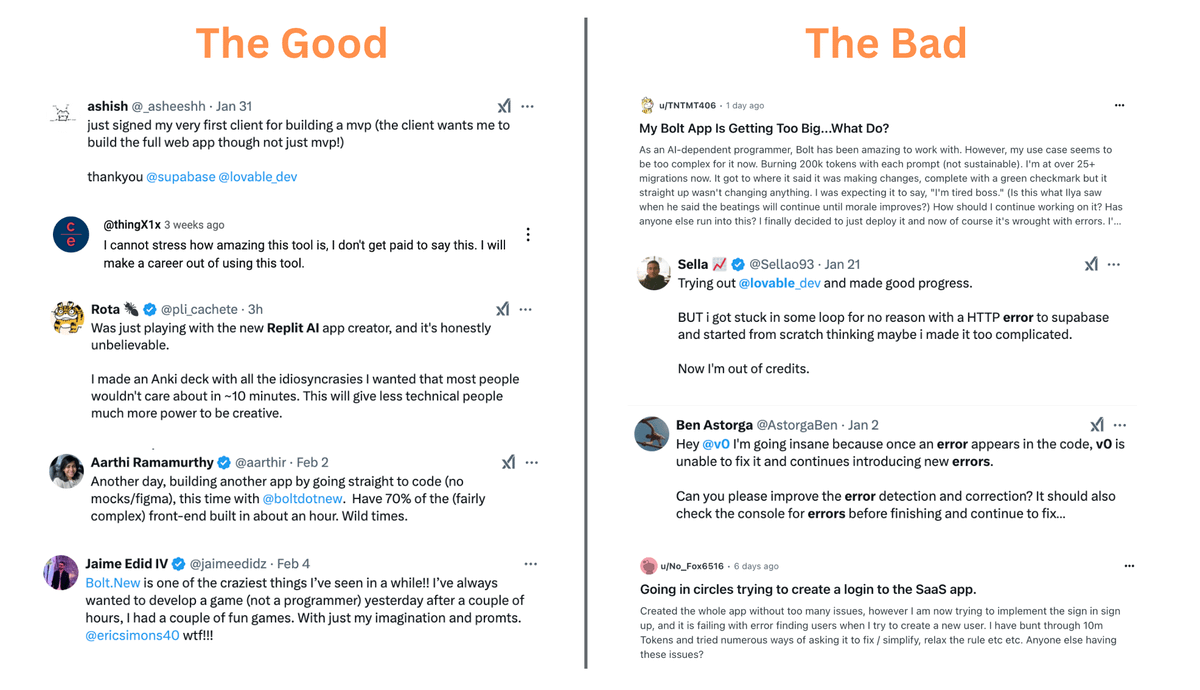
Yes and no. They excel at simple builds. And if you can't code otherwise, they can feel like magic.
But there's a limit to what they can reliably generate. Integrations are difficult, bugs persist, and code can get "too big" quickly. x.com
Yes and no. They excel at simple builds. And if you can't code otherwise, they can feel like magic.
But there's a limit to what they can reliably generate. Integrations are difficult, bugs persist, and code can get "too big" quickly. x.com
4/ How do users pick a product?
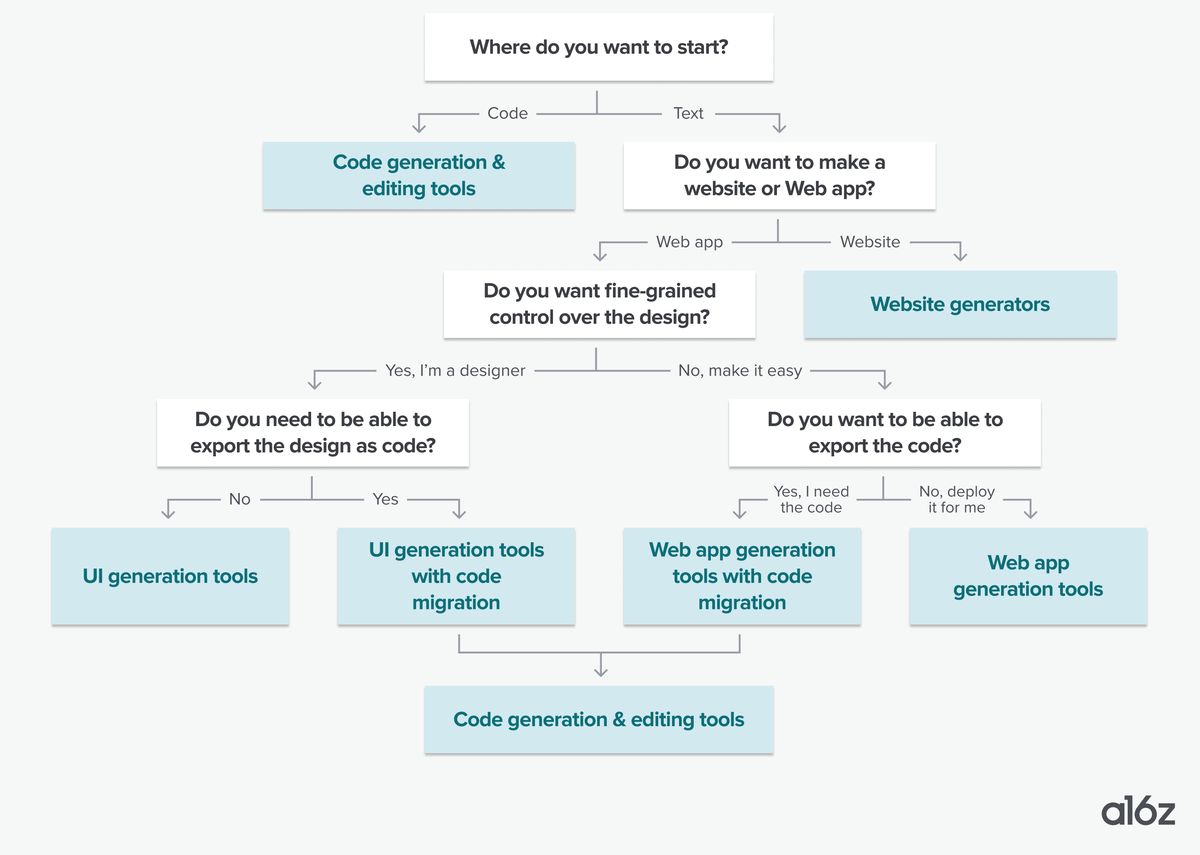
We interviewed dozens of customers and scoured thousands of posts...and created a flow chart!
Web app generation tools are great for those who (1) don't want to code, (2) don't need design control, and (3) want to make an interactive site.
From there, you can decide if you want the flexibility to download your code (to edit in your own IDE or deploy wherever you want) - or not.
We interviewed dozens of customers and scoured thousands of posts...and created a flow chart!
Web app generation tools are great for those who (1) don't want to code, (2) don't need design control, and (3) want to make an interactive site.
From there, you can decide if you want the flexibility to download your code (to edit in your own IDE or deploy wherever you want) - or not.
Other options:
If you're looking for a landing page or informational site, a website generator like @squarespace or @DurableAI might work.
If you're a designer, you may want to use a more specialized UI generation & editing tool like @relume_io, @Galileo_AI, or @uizard.
If you're an experienced developer, you could start directly in an AI-assisted IDE like @cursor_ai (or you'll likely export your code from a generation product to edit there).
If you're looking for a landing page or informational site, a website generator like @squarespace or @DurableAI might work.
If you're a designer, you may want to use a more specialized UI generation & editing tool like @relume_io, @Galileo_AI, or @uizard.
If you're an experienced developer, you could start directly in an AI-assisted IDE like @cursor_ai (or you'll likely export your code from a generation product to edit there).
5/ What are people building?
We segment users into 3 categories:
Consumers - long tail of personalized apps that cater to unique interests and needs. Typically not monetizing or serving users at scale.
E.g. a dad's bedtime story creator ⬇️
x.com
We segment users into 3 categories:
Consumers - long tail of personalized apps that cater to unique interests and needs. Typically not monetizing or serving users at scale.
E.g. a dad's bedtime story creator ⬇️
x.com
The last user segment is consultants & agencies.
These people typically aren't engineers, but are hired to make websites for solopreneurs or SMBs. They previously used tools like Squarespace or Wix.
E.g. this restaurant's website built by @XavAnd32:
enchante.fi
These people typically aren't engineers, but are hired to make websites for solopreneurs or SMBs. They previously used tools like Squarespace or Wix.
E.g. this restaurant's website built by @XavAnd32:
enchante.fi
6/ Where do we see these products going next?
A couple ideas of what we expect:
1) Products focused on specific personas. Today, most are "everything to everyone" - but the best tool for consumer landing pages will look different than one for a developers making e-comm sites.
A couple ideas of what we expect:
1) Products focused on specific personas. Today, most are "everything to everyone" - but the best tool for consumer landing pages will look different than one for a developers making e-comm sites.
2) Moving upmarket. Most users today are individuals. Adding collaboration and enterprise features could lead to adoption in orgs.
3) Packaged integrations. Add-ons (e.g. auth, payments, databases) are often hard + buggy. My experience ⬇️
x.com
3) Packaged integrations. Add-ons (e.g. auth, payments, databases) are often hard + buggy. My experience ⬇️
x.com
4) Pixel-level design control. Changing UI with text prompts (e.g. "make the box this color") is both annoying and not precise.
5) Pricing clarity + education. Most products have usage-based pricing, and users don't know how to best spend their tokens or how much it will cost.
5) Pricing clarity + education. Most products have usage-based pricing, and users don't know how to best spend their tokens or how much it will cost.

7/ Finally - do today's text-to-web app tools persist as standalone products?
This is an interesting surface area for many products to explore - you could imagine design tools, code editors, or even the LLM companies wanting to add this as a feature. And the user experience may benefit from their broader ecosystem of features.
For today's tools, we see real opportunity in vertical-izing and going deeper into workflow. For example, imagine a product that not only helps a small business set up their website, but also makes it easy to reserve a custom domain, make marketing materials, schedule appointments, or run ads.
This is an interesting surface area for many products to explore - you could imagine design tools, code editors, or even the LLM companies wanting to add this as a feature. And the user experience may benefit from their broader ecosystem of features.
For today's tools, we see real opportunity in vertical-izing and going deeper into workflow. For example, imagine a product that not only helps a small business set up their website, but also makes it easy to reserve a custom domain, make marketing materials, schedule appointments, or run ads.
For more of our thoughts, check out the full blog post below - and reach out if you're building something here!
Huge thanks to my amazing co-authors: @stuffyokodraws, @Mascobot, @GEVS94, and @kirbyman01
a16z.com
Huge thanks to my amazing co-authors: @stuffyokodraws, @Mascobot, @GEVS94, and @kirbyman01
a16z.com

And tagging the companies in the market map:
Website generation - @ButternutAI, @DoraTool, @dorik_io, @DurableAI, @framer, @Hostinger, @jimdo, @squarespace, @Wix, @10Web_io
Web app generation - @bubble, @DatabuttonHQ, @tryoharaAI, @softr_io, @ValDotTown
Website generation - @ButternutAI, @DoraTool, @dorik_io, @DurableAI, @framer, @Hostinger, @jimdo, @squarespace, @Wix, @10Web_io
Web app generation - @bubble, @DatabuttonHQ, @tryoharaAI, @softr_io, @ValDotTown
Web app generation w/ code migration - @boltdotnew, @codotdev, @create_xyz, @getcreatr, @heybossAI, @getLazyAI, @lovable_dev, @Replit, @SoftgenAI, @Tempo_Labs, @Trickle_HQ, @v0
@boltdotnew @codotdev @create_xyz @getcreatr @heybossAI @getLazyAI @lovable_dev @Replit @SoftgenAI @Tempo_Labs @Trickle_HQ @v0 None of the above should be taken as investment advice or an advertisement for investment services; some of the companies mentioned above are portfolio companies of a16z.
A list of investments made by a16z is available at a16z.com.
A list of investments made by a16z is available at a16z.com.

Loading suggestions...