
🧵 The Facial Nerve (CN VII): Anatomy, Function, & Clinical Relevance
1/ The Facial Nerve (CN VII) is a mixed nerve controlling facial expression, taste, salivation, and lacrimation.
✅ Motor → Facial muscles
✅ Sensory → Taste (anterior 2/3 tongue)
✅ Parasympathetic → Lacrimal & salivary glands
🚀 Dysfunction leads to facial palsy, taste loss, and dry eyes/mouth!
#NeuroAnatomy #FacialNerve #Neurosurgery
Image: Paulsen F, Waschke J. Sobotta Atlas of Human Anatomy, Vol. 3. 15th ed. Munich, Germany: Urban & Fischer; 2012:133-160
1/ The Facial Nerve (CN VII) is a mixed nerve controlling facial expression, taste, salivation, and lacrimation.
✅ Motor → Facial muscles
✅ Sensory → Taste (anterior 2/3 tongue)
✅ Parasympathetic → Lacrimal & salivary glands
🚀 Dysfunction leads to facial palsy, taste loss, and dry eyes/mouth!
#NeuroAnatomy #FacialNerve #Neurosurgery
Image: Paulsen F, Waschke J. Sobotta Atlas of Human Anatomy, Vol. 3. 15th ed. Munich, Germany: Urban & Fischer; 2012:133-160
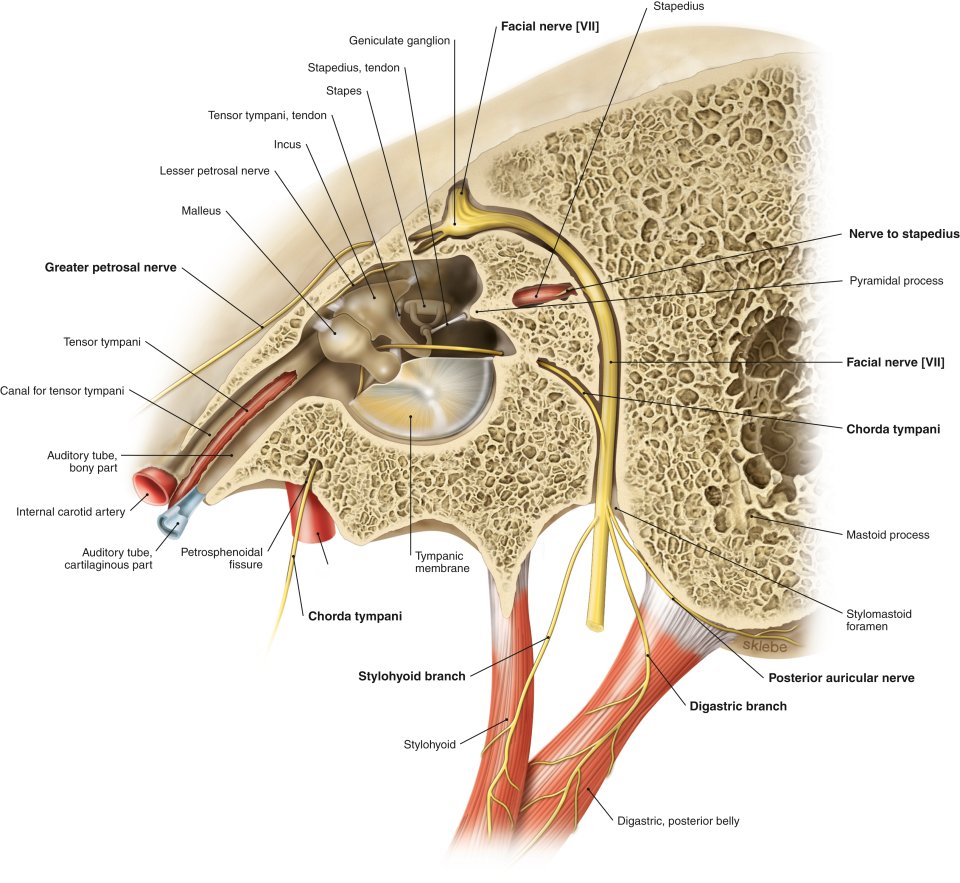
2/ Facial Nerve Course & Branches
📌 1. Intracranial (Brainstem → Internal Acoustic Meatus)
📌 2. Intratemporal (Facial Canal → Middle Ear → Stylomastoid Foramen)
📌 3. Extracranial (Parotid Gland → Facial Muscles)
🚀 Key Branches:
✅ Greater Petrosal Nerve → Lacrimal gland (Tears)
✅ Nerve to Stapedius → Dampens loud sounds
✅ Chorda Tympani (Exits: Petrotympanic Fissure) → Taste (Anterior 2/3 tongue), Salivation (Submandibular & Sublingual Glands)
✅ Terminal Branches in the Face (Motor, Exits: Stylomastoid Foramen):
🔹 Temporal
🔹 Zygomatic
🔹 Buccal
🔹 Mandibular
🔹 Cervical
📌 1. Intracranial (Brainstem → Internal Acoustic Meatus)
📌 2. Intratemporal (Facial Canal → Middle Ear → Stylomastoid Foramen)
📌 3. Extracranial (Parotid Gland → Facial Muscles)
🚀 Key Branches:
✅ Greater Petrosal Nerve → Lacrimal gland (Tears)
✅ Nerve to Stapedius → Dampens loud sounds
✅ Chorda Tympani (Exits: Petrotympanic Fissure) → Taste (Anterior 2/3 tongue), Salivation (Submandibular & Sublingual Glands)
✅ Terminal Branches in the Face (Motor, Exits: Stylomastoid Foramen):
🔹 Temporal
🔹 Zygomatic
🔹 Buccal
🔹 Mandibular
🔹 Cervical
3/ Functions of the Facial Nerve
📌 Motor (Somatic Efferent)
✅ Controls muscles of facial expression
✅ Stapedius muscle (Dampens loud noise)
📌 Sensory (Special & General Afferent)
✅ Taste → Anterior 2/3 tongue (via Chorda Tympani)
✅ Small sensory contribution to external ear
📌 Parasympathetic (Visceral Efferent)
✅ Lacrimation → Greater Petrosal Nerve → Lacrimal gland
✅ Salivation → Chorda Tympani → Submandibular & Sublingual glands
🚨 Facial nerve palsy can affect any of these functions!
📌 Motor (Somatic Efferent)
✅ Controls muscles of facial expression
✅ Stapedius muscle (Dampens loud noise)
📌 Sensory (Special & General Afferent)
✅ Taste → Anterior 2/3 tongue (via Chorda Tympani)
✅ Small sensory contribution to external ear
📌 Parasympathetic (Visceral Efferent)
✅ Lacrimation → Greater Petrosal Nerve → Lacrimal gland
✅ Salivation → Chorda Tympani → Submandibular & Sublingual glands
🚨 Facial nerve palsy can affect any of these functions!
4/ Facial Nerve Temporal Bone Segments
🚀 Key Intratemporal Segments:
1️⃣ Labyrinthine Segment
Between IAC & Geniculate Ganglion
Narrowest part → Most vulnerable to compression (e.g., Bell’s Palsy)
Gives off the Greater Petrosal Nerve (Lacrimation)
2️⃣ Tympanic (Horizontal) Segment
Runs above the promontory of the middle ear
Gives off the Nerve to Stapedius (Dampens loud sounds)
3️⃣ Mastoid (Vertical) Segment
Runs downward to the stylomastoid foramen
Gives off the Chorda Tympani (Taste, Salivation)
📌 Exits the skull at the Stylomastoid Foramen → Enters the Parotid Gland → Facial branches.
🚀 Key Intratemporal Segments:
1️⃣ Labyrinthine Segment
Between IAC & Geniculate Ganglion
Narrowest part → Most vulnerable to compression (e.g., Bell’s Palsy)
Gives off the Greater Petrosal Nerve (Lacrimation)
2️⃣ Tympanic (Horizontal) Segment
Runs above the promontory of the middle ear
Gives off the Nerve to Stapedius (Dampens loud sounds)
3️⃣ Mastoid (Vertical) Segment
Runs downward to the stylomastoid foramen
Gives off the Chorda Tympani (Taste, Salivation)
📌 Exits the skull at the Stylomastoid Foramen → Enters the Parotid Gland → Facial branches.
5/ Upper vs. Lower Motor Neuron (UMN vs. LMN) Lesions
🚨 Facial nerve lesions cause facial weakness, but the distribution depends on the location.
✅ UMN Lesion (Central – Stroke, Tumors)
Contralateral lower face weakness ONLY
Forehead spared (bilateral corticobulbar innervation)
✅ LMN Lesion (Peripheral – Bell’s Palsy, Trauma)
Ipsilateral complete facial weakness (Forehead + Lower Face)
Cannot close eye, drooping mouth
📌 How to Differentiate?
✅ UMN = Forehead Spared
✅ LMN = Whole Face Affected
🚨 Facial nerve lesions cause facial weakness, but the distribution depends on the location.
✅ UMN Lesion (Central – Stroke, Tumors)
Contralateral lower face weakness ONLY
Forehead spared (bilateral corticobulbar innervation)
✅ LMN Lesion (Peripheral – Bell’s Palsy, Trauma)
Ipsilateral complete facial weakness (Forehead + Lower Face)
Cannot close eye, drooping mouth
📌 How to Differentiate?
✅ UMN = Forehead Spared
✅ LMN = Whole Face Affected
5/ Bell’s Palsy → Idiopathic Facial Nerve Paralysis
🚨 Most common cause of LMN facial paralysis (~60-70% cases).
✅ Sudden, unilateral facial weakness
✅ Cannot close eye, drooping mouth, loss of nasolabial fold
✅ Hyperacusis (Stapedius dysfunction), taste loss (Chorda Tympani involvement)
📌 Causes:
✅ Idiopathic (Most cases)
✅ Reactivation of HSV-1 in Geniculate Ganglion
✅ Lyme Disease, Ramsay Hunt Syndrome (VZV)
📌 Treatment:
✅ Prednisone (Best if started within 72 hrs)
✅ Acyclovir (If HSV suspected)
✅ Eye protection (Artificial tears, patching at night)
🚨 85% recover fully within 3 months!
🚨 Most common cause of LMN facial paralysis (~60-70% cases).
✅ Sudden, unilateral facial weakness
✅ Cannot close eye, drooping mouth, loss of nasolabial fold
✅ Hyperacusis (Stapedius dysfunction), taste loss (Chorda Tympani involvement)
📌 Causes:
✅ Idiopathic (Most cases)
✅ Reactivation of HSV-1 in Geniculate Ganglion
✅ Lyme Disease, Ramsay Hunt Syndrome (VZV)
📌 Treatment:
✅ Prednisone (Best if started within 72 hrs)
✅ Acyclovir (If HSV suspected)
✅ Eye protection (Artificial tears, patching at night)
🚨 85% recover fully within 3 months!
Loading suggestions...