

Further confirmation that agriculture was an indigenous development in India.
"Our results—combined with archaeological evidence of XI cultivation for >9,000 years in both India and China—support multiple independent domestications of O. sativa."
nature.com
"Our results—combined with archaeological evidence of XI cultivation for >9,000 years in both India and China—support multiple independent domestications of O. sativa."
nature.com
A 'culinary historian' now joins the Aryan invasion wagon. Her argument no less pitiful than the usual in her camp. She declares that the Rig Vedic people did not cultivate rice. They, it seems, only grazed cattle and maaybe chewed on a few pulses & barley
livehistoryindia.com
livehistoryindia.com
But why?
Why are the Muellerians attacking rice so unrelentingly?Why do they ignore glaringly profuse evidences? She is not the first. This has been going on for decades. Why are they so desperate to show that the Vedic people did not cultivate rice or cereals? The INDIAN Vrihi!
Why are the Muellerians attacking rice so unrelentingly?Why do they ignore glaringly profuse evidences? She is not the first. This has been going on for decades. Why are they so desperate to show that the Vedic people did not cultivate rice or cereals? The INDIAN Vrihi!
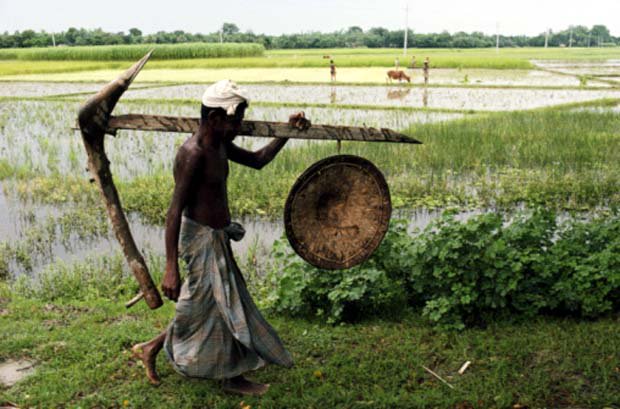
Because rice is powerful. The foundation of our agricultural history. The one cereal that pushes our antiquity into fearsome,unrecorded prehistory. The first seed & staple of our civilization.
Because nothing grew on the wastelands of central Asia where they wish Vedic came from.
Because nothing grew on the wastelands of central Asia where they wish Vedic came from.
The words dhana, dhaana, dhanya found in verses such as IV.24.7, I.16.2 & V.53.13 mean either rice or cereals in general. According to the ancient surgeon Sushruta, only rice is dhanya, the others are kudhanya.
According to Sayana, tandula in 1.16.2 refers to rice porridge.
According to Sayana, tandula in 1.16.2 refers to rice porridge.
Vrihi appears three times in his commentary of III.56.3. But ALL Muellerian have translated it as wheat or barley! Many rice dishes are mentioned-
Apupa- rice cake- III. 52.1, 7
Tandula-rice porridge-I.16.2
Purodasa:ground rice cakes-III. 28.1-6
Odana: boiled rice VIII. 69.14
Apupa- rice cake- III. 52.1, 7
Tandula-rice porridge-I.16.2
Purodasa:ground rice cakes-III. 28.1-6
Odana: boiled rice VIII. 69.14
The inescapable Biblical bias in western scholarship assumes agriculture began incontestably in the fertile crescent & 'spread to South Asia'
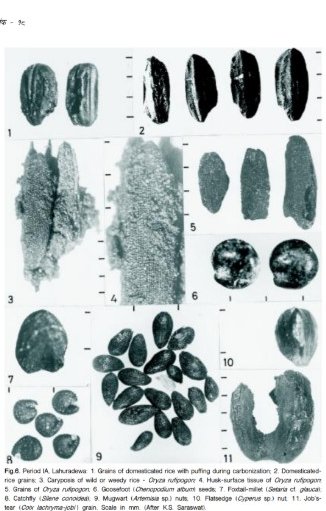
Lahuradeva lake gives-
Carbonized rice grains from ~11,000BCE
Evidence of slash & burn agriculture ~13,000BCE
1/n
indiafacts.org
Lahuradeva lake gives-
Carbonized rice grains from ~11,000BCE
Evidence of slash & burn agriculture ~13,000BCE
1/n
indiafacts.org
Horton Plains in Sri Lanka- early exploitation of wild barley & oats~15,500 BCE
Nilgiri Hills~11,500 BCE
Sambar lake~8300BCE
Prayaga- Multiple cropping with many types of wheat ,rice & legumes- 7th mBCE
Indigenous, diverse, widely spread & very possibly older than the crescent
Nilgiri Hills~11,500 BCE
Sambar lake~8300BCE
Prayaga- Multiple cropping with many types of wheat ,rice & legumes- 7th mBCE
Indigenous, diverse, widely spread & very possibly older than the crescent
Not true. Agriculture in the sub continent began in the Gangetic plains. It gives more antique, consistent dates with more widespread & diverse seed remains.
Ref: Pal J.N. Early Farming of the Middle Ganga Plain with ref to Jhusi & Hetapatti // Prāgdhārā
Ref: Pal J.N. Early Farming of the Middle Ganga Plain with ref to Jhusi & Hetapatti // Prāgdhārā
Sites so far excavated gives dates from 7477 BCE - 5837 BCE. Look at the sheer diversity of crops Indians consumed in neolithic depths of time!
Layer 55 (13.88- 14.02 meters) — Hordeum vulgare (barley), Triticum aestivum (bread wheat), Oryza sativa (rice)
1/n
Layer 55 (13.88- 14.02 meters) — Hordeum vulgare (barley), Triticum aestivum (bread wheat), Oryza sativa (rice)
1/n
Layer 53 (13.70-13.80 meters) — H. vulgare, Triticum sphaerococcum (round grain wheat), Lens culinaris (lentil), Pisum arvense (peas), Lathyrus sativus (grass peas), Macrotyloma uniflorum (horse peas), Vitis vinifera (grape), Ziziphus nummularia (buckthorn), Vicia sativa (vetch)
Additional finds in specific layers-
Layer 52 (13.57—13.70 meters)-Vigna radiata (black peas) etc.;
Layer 50 (13.37—13.47m)-Emblica officinalis (myrobalan);
Layer 49(13.28—13.37m)-Sesamum indicum
This is just the first scratch on the surface of our agricultural history!
Layer 52 (13.57—13.70 meters)-Vigna radiata (black peas) etc.;
Layer 50 (13.37—13.47m)-Emblica officinalis (myrobalan);
Layer 49(13.28—13.37m)-Sesamum indicum
This is just the first scratch on the surface of our agricultural history!
Archaeology in India has not attained the sophistication that sites in the fertile crescent and Europe has been subjected to. Outdated, simplistic and OUTRIGHT WRONG conclusions like 'Balochistan origins' & 'Iranian farmers brought agriculture' continue to circulate.
Reject them!
Reject them!
Loading suggestions...