

The study of obesity is the study of mysteries.
slimemoldtimemold.com
slimemoldtimemold.com
The first mystery is the epidemic itself. For most of history, the obesity rate was about 1%, even for people who had all the food they wanted. Today, many countries are 40% obese or more. Even in lean countries like Italy, France, and Sweden, the obesity rate is around 20%.

The second mystery is how quickly the shift occurred. In 1975, there wasn’t a single country in the world with an obesity rate higher than 15%. In most countries, obesity was steady at about 10% until around 1980, when it suddenly began rising.
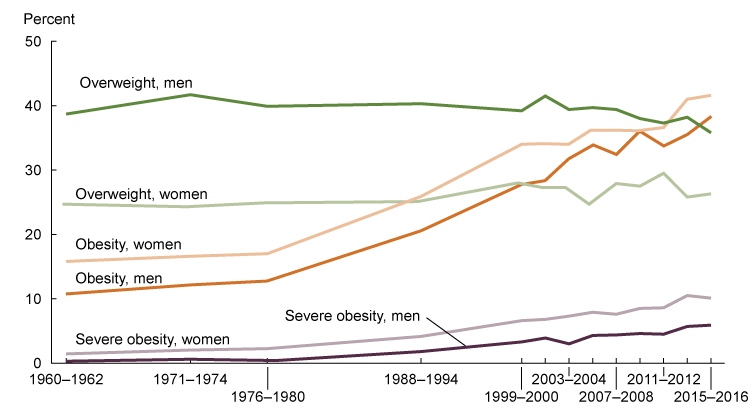
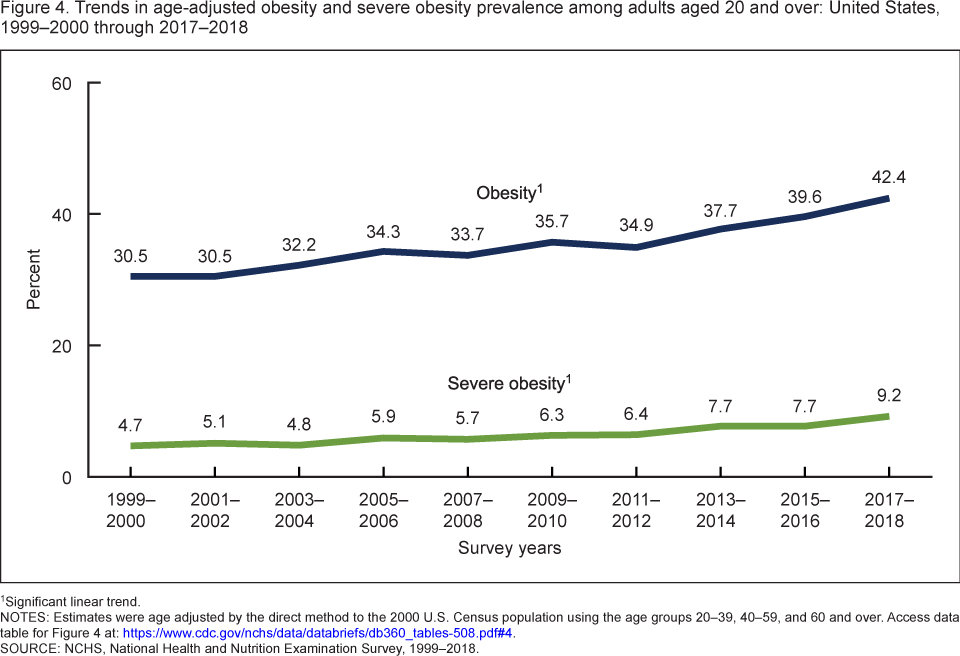
The third mystery is that obesity rates haven’t stopped climbing since 1980, and show no sign of slowing down. Obesity increased more than twice as much between 2010 and 2018 than it did between 2000 and 2008. After forty years, this seems normal, but historically it is bizarre.
Mystery four is that hunter-gatherers almost never become obese. Different groups eat very different diets. Some have diets that are extremely varied, while others survive largely off of just two or three foods. Despite this, they almost never become obese, or even overweight.

(This can’t be explained by the amount of food available or by exercise, because many tribes have more food than they can eat and partake in very little exercise.)
Mystery five is that zoo animals, domestic pets, and wild animals are becoming more obese as well. This can’t be the result of changes in their diets, because lab animals, which live in contained environments with highly controlled diets, are also becoming more obese.

Mystery six is that there seems to be something especially fattening about human foods. Animals quickly become overweight on a diet of human snack foods, but tend to remain lean on a diet of animal chow, even when the chow is also high-fat and nutritionally matched.

Mystery seven is that people who live at higher altitudes have lower rates of obesity. Colorado is the highest-altitude US state, and also has the lowest incidence of obesity. Mississippi has the highest rate of obesity and is only a few hundred feet above sea level on average.

(This isn’t limited to the US — we see the same altitude-obesity relationship in countries like China, Spain, Tibet, and Iran.)

Finally, mystery eight is that diets don’t cause reliable weight loss. This has been demonstrated repeatedly in many meta-analyses published over the last decade. On pretty much every diet, people lose a little weight at first, but gain most of that weight back within a year.

Current theories of the obesity epidemic are inadequate. None of them hold up to scrutiny, and none can explain all of these mysteries. You’re probably familiar with several theories of obesity, but there is strong evidence against all of them.
slimemoldtimemold.com
slimemoldtimemold.com
The calories-in-calories-out perspective assumes that the body stores every extra calorie you eat as fat. But this isn’t the case. Your body has the ability to regulate things like its temperature, and it has similar tools to regulate body fatness.
Studies of controlled overfeeding — you get people to eat way more than normal — reliably find two things.
1) A person at a healthy weight has to eat huge amounts to gain even a few pounds.
2) After the overfeeding stops, people go right back to the weight they were before.
1) A person at a healthy weight has to eat huge amounts to gain even a few pounds.
2) After the overfeeding stops, people go right back to the weight they were before.
Dietary fat seems like a possible culprit, but fat consumption has actually fallen over the past decades. Plenty of cultures eat extremely high-fat diets and remain very lean indeed. When directly compared, low-fat and high-fat diets have about the same impact on weight loss.
It can't be carbs, because as obesity has gone up, consumption of carbohydrates has gone down:

The same is true for sugar. Sugar consumption has been declining for 20 years in the US (and worldwide), while obesity and diabetes rates have increased:

There is one theory of obesity which is *almost* entirely satisfying.
A house has a thermostat, which regulates the indoor temperature. The human body has a lipostat (from the Greek lipos, meaning fat), which regulates body fatness.
A house has a thermostat, which regulates the indoor temperature. The human body has a lipostat (from the Greek lipos, meaning fat), which regulates body fatness.
According to this theory, people become obese because something has gone wrong with the lipostat. If the owner of a house sets the thermostat to 120°F, the house will quickly become too hot, and stay that way until the set point is changed or the furnace explodes.
Something similar appears to be happening in obesity — the set point for body fatness has accidentally been set at a BMI of 30+ instead of about 23, and the lipostat defends that weight. But it's not clear what could be throwing this system so totally out of balance.
Only one theory can account for all of the available evidence: the obesity epidemic is caused by one or more environmental contaminants, compounds in our water, food, air, at our jobs and in our homes, that change how our bodies regulate weight.
slimemoldtimemold.com
slimemoldtimemold.com
We know that this is biologically plausible because there are many compounds that reliably cause people to gain weight, sometimes a lot of weight. Good examples are medications like Haldol, Clozaril, and Zyprexa, which reliably make people gain 20+ lbs.
This fits the mysteries we described in Part I. People were skinny before the modern era because these contaminants didn’t exist back then. People rapidly started getting more obese around 1980 because the contaminants are the product or byproduct of some industrial process.
The obesity epidemic keeps getting worse because these contaminants continue to be produced and continue to build up in the environment. Every year they accumulate and each of us gets a larger dose.
Different groups of hunter-gatherers remain lean while eating very different diets because the human body can thrive on many kinds of food. When hunter-gatherers adopt an industrialized lifestyle, however, they become obese just like anyone else.
Lab animals and wild animals are becoming more obese because they are exposed to the same contaminants that we are — living around humans, in and around our buildings, eating industrially-prepared food scraps, they are exposed to contaminants in the same way as the rest of us.
Lab rats gain more weight from human foods than they do from rat chow because obesity doesn’t come from fat or carbohydrate content, but from contaminants in the food, and human food has more contaminants than the rat chow does, likely from packaging and processing.
Obesity is less common at high altitudes because of the watershed. Environmental contaminants build up as water flows downhill and are in much higher concentrations as you approach sea level.
Compare this map of obesity by state to this map of US watersheds:
Compare this map of obesity by state to this map of US watersheds:


And we see similar patterns in other countries:

Finally, no diet will reliably help because obesity isn’t caused by a bad diet and can’t be cured by a good one. The fact that diets don’t work very well for most people suggests that we pick up these contaminants from other sources than just our food.
Calories In Calories Out (CICO) gave us more trouble than any other section we worked on when writing A Chemical Hunger.
But feedback on the posts has proved extremely helpful, and we think we can now do a better job explaining what we meant.
slimemoldtimemold.com
But feedback on the posts has proved extremely helpful, and we think we can now do a better job explaining what we meant.
slimemoldtimemold.com
Before trying to figure out which contaminants are responsible, we should take a minute to think about exactly what we are looking for. There are a number of signs we can look for, but there are a number of issues we need to be cautious around.
slimemoldtimemold.com
slimemoldtimemold.com
If we’re lucky, a few compounds are entirely responsible for the increase in obesity over the past forty years, and we can ban those chemicals.
If we’re not lucky, the obesity epidemic is the result of dozens or even hundreds of different contaminants, each with a small effect.
If we’re not lucky, the obesity epidemic is the result of dozens or even hundreds of different contaminants, each with a small effect.
The big inflection point for the obesity epidemic was around 1980, so we should be looking for compounds that entered the environment slightly before then.
We’re aware that correlation doesn’t imply causation. But it is suspicious, something to look for, a place to start.
We’re aware that correlation doesn’t imply causation. But it is suspicious, something to look for, a place to start.
If we don’t see a relationship between a contaminant and the obesity epidemic, it’s harder to make the case for that contaminant. A relationship is one of the first signs we should look for in a proposed explanation, even though by itself it’s not enough to be convincing.
Evidence of a dose-dependent relationship would be a smoking gun in favor of a contaminant being one cause of the obesity epidemic. However, there are statistical concerns — restricted ranges, lagging indicators, etc. — that make finding a dose-dependent relationship tricky.
Finally, the fact that contaminants can interact in complicated ways both in the environment and in our bodies means that the contaminants may be substances that seem harmless by themselves — or they might be compounds we have never even heard of before.

Carson (Silent Spring) describes how contaminants “pass mysteriously by underground streams until they emerge and, through the alchemy of air and sunlight, combine into new forms that kill vegetation, sicken cattle, and work unknown harm on those who drink from once pure wells.”
Obesity in the United States – Dysbiosis from Exposure to Low-Dose Antibiotics? (Riley, Raphael, & Faerstein, 2013) suggests that the obesity epidemic is driven by exposure to residual antibiotics from livestock cultivation.
slimemoldtimemold.com
slimemoldtimemold.com
Their explanation is that antibiotics disrupt the intestinal microbiome, which leads to obesity. For a number of reasons, this looks like a plausible explanation.
A large percentage of antibiotics are excreted in animal waste and end up in the water supply, where they affect natural microorganisms. Relevant to our interests, antibiotics are more and more prevalent in rivers as they make their way towards the ocean.
In meat animals, antibiotics often lead to weight gain, sometimes as high as 40% weight gain compared to control. In humans, even short courses of antibiotics can reduce gut microbiota and increase BMI, though this doesn't seem to happen for all antibiotics.
People who eat fewer animal products have lower BMIs, and the effect seems to be dose-dependent. Vegans are generally leaner than vegetarians, who are generally leaner than meat-eaters. (Though in RCTs, vegan diets don't work much better than other diets.)
However, there is also evidence against this picture. Germany, Spain, Italy, and Japan all use a lot of antibiotics in their meat, and none of these countries are particularly obese. Australia and South Africa are both obese, but use less antibiotics than average.
The consumption of animal products could also lead to obesity through bioaccumulation of other contaminants. A cow fed contaminated corn will end up with a higher concentration of the contaminant in its body than there was in the corn.
The food reward / palatability / hyperpalatability theory of obesity gets a lot of support from studies done in the '60s, where obese patients fed a bland liquid formula diet lost huge amounts of weight. But just how good were those studies?
slimemoldtimemold.com
slimemoldtimemold.com
Per- and polyfluoroalkyl substances (PFAS) are a group of compounds used to make a wide variety of products, including packaging, carpets, nonstick cookware, water-repellant gear like tents and jackets, firefighting foams, ski wax, and cleaning products.
slimemoldtimemold.com
slimemoldtimemold.com
PFAS are practically indestructible. They repel oil and water and are heat-resistant, which is part of why they have so many applications, but these features also ensure that they degrade very slowly in the environment, if they degrade at all.

They not only stick around for a long time in the environment, they stick around for a long time in your body. If you’re reading this, there’s probably PFAS in your blood. A CDC report from 2015 found PFAS in the blood of 97% of Americans.
NRDC: “People are concurrently exposed to dozens of PFAS chemicals daily, through their drinking water, food, air, indoor dust, carpets, furniture, ... and clothing. As a result, PFAS are now present throughout our environment and in the bodies of virtually all Americans.”
There's a lot of evidence that there is a dose-dependent relationship between PFAS exposure and obesity. Read the blog post for the details, but here are a couple examples:
PFAS are common in firefighting foams, cookware, cleaning products, vehicles, and healthcare equipment.
Looking at employment data, the most obese professions are the ones that work with these products — firefighters, cooks, cleaners, mechanics, healthcare workers, etc.
Looking at employment data, the most obese professions are the ones that work with these products — firefighters, cooks, cleaners, mechanics, healthcare workers, etc.
Internal 3M documents from the 1990s show that people who work with PFAS directly show an obvious effect — the workers with the lowest levels of PFAS exposure have the lowest BMIs, and the people with the highest levels of PFAS exposure have the highest BMIs.
In addition, we look at publicly available health data and find a relationship between specific PFAS and BMI that appears to have gone unnoticed — but it's there in the data, and you can check for yourself.
This is only a small selection of the evidence that PFAS causes obesity.
This is only a small selection of the evidence that PFAS causes obesity.
Lithium is the third element on the periodic table, the lightest metal, a hit Nirvana single, and a mood-stabilizing drug often used to treat bipolar disorder.
slimemoldtimemold.com
slimemoldtimemold.com
Unlike the other contaminants we’ve reviewed, we don’t need to spend any time convincing you that lithium makes people gain weight: it does. Almost everyone who takes lithium at therapeutic levels gains some weight, often around 20 pounds, but in many cases more.
Almost no lithium was produced before 1950, so human activity couldn’t have been adding a meaningful amount to the environment back then. Serious lithium production started around 1950, but we see that lithium production truly spikes around 1980.

Most people aren't getting a clinical dose, but they may be getting trace doses. But perhaps surprisingly, even very low levels can have an influence on our health and mental states. A large literature finds that trace levels of lithium reduce suicide, homicide, aggression, etc.
Surveying the literature on lithium levels and obesity around the world, we see a number of connections between chronic lithium exposure and obesity.
Much of this is from lithium in the groundwater, but there are many other potential sources of contamination.
Much of this is from lithium in the groundwater, but there are many other potential sources of contamination.
One source of exposure is lithium grease. This grease is ubiquitous in auto engineering, and is commonly used on heavy machinery, like logging equipment, trains, and tractors.
This may explain why professions that work closely with heavy machinery tend to be more obese.
This may explain why professions that work closely with heavy machinery tend to be more obese.

Finally, there's evidence that lithium accumulates in the brain and endocrine system, especially the parts related to weight regulation.
If small doses build up in the brain over time, then it's not surprising that even trace exposure could eventually lead to obesity.
If small doses build up in the brain over time, then it's not surprising that even trace exposure could eventually lead to obesity.

There were a number of interesting comments on a thread recently posted on r/slatestarcodex, so we wanted to feature and discuss a few of them in an interlude. Thanks to everyone who commented and asked questions, we appreciate the feedback.
slimemoldtimemold.com
slimemoldtimemold.com
Glyphosate (AKA Roundup) is a modern herbicide used in massive amounts. @jwmares (thanks!) pointed out that it fit a bunch of our criteria, so we decided to take a look
Long story short, buckaroos, glyphosate doesn't seem to cause weight gain or obesity
slimemoldtimemold.com
Long story short, buckaroos, glyphosate doesn't seem to cause weight gain or obesity
slimemoldtimemold.com
By popular demand, a review of the case for industrial seed oils — h/t to @jeffnobbs for his excellent series on the topic
While this theory seems very plausible at first, we find very little evidence that seed oils cause obesity
slimemoldtimemold.com
While this theory seems very plausible at first, we find very little evidence that seed oils cause obesity
slimemoldtimemold.com
Sometimes drugs have what’s called a paradoxical reaction, where the drug does the opposite of the thing it normally does.
slimemoldtimemold.com
slimemoldtimemold.com
For example, amphetamines are usually a stimulant, but in a small percent of cases, they make people drowsy instead. Antidepressants usually make people less suicidal, but sometimes they make people more suicidal.
Weight gain is a common side effect of the drugs alprazolam, clozapine, and lithium — but sometimes there's a paradoxical reaction and people lose weight on these drugs instead.
One patient on clozapine (a woman in her 30s) lost about 50% of her bodyweight, from 148 to 75 lbs
One patient on clozapine (a woman in her 30s) lost about 50% of her bodyweight, from 148 to 75 lbs
If weight gain is the main effect of a drug, the paradoxical reaction is weight loss. If the obesity epidemic is caused by contaminants that cause weight gain, we should expect some paradoxical reactions.
If obesity is the condition, the paradoxical condition would be anorexia.
If obesity is the condition, the paradoxical condition would be anorexia.

This is biologically plausible. People with anorexia have extremely low leptin levels, and some reports suggest that leptin levels are correlated with symptoms other than just BMI. Anorexia risk is genetically heritable and some of the genes involved have already been identified.
One genetic review concludes, "Low BMI has traditionally been viewed as a consequence of ... drive for thinness and body dissatisfaction ... This perspective has failed to yield interventions that reliably lead to sustained weight gain and psychological recovery."
Brain lesions alone can cause anorexia nervosa, complete with the characteristic psychopathologies like fear of fatness, drive for thinness, and body image disturbance. So can disruption of the microbiome.
When you overfeed most people, they fidget intensely to burn off the excess energy
When you underfeed most people, they become sluggish and fatigued to conserve energy
When you underfeed most people, they become sluggish and fatigued to conserve energy
It seems like people with anorexia should also be sluggish and fatigued
But in fact, a classic symptom of anorexia is excessive physical activity. Anorexics fidget about twice as much as normal. This is the classic response of people whose bodies are fatter than they want to be.
But in fact, a classic symptom of anorexia is excessive physical activity. Anorexics fidget about twice as much as normal. This is the classic response of people whose bodies are fatter than they want to be.
If anorexia were really a paradoxical reaction to the same contaminants that cause obesity, then in the past we would see almost no anorexia in the population, up to a sharp spike around 1980. This is exactly what we see.

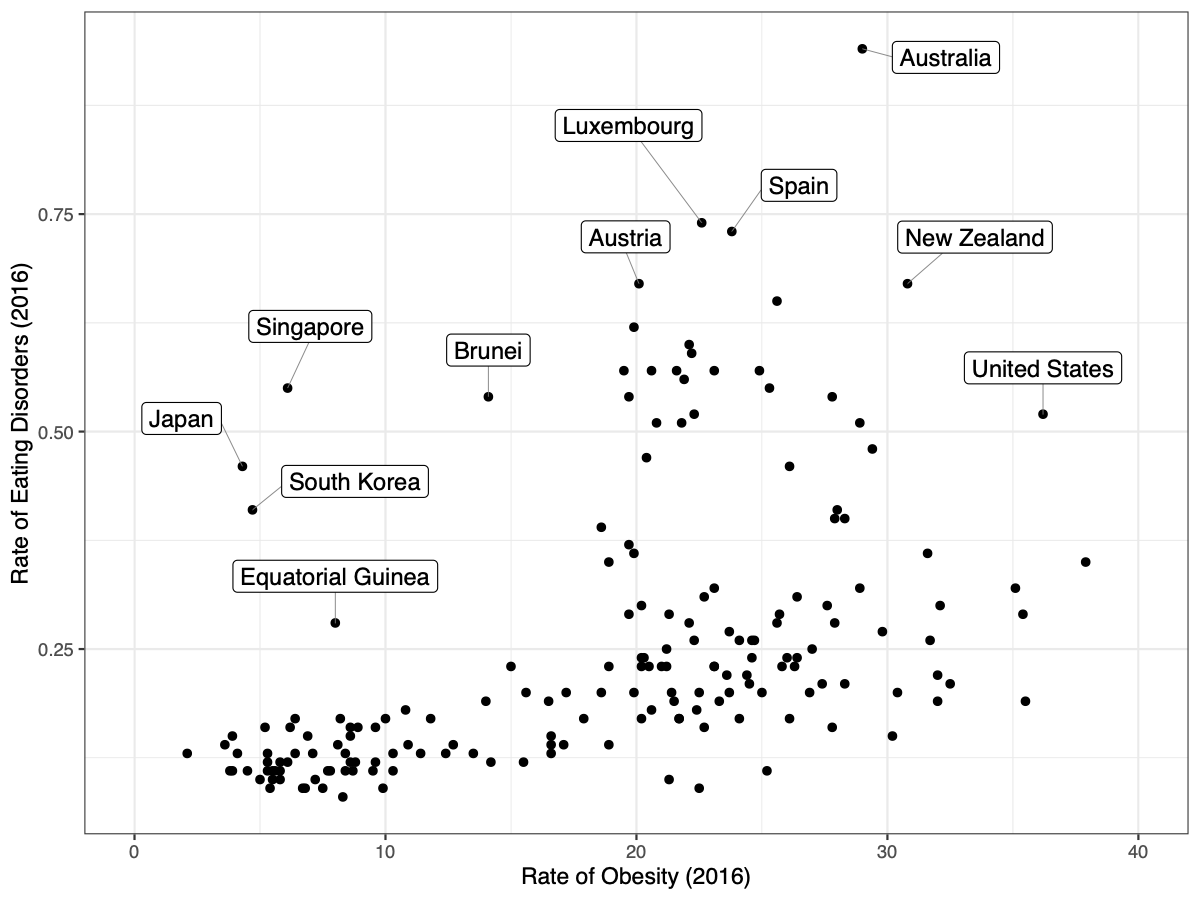
The most obese countries are also the countries with the highest rates of eating disorders. In 2016, rates of eating disorders were correlated with obesity, r = .46, p < .001
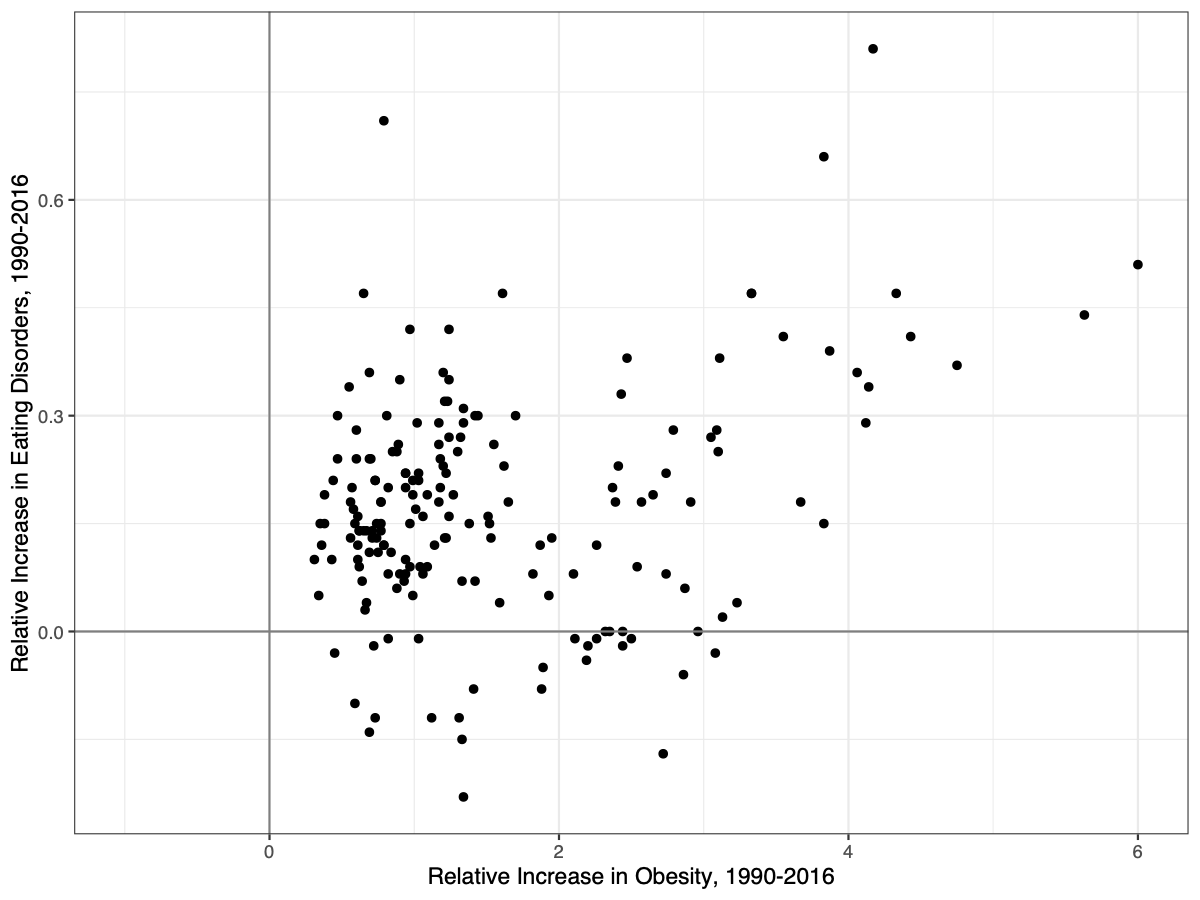
Perhaps most compelling, we find that the rate of change in obesity between 1990 and 2016 is correlated with the rate of change in eating disorders between 1990 and 2016. The correlation is r = .26, p = .0004, and it’s r = .30 if we kick out Equatorial Guinea, an extreme outlier
We even see signs of a paradoxical reaction in some of the contaminants we reviewed earlier. Mice gain weight when exposed to PFOA in-utero, but lose weight when exposed as adults.
In one study of 3M employees, the group with the highest PFOS levels had a higher average BMI, but there were also more more *underweight* employees in this group
In one study of newborn deliveries, obese mothers had babies with higher levels of PFOS than mothers of a healthy weight. But underweight mothers also had babies with higher levels of PFOS. In fact, babies from underweight mothers had the *highest* levels of PFOS exposure.
In addition, there is rare but occasional weight loss seen on therapeutic doses of lithium, such as in this study: sciencedirect.com
Oh yes, the data for both of these analyses are courtesy of @OurWorldInData! Thanks!
We’ve previously reviewed the evidence that animals have gotten more obese over the past several decades. We’ve also argued that anorexia is a paradoxical reaction to whatever causes obesity
If this is true, we should see evidence of anorexia in animals
slimemoldtimemold.com
If this is true, we should see evidence of anorexia in animals
slimemoldtimemold.com
Animals that are more closely related to humans have generally gained the most weight, especially primates, and this makes sense because of the genetic similarity
As a result, it's more likely we'll see signs of anorexia in animals closely related to humans, probably primates
As a result, it's more likely we'll see signs of anorexia in animals closely related to humans, probably primates
This will be slightly tricky! Wild animals that become anorexic probably just die, so they'll never turn up in our data
When pets and zoo animals stop eating, this will usually be recorded as a symptom of something else, rather than as an eating disorder
When pets and zoo animals stop eating, this will usually be recorded as a symptom of something else, rather than as an eating disorder
But we CAN expect to see certain statistical signatures, which may appear even in pretty small datasets
In humans, the obesity epidemic has been matched by an increase in the variance of BMI, which means more people who are overweight AND more people who are underweight
In humans, the obesity epidemic has been matched by an increase in the variance of BMI, which means more people who are overweight AND more people who are underweight
We should expect that animals today will have higher variation of body weights than they did in the past, just like humans do. We can similarly expect that animals that live in captivity will have higher variation of body weights than animals that live in the wild.
A particularly telling sign of this will be that while animals today (or in captivity) will on *average* be fatter than animals in the past (or in the wild), the *leanest* animals will actually be in the modern (or captive) group.
We may not see animals with recognizable anorexia, but we should expect to see animals that are thinner than they would be in the wild, which is presumably thinner than is healthy for them.
We looked around for some data on this and found a 2019 paper from Sterck and colleagues working with long-tail macaques
In this paper, they develop a weight-for-height index which they called WHI2.7, which works a lot like BMI does for humans
In this paper, they develop a weight-for-height index which they called WHI2.7, which works a lot like BMI does for humans

This paper compares a "current" group of macaques living in the lab in 2019 to a "founder" group from the lab 1987-89 and a wild group in Indonesia in 1989
Sure enough, the wild group is the leanest, the founder group somewhat heavier, and the current group fattest of all
Sure enough, the wild group is the leanest, the founder group somewhat heavier, and the current group fattest of all
More interesting is that the wild group has the least variance, the founder group more variance, and the current group the most variance!
When we frame this in terms of standard deviation, we see that the standard deviation more than doubled between wild and current macaques
When we frame this in terms of standard deviation, we see that the standard deviation more than doubled between wild and current macaques

Male macaques are never underweight in these data, so we decided to limit our analysis to females
Based on the WHI2.7 distribution in these data, we calculated that about 0.03% of wild female macaques would be anorexic, compared to a rate of about 0.22% in the current population
Based on the WHI2.7 distribution in these data, we calculated that about 0.03% of wild female macaques would be anorexic, compared to a rate of about 0.22% in the current population


This means that for any reasonable definition of "severely underweight", we should expect to see many more severely underweight macaques in current populations than in wild ones

In short, it’s clear that modern captive macaques have higher rates of anorexia than wild macaques from the 1980s, just the kind of paradoxical reaction this theory predicts
Some readers have asked if demographic factors like income and race/ethnicity can explain any of the patterns we've reviewed in this series.
We think that they can't, not least because income simply doesn't seem to be all that related to obesity.
slimemoldtimemold.com
We think that they can't, not least because income simply doesn't seem to be all that related to obesity.
slimemoldtimemold.com
Let’s talk about some of the new stuff we’ve learned about lithium. For starters, if you work with lithium grease, we recommend you don't eat it.
slimemoldtimemold.com
slimemoldtimemold.com
We've wondered why some countries in the middle east are so obese. A possible answer is that they drink desalinated seawater high in lithium — but we've recently learned that petroleum mining produces brines that can contain 10x, 100x, or even 10,000x more lithium than seawater

What's more, we seem to be very bad at keeping these brines under control
America also produces a lot of oil, and there's a lot of good documentation that we are spilling millions of gallons of these lithium-heavy brines all over the country every year. This seems like bad news
America also produces a lot of oil, and there's a lot of good documentation that we are spilling millions of gallons of these lithium-heavy brines all over the country every year. This seems like bad news
An early and interesting case is the Pima people of the Gila River Valley, a group of Native Americans. They lived (and still live) downstream from improperly sealed abandoned petroleum boreholes that constantly leak salt brines to the surface, and were about 40% obese by 1970
We finally got our hands on a copy of one of the original reports from the 1970s, which found that the Pima had about 100 ng/mL of lithium in their drinking water, which is more than even most modern sources and 50x the average for drinking water in the 1960s

They also report that lithium concentrated specifically in certain crops, in particular the wolfberry, which contained around 1,120,000 ng/mL lithium!
This suggests that we should be concerned that other crops might also concentrate such huge doses, and might still do so today
This suggests that we should be concerned that other crops might also concentrate such huge doses, and might still do so today
The authors even say, "It is tempting to postulate that the lithium intake of Pimas may relate ... to relative physical inactivity and high rates of obesity and diabetes mellitus."
While most of us don’t live near improperly sealed abandoned boreholes, there is a different kind of hole in the ground that many of us interact with every day — the wells we draw our water from.
slimemoldtimemold.com
slimemoldtimemold.com
There are a couple of things that make wells seem kind of suspicious. Back in the day, nobody got their water from deep, drilled wells. Nowadays, millions of people drink well water every single day
The timeline matches pretty well too — most wells have been drilled since 1970
The timeline matches pretty well too — most wells have been drilled since 1970
The USGS notes: “Old groundwater is more likely than young groundwater to have contaminants from natural sources, such as metals and radionuclides, because old groundwater can spend thousands of years in contact with and reacting with aquifer rocks and minerals.”
Similar things have happened with other contaminants. In Bangladesh, people switched from surface water to well water in order to avoid diseases like cholera, but ended up getting exposed to huge amounts of arsenic from their new wells
hrw.org
hrw.org
Historical records from the 1960s and 70s note that back then, water from deep wells had higher levels of lithium than water from other sources. One paper straight up says, "the highest lithium levels were found in deep wells."
This is supported by a new report from the USGS that just came out this year
They find that there are high levels of lithium in US groundwater today, and that there's generally more lithium in deeper wells
usgs.gov
They find that there are high levels of lithium in US groundwater today, and that there's generally more lithium in deeper wells
usgs.gov
Americans are exposed to more lithium now than they used to be. The average level of lithium in US water today is much higher than it was in 1964, and the outliers are more extreme.
We can also compare levels in US drinking water to the levels in other countries
The US has an especially high rate of obesity, and we see that our drinking water contains more lithium than the other countries we have data for — in particular, much more than Japan
The US has an especially high rate of obesity, and we see that our drinking water contains more lithium than the other countries we have data for — in particular, much more than Japan

Well-water isn't the only game in town, because many people still get their drinking water from surface water sources like lakes and rivers
But well-water still concerns all of us — in particular because well water is commonly used to irrigate crops. You eat crops right?
But well-water still concerns all of us — in particular because well water is commonly used to irrigate crops. You eat crops right?

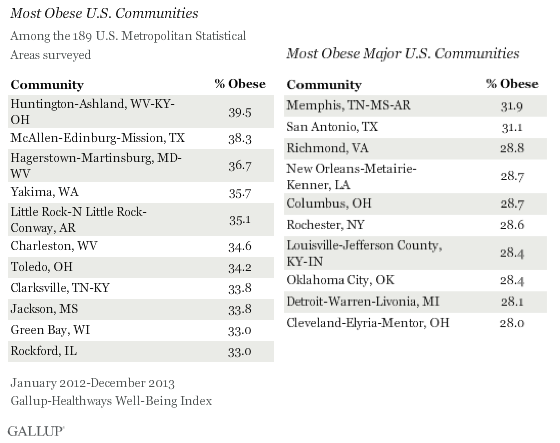
While it's hard to find great numbers on which cities are the most and least obese, there is definitely some variation
If lithium (or something) is responsible for obesity, we should see low levels near lean cities and high levels near obese cities
slimemoldtimemold.com
If lithium (or something) is responsible for obesity, we should see low levels near lean cities and high levels near obese cities
slimemoldtimemold.com
We started with a Gallup report from 2014 that surveyed 189 metro areas around the United States and came up with a list of the most and least obese communities in America. For now, this is our list of most and least obese cities/communities
news.gallup.com
news.gallup.com
In the least obese communities, we found little evidence of lithium contamination. We were able to find drinking water measurements for five of these communities, and in all five, the level of lithium in their drinking water was quite low, with averages around 2 ng/mL.

In the most obese communities, we found abundant evidence of lithium contamination
A common source was contamination from nearby coal power plants
Coal plants maintain groundwater testing wells to monitor contaminants, including lithium, and many of the most obese communities were downriver of plants with testing wells showing lithium levels above 100 ng/mL
Coal plants maintain groundwater testing wells to monitor contaminants, including lithium, and many of the most obese communities were downriver of plants with testing wells showing lithium levels above 100 ng/mL

When it wasn't coal power plants, it was often other fossil fuel sites, such as gas pipelines, brine deposits, or injection wells

Or simply explosions at nearby lithium grease plants:
We're *still* surprised at how well this lines up. We didn't expect cities to matter very much — but based on what we've found, there looks like a pretty strong relationship between obesity rates and lithium contamination in the local water
Assuming you take this theory seriously, what should you do about it? And what should WE do about it?
slimemoldtimemold.com
slimemoldtimemold.com
Our diet advice, just in time for Thanksgiving:
Be nice to yourself. Eat mostly what you want. Trust your instincts.
Don’t be mean to fat people. If you’re fat, don’t be mean to yourself about it. Don’t be a dick.
Be nice to yourself. Eat mostly what you want. Trust your instincts.
Don’t be mean to fat people. If you’re fat, don’t be mean to yourself about it. Don’t be a dick.

Diet and exercise are still important for your health and well-being.
Eat enough that you have energy to do all the things you want to do. Exercise so you can stay fit and capable.
Just don't expect diet and exercise to change your weight more than a couple pounds.
Eat enough that you have energy to do all the things you want to do. Exercise so you can stay fit and capable.
Just don't expect diet and exercise to change your weight more than a couple pounds.
And what if you *do* want to lose weight? Unfortunately, we think there's not much you can do. Obesity increases every year in every country around the world, and every county in the US. The population-level trend is incredibly reliable, and it's hard to fight that.

That said, here are a few suggestions on how you *might* be able to lose weight (read the post for much more detail).
You can put on muscle mass. This won’t affect your weight as it appears on the scale, but it does often seem to affect people’s body composition. If you gain muscle mass, you may lose fat mass.

You can eat more whole foods, fewer animal products, and fewer processed foods. We think these foods probably contain less contamination than average. But of course, if you're trying to lose weight, you've probably tried this one already.

You can change careers. Career is a big source of variance in obesity rates, so if you have a job in a high-obesity profession like truck driver or mechanic, consider switching to a job in a low-obesity profession like teacher or surveyor.

You can change where you live. If you’re in the United States, we recommend Colorado. Colorado is the leanest state, has exceptionally pure water sources, individual cities and counties in Colorado are extreme lean outliers, etc. Unbelievably, this comic exists:

If that's not enough (and it may not be, Colorado is still 20% obese), you can move someplace really lean, like Japan (4%) or Vietnam (2%). This is a big ask, but there's lots of anecdotal evidence that Americans who spend time in these countries really do lose weight.

Right now, that's what we can recommend you do, if you're up for it.
What about what WE should do? Well, we want to do more research, so we can make better recommendations, and (eventually) try to cure obesity once and for all.
What about what WE should do? Well, we want to do more research, so we can make better recommendations, and (eventually) try to cure obesity once and for all.
There are a lot of studies we are considering, so see the full post for details. But here are a few favorites:
SLIME MOLD TIME MOLD’S EXCELLENT ADVENTURE: Send a bunch of people to Colorado, or somewhere further afield like Vietnam, for a year or so, and see if they lose any weight. Any volunteers?

WATER FILTERS: If we find a water filter that removes lithium from drinking water, we can send people the filter and see if they lose weight. The details would be complex, but the idea is simple enough.
(To do this, we would need to first run a study testing different filters)
(To do this, we would need to first run a study testing different filters)

AMISH: The Amish in Ohio are about as obese as everyone else, around 30%. But the Amish in Ontario, not that far away, are only 4% obese. Why is that? Can we find any differences in their water? If you know any Amish people, please send them our way.

There are also some studies that we don't plan to run ourselves, but that we would love to help with if someone else wants to put them together. Here are a few (again see the blog post for full list):
POTATOES: There are a lot of anecdotes of people losing lots of weight on an all-potato diet. But no one has tried running a study on this diet. Potatoes are great, someone should do this. It could be you! DM us if you want to lead this.

ALKALI METALS: We’re interested in the effect of alkali metal ions, especially potassium. Lithium is an alkali metal ion and it seems to mess with other ions in the brain. There are hints that K+ consumption is related to successful weight loss. This is a long shot, but low risk

We’re also interested in advising original ideas. We love it when you send us ideas we never would have come up with ourselves. So if you have some great idea of what to do next, let us know!

That's the end of the series!!! We'll keep doing more work on this but A Chemical Hunger is over! Thank you for reading! 🥳🥳🥳

If you’re interested in supporting this research, you can become a patron on Patreon. If you want to help fund a larger project (maybe one we describe above), please contact us!
patreon.com
patreon.com
"If you like our show, tell everyone but /
If you think it stinks, keep your big mouth shut!"
youtube.com
If you think it stinks, keep your big mouth shut!"
youtube.com
Loading suggestions...