

Last week, we discussed the history of one of the 🌏 most 🌎 widely 🌍 used English Qur'an translations. But what about its ideological background? And how does the early 1977 edition of the Hilali-Khan translation differ from later revisions? #qurantranslationoftheweek
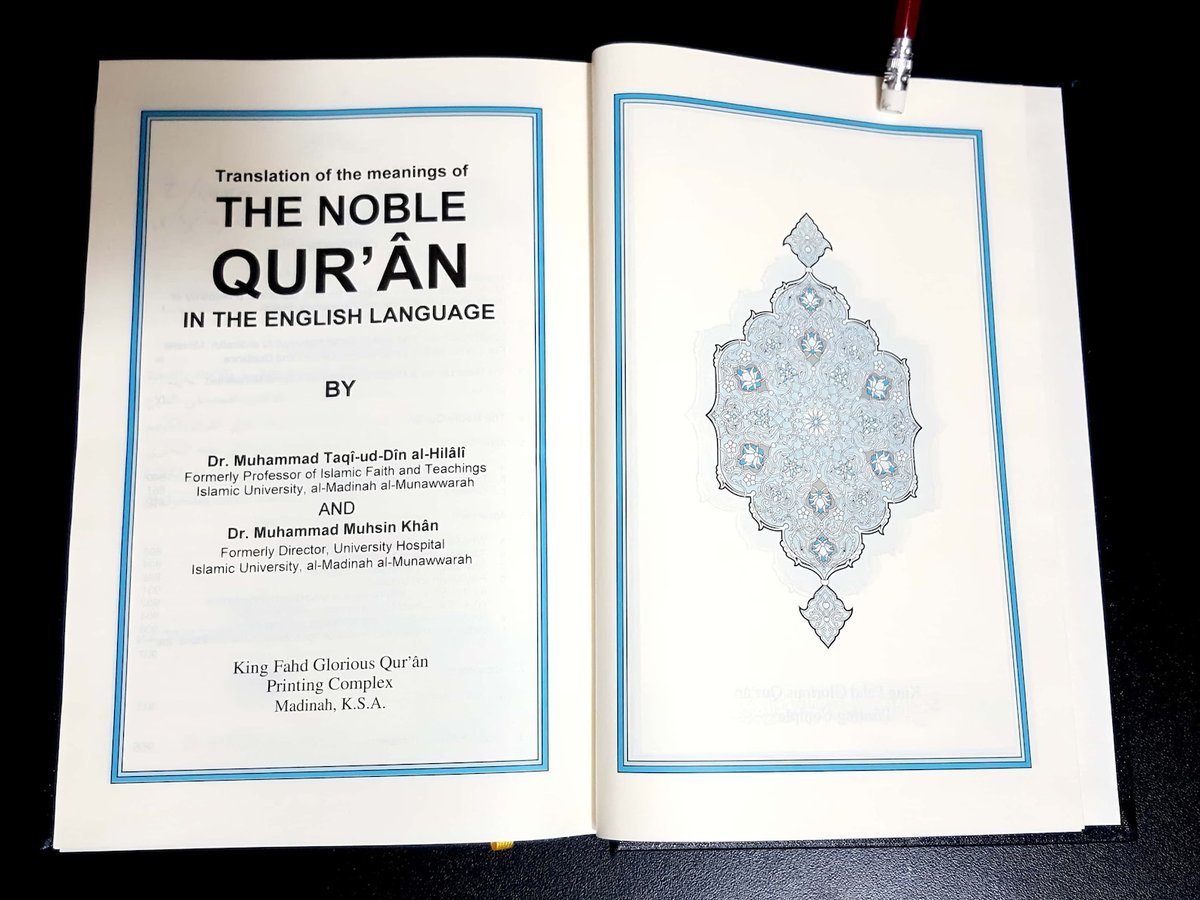
First of all, the English text of 1977 is almost completely free from the inclusion of Arabic glosses, i.e. transliterated Arabic words inserted in brackets, with only very few exceptions.
Consider, for example, Q 2:43. In both the 1977 and 1978 editions, one may read: 'And offer the prayer perfectly and give the obligatory charity (Zakat) …
… and submit yourselves with obedience to Allah (with Muhammad a.s.) as the Muslims have done (i.e. embrace Islam, worshipping none but Allah alone and doing good with the only intention of seeking Allah’s Pleasure).'
In the 1997 KFQPC edition, we instead have the following amended translation, with commentary appended as a footnote:
‘And perform Aṣ-Ṣalāt (Iqāmat-aṣ-Ṣalāt), and give Zakāt, and bow down (or submit yourselves with obedience to Allāh) along with Ar-Rāki‘ūn’.
‘And perform Aṣ-Ṣalāt (Iqāmat-aṣ-Ṣalāt), and give Zakāt, and bow down (or submit yourselves with obedience to Allāh) along with Ar-Rāki‘ūn’.
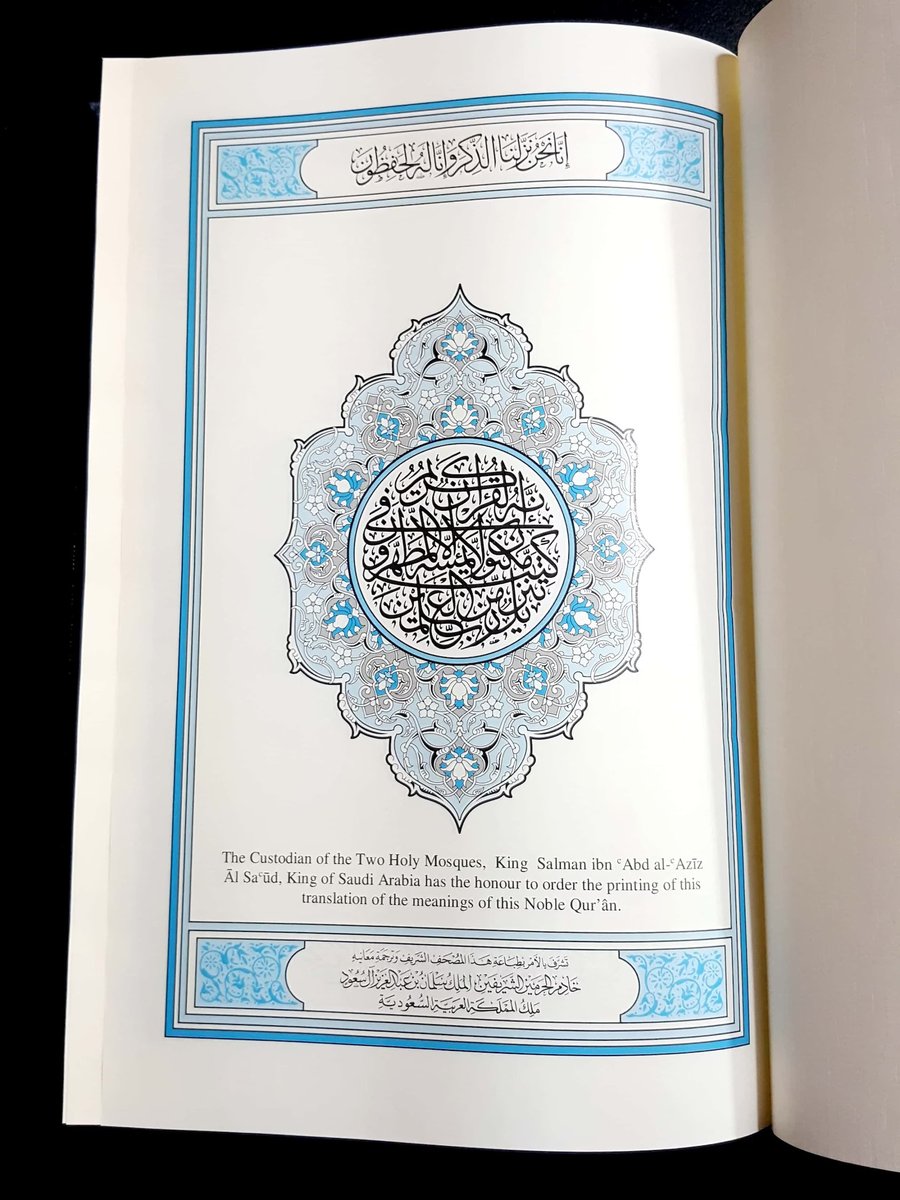
Later editions have made the text even more complicated, not only by using Arabic words to retranslate (or reinterpret) the basic Qur’anic vocabulary, but also by adding plenty of explanation in brackets, thereby erasing the line between the ‘translation’ and the ‘commentary’.
For example, the 1977/1978 editions translate Q 24:36 as follows:
‘In houses which Allah has ordered to be raised, to be cleaned, and to be honoured, in them His Name is glorified in the mornings and in the evenings’.
‘In houses which Allah has ordered to be raised, to be cleaned, and to be honoured, in them His Name is glorified in the mornings and in the evenings’.
The later editions introduce many changes to the target text:
‘In houses (mosques) which Allâh has ordered to be raised (to be cleaned, and to be honoured), in them His Name is remembered [i.e. Adhan, Iqamah, Salât (prayers), invocations, recitation of the Qur’ân etc.]. …
‘In houses (mosques) which Allâh has ordered to be raised (to be cleaned, and to be honoured), in them His Name is remembered [i.e. Adhan, Iqamah, Salât (prayers), invocations, recitation of the Qur’ân etc.]. …
… Therein glorify Him (Allah) in the mornings and in the afternoons or the evenings’.
Here we see the insertion of comments explaining that the verse describes only Muslim religious practice, which is not apparent in the early editions.
Here we see the insertion of comments explaining that the verse describes only Muslim religious practice, which is not apparent in the early editions.
For example, the early editions had given ‘houses’ for the original Arabic ‘buyūt’, without adding that, in the context, this actually refers to mosques that issue the call to prayer.
The first editions also contain traces of the ‘scientific hermeneutics’ of the Qur’an, which was quite a popular trend in the Muslim world in the 1970s.
For example, for the Arabic word ‘yawmayn’ (lit. ‘two days’) in Q 41:9, the first edition provides ‘Do you verily disbelieve in Him Who created the earth in two Days (Periods)?’, while the later KFQPC edition removes the word ‘Periods’, thus reducing the meaning to just ‘days’.
This reflects a particular ideological stance, as modern Salafi hermeneutics considers any interpretation of the Qur’an in the light of contemporary science to be merely controversial ‘pseudo-rationalism.’
Such ideological differences are even more visible in the respective translations of the word ‘al-burūj’ from the phrase ‘wa ’l-samāʾi dhāti ’l-burūj’ in Q 85:1.
The first editions render this as ‘By the heaven holding the Zodiacal Signs of the Stars’, while the later KFQPC edition simply provides ‘By the heaven holding the big stars’.
It was Ibn Kathīr who explained ‘al-burūj’ as ‘al-nujūm al-ʿaẓẓām’ (‘the big stars’). It seems that his opinion was not taken into account in the interpretation of this phrase in the first editions, but became influential in the later two editions.
Thus we can see that the Darussalam editors here proposed a ‘more convenient’ (at least in terms of Salafi hermeneutics) meaning, which was later affirmed by the KFQPC translation.
Probably the most illustrative (and controversial) case is that of Q.1:7, ‘ṣirāṭa ’lladhīna anʿamta ʿalayhim ghayri ’l-maghḍūbi ʿalayhim wa-lā ’l-ḍāllīn’ (‘the Path of those You have blessed, those who earned Your Anger, and not those who went astray’).
The main question here is who is intended by the expressions ‘those who earned Your Anger’ (‘maghḍūbi ʿalayhim’) and ‘those who went astray’ (‘ḍallīn’).
In classical tafsirs it is quite common to interpret this as referring to ‘Jews and Christians’ and, in the first 1977/1978 translations, the groups mentioned are likewise referred to as ‘Jews and Christians’.
The same interpretation appears in the first KFQPC edition of 1997.
The same interpretation appears in the first KFQPC edition of 1997.
Later editions (2019 and onwards) made this formula less specific: ‘… not (the way) of those who earned Your Anger (i.e. those who knew the Truth, but did not follow it) nor of those who went astray (i.e. those who did not follow the Truth out of ignorance and error)’.
In the same vein, while the first editions of the translation contained a treatise on jihād as a kind of appendix, the later KFQPC edition replaces this with doctrinal appendices on Sunni-Salafi theology (on subjects such as the ‘true’ meaning of ‘shahādah’, etc.).
In some ways, this shows a kind of evolution in Salafi tradition. In the late 1970s and 1980s, the idea of military jihād may not have been perceived in the West as completely unacceptable (due primarily to support for anti-Soviet Islamic movements).
However, the world in the 1990s and, especially, the first decade of this century, has changed significantly. It is thus no coincidence that in his original introduction, al-Hilālī mentions an anti-Soviet Uzbek fighter he met years ago in Afganistan…
… who used only Arabic as the language of the Qur’an and also prohibited his family members from talking in Russian, designating it as a language of enemy.
Warmly accepted by many readers and critically evaluated by others, the Hilali-Khan translation eventually played quite an important role in the rise of Salafi exegesis among a non-Arab readership, and even more so in promoting the extensive use of tafsīr in translation.
Still used as a main reference by a large number of English-speaking Salafi Muslims (and elsewhere in the mainstream Sunni community), its wide availability and extensive use of tafsīr sources marked a very important turn in Qur’anic Studies.
Many critical voices (especially from among Muslim scholars) have, however, spoken out over the last few decades, and these have seriously challenged the popularity of this work.
Due in no small part to such criticism, and with the appearance of new translations, it will hardly continue to retain the predominance it had ten or twenty years ago. ~ MY ~ #qurantranslationoftheweek
Loading suggestions...