

ANCIENT GREEK ATHLETIC TRAINING
Olympiads, Hoplites, and how they attained their physiques & physical prowess.
Thread (1/)
Olympiads, Hoplites, and how they attained their physiques & physical prowess.
Thread (1/)


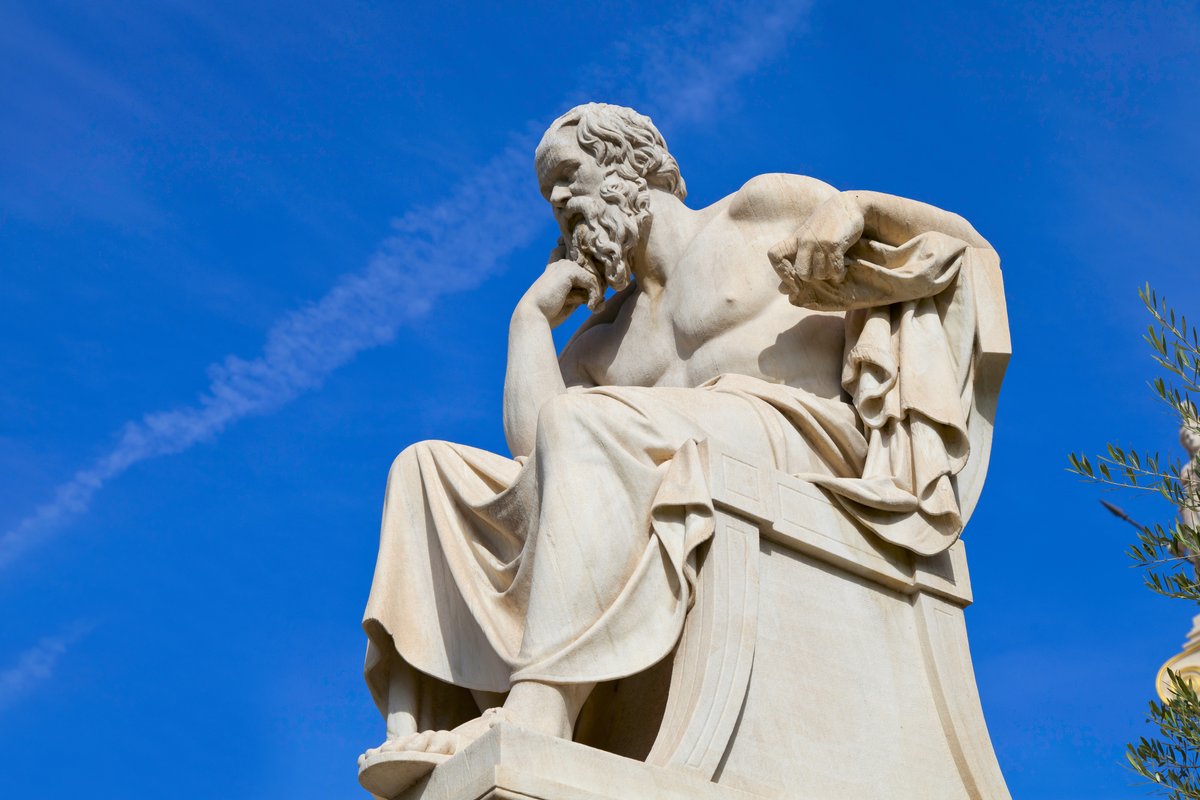
A famous quote from Socrates:
"It is a shame for a man to grow old without seeing the beauty and strength of which his body is capable."
"It is a shame for a man to grow old without seeing the beauty and strength of which his body is capable."
And another:
"No citizen has any right to be an amateur in the matter of physical training: it is part of his profession as a citizen to keep himself in good condition, ready to serve his state at a moment's notice."
"No citizen has any right to be an amateur in the matter of physical training: it is part of his profession as a citizen to keep himself in good condition, ready to serve his state at a moment's notice."

The Greeks held physical prowess in high regard, and readiness for war was a requirement for all citizens of Athens (& other cities).
Athletic training began young and continued throughout life. Olympians regularly competed well into their 30s, 40s, even 50s.
Athletic training began young and continued throughout life. Olympians regularly competed well into their 30s, 40s, even 50s.
Examples:
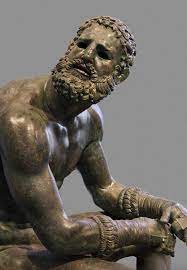
-Theagenes of Thasos won over 1300 bouts of boxing & pankration over a 22-year career.
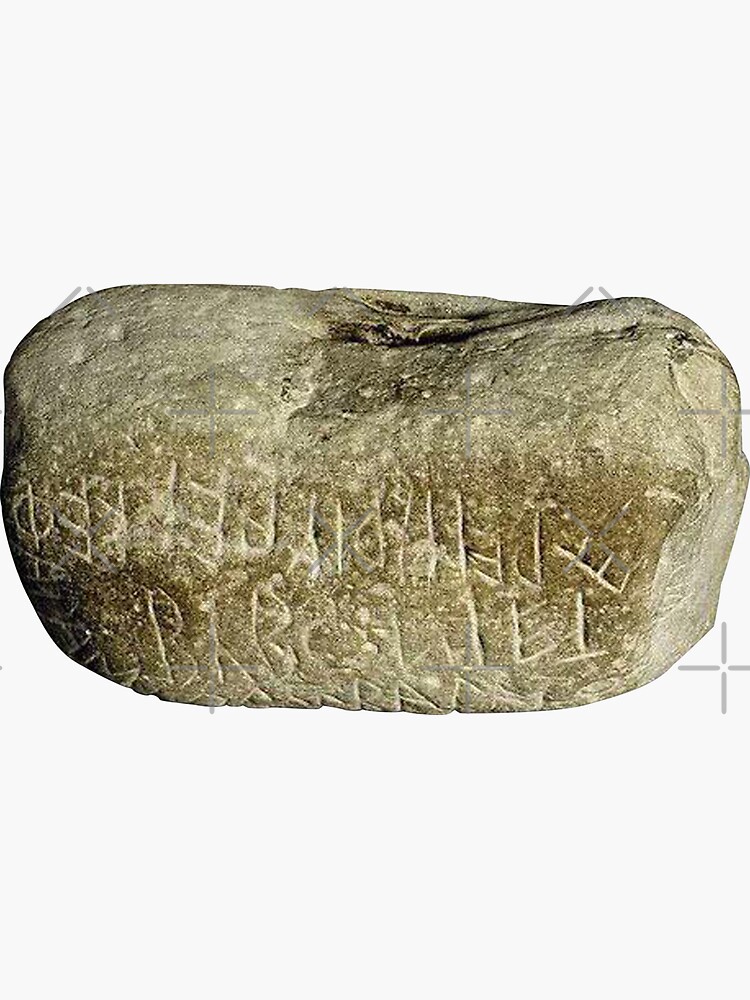
-A 316-lb rock was found engraved with "Bybon, son of Phola, has lifted me over his head with one hand."
These athletic feats are unfathomable by modern standards.
-Theagenes of Thasos won over 1300 bouts of boxing & pankration over a 22-year career.
-A 316-lb rock was found engraved with "Bybon, son of Phola, has lifted me over his head with one hand."
These athletic feats are unfathomable by modern standards.
But how did the Greeks attain such athletic prowess? The Spartans had the agoge, detailed in the thread below.
But otherwise, athletic training occurred in the Ephebic College and gymnasiums.
But otherwise, athletic training occurred in the Ephebic College and gymnasiums.
The Greek conception of athletic training is very different than modern thought. I'll go into those differences, but let's discuss similarities first.
The Greeks shared one concept in particular with modern athletes: the training split.
The Greeks shared one concept in particular with modern athletes: the training split.
The most popular "split", called the Tetrad, was described by Philostratos. It is a 4-day split, alternating rest with activity.
1. HIIT-style exercises; "preparation" for Day 2.
2. All-out, full-body, intense effort.
3. Rest, mostly.
4. Medium-intensity & technical work.
1. HIIT-style exercises; "preparation" for Day 2.
2. All-out, full-body, intense effort.
3. Rest, mostly.
4. Medium-intensity & technical work.
Another concept shared with modern athletic training is progressive overload.
This is best exemplified by Milo of Croton, a legendary athlete who was said to have carried a calf every day as it grew into an ox.
He then carried it to the Olympics, slaughtered it, and ate it raw.
This is best exemplified by Milo of Croton, a legendary athlete who was said to have carried a calf every day as it grew into an ox.
He then carried it to the Olympics, slaughtered it, and ate it raw.

However, the actual exercises undertaken by Greek athletes and military trainees are largely different from modern workouts.
Anecdotal examples include chasing or wrestling animals, climbing trees, pulling carts, and swimming in full battle armor (28-70 lbs).
Anecdotal examples include chasing or wrestling animals, climbing trees, pulling carts, and swimming in full battle armor (28-70 lbs).
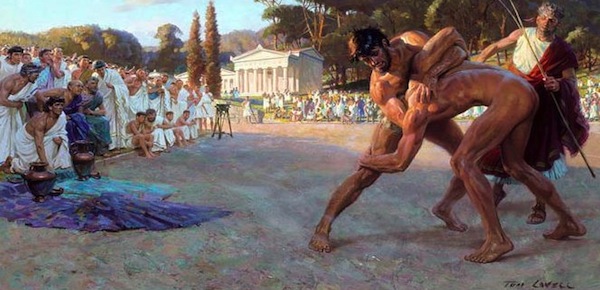
Common exercises included running (especially on sand), sparring in wrestling & boxing, lifting heavy stones, etc.
Many rocks with handles have been found at gymnasium sites, for use as dumbbells.
Many rocks with handles have been found at gymnasium sites, for use as dumbbells.

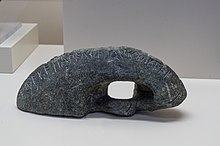
The exercises described boil down to a few categories:
1. Strength training via compound lifts of unwieldy, large objects such as boulders
2. Longform cardio (runs, hikes, swimming) & sprints
3. Agility and technique exercises (think Rocky chasing chickens)
4. Sparring.
1. Strength training via compound lifts of unwieldy, large objects such as boulders
2. Longform cardio (runs, hikes, swimming) & sprints
3. Agility and technique exercises (think Rocky chasing chickens)
4. Sparring.
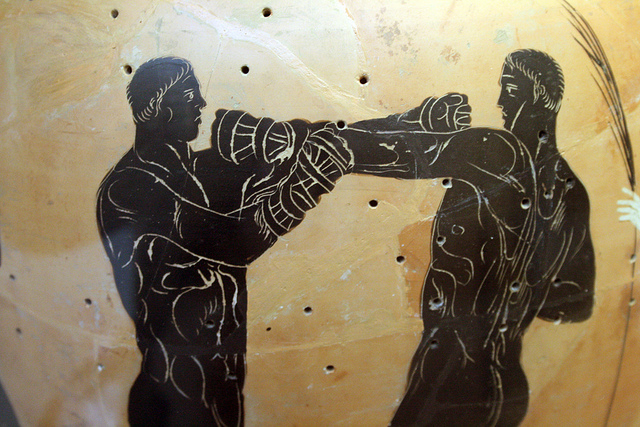
Anecdote about Greek mental frame regarding sports:
The Thebeans conceptualized sport in three categories: weight lifting, wrestling and gymnastics. Theseus himself posited that a well-rounded education in these would produce complete athletes (and therefore good warriors).
The Thebeans conceptualized sport in three categories: weight lifting, wrestling and gymnastics. Theseus himself posited that a well-rounded education in these would produce complete athletes (and therefore good warriors).
Also: for military training, extensive drilling would have been a major factor, in full armor. Fighting as a hoplite in a phalanx required high-level coordination and organization, but practicing formation tactics would be an intense exercise as well.
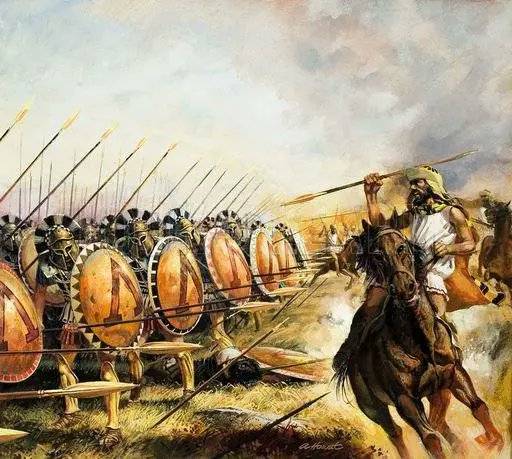
The war-focused nature of athletic pursuits is best exemplified by the hoplitodromos, a ~400m race in full armor with a heavy shield.
A pole would have to be placed at turns in the track so competitors could swing themselves around the hairpin curve.
A pole would have to be placed at turns in the track so competitors could swing themselves around the hairpin curve.

The end result of practicing athletics was always preparation for war. Citizens were expected to be able to wage war as a matter of course; when a campaign began, they simply rallied without any further training needed.
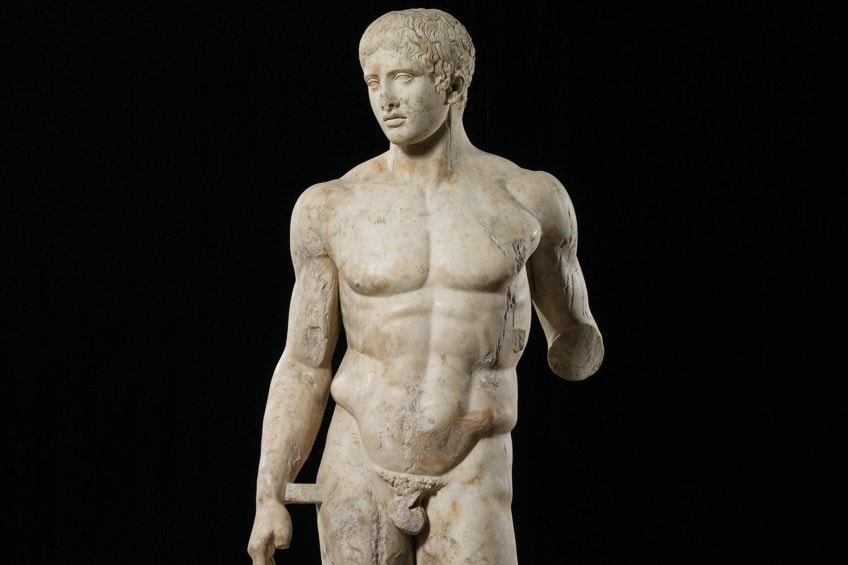
The ideal physique for a youth training for warfare is best exemplified by the Doryphoros statues.
Muscular, yet not bulky. Agile. Broad in the shoulders and in the waist. Strong lower body and core. Built by and for armored combat and compound lifts.
Muscular, yet not bulky. Agile. Broad in the shoulders and in the waist. Strong lower body and core. Built by and for armored combat and compound lifts.
The result of this training and athletic culture was twofold:
1. Incredible athletes, with a culture of competition as a way to honor the gods.
2. A populace of unmatched warriors, capable of unfathomable physical feats (such as those of the Battle of Marathon).
1. Incredible athletes, with a culture of competition as a way to honor the gods.
2. A populace of unmatched warriors, capable of unfathomable physical feats (such as those of the Battle of Marathon).
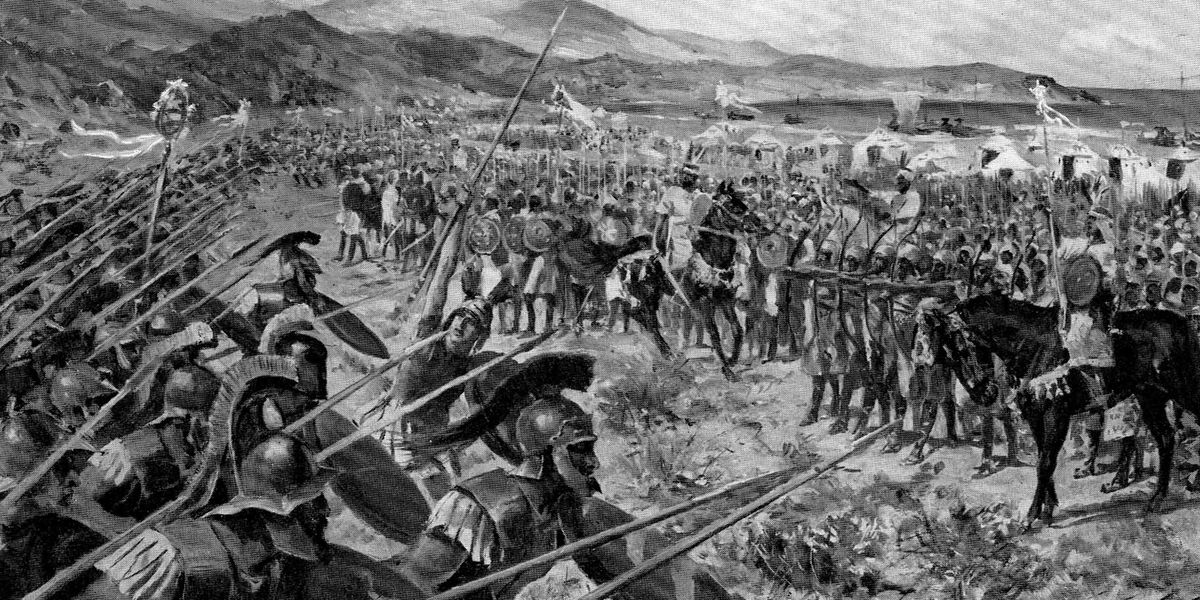
It is also worth noting that the Greeks considered intellectual development to be key to physical development.
Training was integrated with lectures, discussions, reading. Morality, virtue, and beauty were integral to their training philosophy.
Training was integrated with lectures, discussions, reading. Morality, virtue, and beauty were integral to their training philosophy.
As always with topics like this, I recommend @corsair21c's book King of All Things. It heavily inspired and informed this thread.
I also referenced primary sources (namely Philostratos' Gymnasticus) and the journal article linked below.
doi.org
I also referenced primary sources (namely Philostratos' Gymnasticus) and the journal article linked below.
doi.org

Also, this thread is by no means a complete source. It barely skims the surface. I'm planning on uploading a longform piece (~10k words?) to my substack about warrior training throughout the pre-firearm era, highlighting a few cultures (+ more threads).
Loading suggestions...