
Health
Medical
Healthcare
Critical Care
Medical Research
Medicine
intensive care
Ventilator Management

ICU (evolving) stories: A young patient was admitted with "aspiration pneumonia" a few days ago. On mechanical ventilation. Afebrile. Negative cultures. CXR when you first see him (ET tube a bit deep, by the way):

You take a look at the ventilator screen. Patient on assist/volume control, 25 breaths, Vt 300 cc, FiO2 80%, PEEP 5.

U are a strong believer of guideline-directed medical therapies (GDMT). U know that following the PEEP table - as used in the ARDSnet study (NEJM 2004; 351(4): 327-36.
doi: 10.1056/NEJMoa032193) - is a well-tested way to set PEEP. For FiO2 of 80%, the recommended PEEP is:
doi: 10.1056/NEJMoa032193) - is a well-tested way to set PEEP. For FiO2 of 80%, the recommended PEEP is:
The ARDSnet/ALVEOLI study had a "low" and a "high" PEEP group (with similar outcomes; rates of death before hospital discharge were 24.9% and 27.5%, respectively; P=0.48):

So, now what PEEP would you choose?
It's a good idea to gather some information about the lung mechanics, especially in really sick ARDS patients. You don't have to be very fancy. A plateau pressure is important to be checked. Let's try at the set PEEP level of 5:
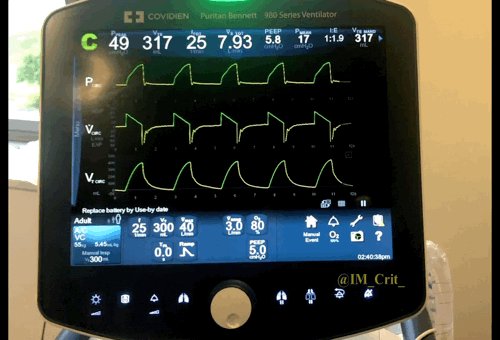
Plateau is 45 at PEEP of 5... Increasing PEEP to even 8 was bringing the Ppl > 50. What happens if the PEEP level is decreased to < 5? I know, you think it's crazy for a bad ARDS to be ventilated with a PEEP of 3, right?
A PEEP level decrease of 2 points was leading to decrease of Ppl of 8 points (from 45 to 37). Overdistention, maybe? Still terrible plateau & driving pressure (> 30... 🤦♂️). Did I mention that patient was already prone/paralyzed & had normal intra-abd pressure? Very tough case...
Take-home message:
Patients do not read textbooks and guidelines. And even if they read them, they do whatever they like... Blind application of guidelines and algorithms is ill-advised...
@msiuba has a nice discussion about setting PEEP.
Thanks for reading!
Patients do not read textbooks and guidelines. And even if they read them, they do whatever they like... Blind application of guidelines and algorithms is ill-advised...
@msiuba has a nice discussion about setting PEEP.
Thanks for reading!
Loading suggestions...