

HOW TO: Hack your sleep
Sleep is the backbone of a healthy life.
But I bet you aren’t getting nearly enough high-quality, restful sleep.
Here’s how to build an OPTIMIZED SLEEP STACK and get the best sleep of your life 🧵👇
#supplements #biohacking
Sleep is the backbone of a healthy life.
But I bet you aren’t getting nearly enough high-quality, restful sleep.
Here’s how to build an OPTIMIZED SLEEP STACK and get the best sleep of your life 🧵👇
#supplements #biohacking
Many people do not get enough high quality, restful sleep due to a variety of factors like a busy schedule, work stressors, a weak immune system, an unhealthy diet, or poor sleep hygiene.
Sleep is essential for weight management, productivity, skincare, immune response, mood, cognition, and general health & wellbeing.
In this thread we’ll build a sleep module that you can layer on top of the Healthy Living protocol we discussed yesterday. This is the exact sleep stack I’ve used to eliminate my insomnia.
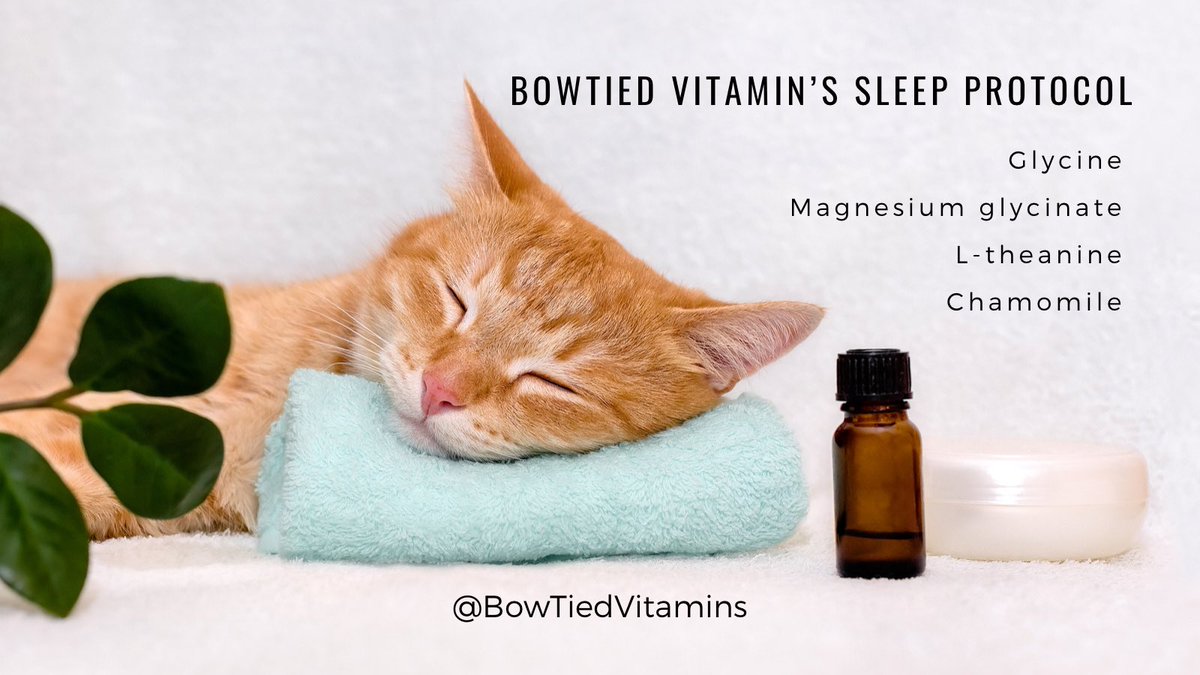
This sleep stack includes:
Glycine
Magnesium glycinate
L-theanine
Chamomile
Let’s begin:
This sleep stack includes:
Glycine
Magnesium glycinate
L-theanine
Chamomile
Let’s begin:
1. Glycine
Glycine is an amino acid that your body uses to make proteins. It’s the main ingredient in collagen, which is the most abundant protein in the body and provides strength for muscles, skin, hair, joints, etc.
Glycine is an amino acid that your body uses to make proteins. It’s the main ingredient in collagen, which is the most abundant protein in the body and provides strength for muscles, skin, hair, joints, etc.
It’s also a major component of creatine and glutathione, which is a powerful antioxidant that protects cells against damage from free radicals.
Glycine has a calming effect on the brain & can help you fall asleep by lowering your core temperature.
Glycine has a calming effect on the brain & can help you fall asleep by lowering your core temperature.
2. Magnesium glycinate
Magnesium is one of the most important micronutrients and it should already be included in your base layer stack. You can either switch your base layer mag to mag glycinate or you can split your intake between glycinate and another form of your choice.
Magnesium is one of the most important micronutrients and it should already be included in your base layer stack. You can either switch your base layer mag to mag glycinate or you can split your intake between glycinate and another form of your choice.
Magnesium plays a critical role in a ton of bodily functions, including: synthesizing proteins, nerve function & muscle contraction, regulating blood sugar & insulin sensitivity, energy production, managing blood pressure, controlling neurons & assisting in vitamin D activation.
You get the point. It’s important stuff.
Magnesium glycinate is one of the most well tolerated and easily absorbed forms.
Research suggests that 50% of Americans are magnesium deficient. A lack of magnesium can disrupt your circadian rhythm and the function of melatonin.
Magnesium glycinate is one of the most well tolerated and easily absorbed forms.
Research suggests that 50% of Americans are magnesium deficient. A lack of magnesium can disrupt your circadian rhythm and the function of melatonin.
3. L-theanine
L-theanine is an amino acid that is abundant in tea leaves. It is commonly used to treat sleep disturbance, improve non-REM sleep & reduce psychological stress. It can help you fall asleep more quickly and improve the quality of your sleep.
L-theanine is an amino acid that is abundant in tea leaves. It is commonly used to treat sleep disturbance, improve non-REM sleep & reduce psychological stress. It can help you fall asleep more quickly and improve the quality of your sleep.
L-theanine reduces levels of chemicals in the brain that are linked to stress & anxiety, especially glutamate. Studies suggest that L-theanine exerts its relaxant effect by enhancing GABA levels, thereby increasing the expression of dopamine & serotonin in the brain.
4. Chamomile
Chamomile is an herb that’s been consumed for hundreds of years for various health conditions. It’s loaded with antioxidants that may lower your risk of several diseases, including heart disease & cancer.
Chamomile is an herb that’s been consumed for hundreds of years for various health conditions. It’s loaded with antioxidants that may lower your risk of several diseases, including heart disease & cancer.
Chamomile contains apigenin, which is an antioxidant that binds to receptors in your brain that promote sleepiness & reduce insomnia.
There is even some evidence that chamomile may reduce the severity of anxiety & depression.
There is even some evidence that chamomile may reduce the severity of anxiety & depression.
Now, let’s talk about a sleep supplement that you SHOULDN’T take:
Melatonin
Melatonin is a body clock regulator, NOT a sleep initiator. It will tell your brain that it’s time to fall asleep, but it won’t increase your sleep drive or need for sleep.
Melatonin
Melatonin is a body clock regulator, NOT a sleep initiator. It will tell your brain that it’s time to fall asleep, but it won’t increase your sleep drive or need for sleep.
Insomnia is not caused by melatonin deficiency. If you are having trouble falling asleep at night, it’s not because your brain doesn’t know it’s bedtime.
Several studies have shown that melatonin DOES NOT significantly improve sleep time or reduce time it takes to fall asleep.
Several studies have shown that melatonin DOES NOT significantly improve sleep time or reduce time it takes to fall asleep.
Melatonin DOES induce a drowsy stupor because it’s a stress hormone that works to counterbalance cortisol — this is why you don’t feel rested after taking melatonin.
Limited research suggests it may be useful in remedying jet lag, but that’s about it.
Limited research suggests it may be useful in remedying jet lag, but that’s about it.
There are lots of other ways you can hack your sleep:
• use a weighted blanket
• cool the room to 65 degrees
• avoid screens for 1 hour before bed
• only use your bed for sleep & sex
• no caffeine after 12pm
I highly recommend following @BowTiedShrew for more sleep tips.
• use a weighted blanket
• cool the room to 65 degrees
• avoid screens for 1 hour before bed
• only use your bed for sleep & sex
• no caffeine after 12pm
I highly recommend following @BowTiedShrew for more sleep tips.
Add this sleep module to your supplement stack to get deeper, more restful sleep. It worked for me after years of battling insomnia.
You’ll find that better sleep has a positive impact on almost every aspect of your life.
Sleep well, anon 😴
You’ll find that better sleep has a positive impact on almost every aspect of your life.
Sleep well, anon 😴
If you found this thread helpful, please like and retweet the first tweet to help spread the word.
And don’t forget to smash that ‘follow’ button for more helpful tips on how to optimize your life!
#supplements #vitamins #health #wellness #biohacking #nutrition #fitness
And don’t forget to smash that ‘follow’ button for more helpful tips on how to optimize your life!
#supplements #vitamins #health #wellness #biohacking #nutrition #fitness
Loading suggestions...