

This is a common tactic/belief.
The problem? It backfires more often than succeeds.
I researched it & covered it in my book. More often:
It's not the tough ones that stick around; it's the ones who have no other options.
Let's look at some history and research:
The problem? It backfires more often than succeeds.
I researched it & covered it in my book. More often:
It's not the tough ones that stick around; it's the ones who have no other options.
Let's look at some history and research:
Take one of the foundational "hell week" training camps in sport: The Junction Boys.
Paul Bear Bryant took over Texas A&M and put his team through a crazy training camp.
The team went from nearly 100 down to around 30.
Paul Bear Bryant took over Texas A&M and put his team through a crazy training camp.
The team went from nearly 100 down to around 30.
The popular myth went that the strong survived, and that's what led them to success.
But...it's not what really happened.
They were 1-9 that year...
But...it's not what really happened.
They were 1-9 that year...
The people who stayed weren't tougher; they had no other choice.
Jack Pardee echoed a familiar refrain for those who made it through camp: "I never thought about quitting… If I did, where would I go?"
Bobby Drake Keith summed it up:
Jack Pardee echoed a familiar refrain for those who made it through camp: "I never thought about quitting… If I did, where would I go?"
Bobby Drake Keith summed it up:
"A lot has been made about the ones who stuck it out being stronger. But I think most of us survived because football was important to us for whatever reason, & it was in our nature to do whatever we had to do to stay on the team and stay in school. Our instinct was survival."
The "quitters" on that team included players who would quit and go on to play in the NFL, switch sports and win conference in baseball, and go on to become literal war heroes in the military.
They had options. So they left. They weren't weak...
They had options. So they left. They weren't weak...
Two years later, they finally had success, going 9-0, but only 8 players remained from that camp.
The reality is, Bryant got better recruits and changed some of his coaching tactics.
The reality is, Bryant got better recruits and changed some of his coaching tactics.
Even Bryant recognized his mistakes as a young coach. Years later he remarked:
"If it had been me, I'd have quit a dozen times, but they never quit. I didn't know if I was doing it right or not, but it was the only way I knew how to do it."
"If it had been me, I'd have quit a dozen times, but they never quit. I didn't know if I was doing it right or not, but it was the only way I knew how to do it."
Or perhaps most illustratively, when Bryant discussed the star recruit who flamed out under his watch for not coaching/treating him right...
He later wrote a letter explaining how he was sorry and he'd learned and grown as a coach:
He later wrote a letter explaining how he was sorry and he'd learned and grown as a coach:
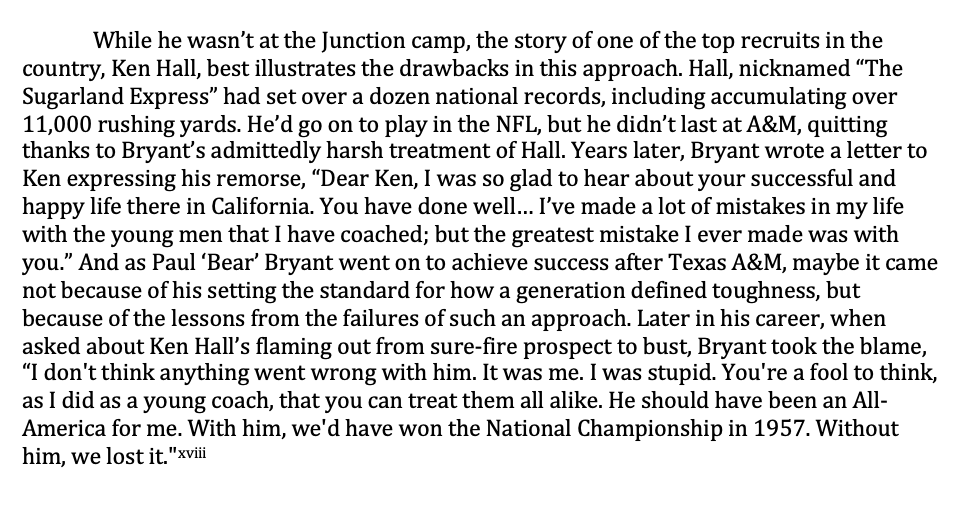
While this is just one story, and I dive into the research in depth in my book, I love Bryant's story because it illustrates growth.
Bryant thought camps from hell and weeding out the weak were the solution. But he learned and grew as a coach to find a better way.
Bryant thought camps from hell and weeding out the weak were the solution. But he learned and grew as a coach to find a better way.
The same applies in the highest level of sport.
A few years ago, researchers studied the impact of a coach on performance in the NBA.
semanticscholar.org
A few years ago, researchers studied the impact of a coach on performance in the NBA.
semanticscholar.org
They found that having an "abusive leader" as a coach changed the trajectory of players' careers.
They had more technical fouls and worse performance over the trajectory of their career. Even when that player had moved on to a different coach.
They had more technical fouls and worse performance over the trajectory of their career. Even when that player had moved on to a different coach.
The authoritarian parent style seems to create the appearance of discipline without actually fostering it.
The same goes for the hardass coach.
Leading by fear and punishment creates the facade of respect, buy-in, and discipline.
It's short-lived.
The same goes for the hardass coach.
Leading by fear and punishment creates the facade of respect, buy-in, and discipline.
It's short-lived.
The "hardass" all-the-time approach runs counter to most of our basic motivational needs.
Over time, you erode self-motivation and have to replace it with something else, or else you lose people.
That something else is often more extrinsic motivation.
Over time, you erode self-motivation and have to replace it with something else, or else you lose people.
That something else is often more extrinsic motivation.
So what works?
Human motivation is simple. Self Determination Theory boils it down to 3 basic needs:
1. Feel like you belong
2. Feel like you can make progress
3. Feel like you have some control over your life and the pursuit (autonomy)
Human motivation is simple. Self Determination Theory boils it down to 3 basic needs:
1. Feel like you belong
2. Feel like you can make progress
3. Feel like you have some control over your life and the pursuit (autonomy)
If you fulfill those, you boost intrinsic motivation.
This is often the hard path. It takes time to develop buy in.
The easy path is to try to force buy-in. It's quick, and takes little knowledge. Just power.
But it fails over the long haul.
This is often the hard path. It takes time to develop buy in.
The easy path is to try to force buy-in. It's quick, and takes little knowledge. Just power.
But it fails over the long haul.
Addition based on comments:
The few places the authoritarian approach 'works' it's because of:
1. A big dream/mission supersedes the poor environment (i.e. I'll put up with it for a bit to get to mars/win super bowl)
Generally, these fall apart once the big motivator is gone
The few places the authoritarian approach 'works' it's because of:
1. A big dream/mission supersedes the poor environment (i.e. I'll put up with it for a bit to get to mars/win super bowl)
Generally, these fall apart once the big motivator is gone
2. When employees have little choice.
Bobby Knight's approach worked in the 70s, 80s, etc. because college athletes had little autonomy. It was hard to transfer, to have a say, so you tolerated.
Once that artificial barrier is lifted...people leave for better opportunities.
Bobby Knight's approach worked in the 70s, 80s, etc. because college athletes had little autonomy. It was hard to transfer, to have a say, so you tolerated.
Once that artificial barrier is lifted...people leave for better opportunities.
In Musk's case, he made the mistake of looking at past success where the mission/purpose/vision was clear and superordinate (i.e. go to Mars) so it kept some highly driven around tolerating the 'hardcore'
Twitter is not transformative. And he hasn't outlined that vision.
Twitter is not transformative. And he hasn't outlined that vision.
So what you're seeing is Twitter isn't keeping the superstars. It's keeping those who need the Visa or have few options, or maybe are just Musk superfans.
At the end of the day, talent is king in any organization or team.
You win with talent. How do you find, develop, and retain it?
Musk seems like he's having a lot of unforced errors losing good talent that will be hard to replace at scale.
You win with talent. How do you find, develop, and retain it?
Musk seems like he's having a lot of unforced errors losing good talent that will be hard to replace at scale.
If you enjoyed this thread, I post about the science and psychology of performance, consider:
1. Following @stevemagness
2. My free weekly newsletter that goes deep on performance & well-being: thegrowtheq.com
1. Following @stevemagness
2. My free weekly newsletter that goes deep on performance & well-being: thegrowtheq.com
Loading suggestions...