

1/6
POLYCLONAL GAMMOPATHY
I was recently referred a patient for evaluation of polyclonal gammopathy.
I have to admit that beyond liver disease and general inflammation, I was drawing blanks! OK, Castleman's and IgG4-related disease, but these are pretty rare.
POLYCLONAL GAMMOPATHY
I was recently referred a patient for evaluation of polyclonal gammopathy.
I have to admit that beyond liver disease and general inflammation, I was drawing blanks! OK, Castleman's and IgG4-related disease, but these are pretty rare.
2/6
So I immersed myself in the topic and came up with some overarching themes:
DEFINITION:
1) A type of hypergammaglobulinemia that results from an increased production of several different immunoglobulins by plasma cells
2) Usually defined as gamma-globulin levels >30 g/dL
So I immersed myself in the topic and came up with some overarching themes:
DEFINITION:
1) A type of hypergammaglobulinemia that results from an increased production of several different immunoglobulins by plasma cells
2) Usually defined as gamma-globulin levels >30 g/dL
3/6
CLINICAL SIGNFICANCE:
1) Most commonly associated with liver disease, acute or chronic inflammation, autoimmune disorders and certain malignancies
2) Is generally considered a benign condition
CLINICAL SIGNFICANCE:
1) Most commonly associated with liver disease, acute or chronic inflammation, autoimmune disorders and certain malignancies
2) Is generally considered a benign condition
4/6
CLINICAL SIGNIFANCE (cont'd)
3) May provide an important clue for less common difficult-to-diagnose conditions, such as IgG4-related disease, and Rosai–Dorfman disease
4) Is part of the diagnostic criteria for rare diseases such as Castleman disease and APLS
CLINICAL SIGNIFANCE (cont'd)
3) May provide an important clue for less common difficult-to-diagnose conditions, such as IgG4-related disease, and Rosai–Dorfman disease
4) Is part of the diagnostic criteria for rare diseases such as Castleman disease and APLS
5/6
DIAGNOSIS
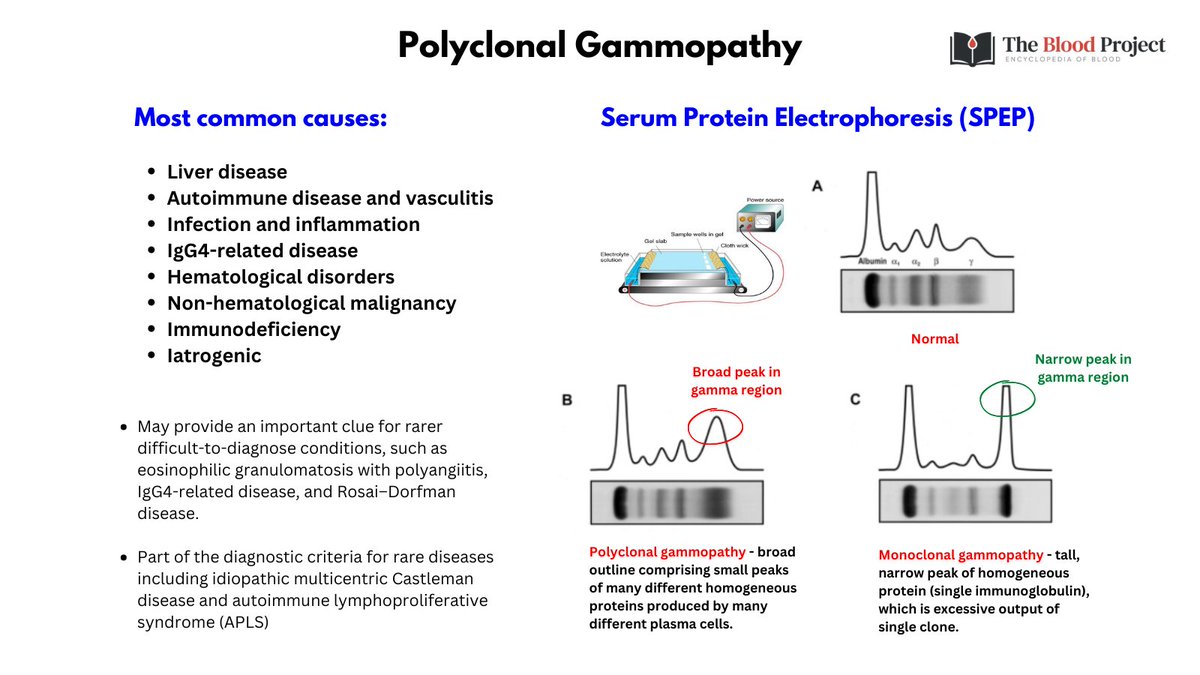
1) SPEP/IFE shows a polyclonal increase in immunoglobulins (having 1 or more heavy-chain classes and both kappa and lambda light-chain types)
2) w/u for underlying causes includes CBC, smear, CRP, liver enzymes, ANA/ANCA, IgG subclasses
DIAGNOSIS
1) SPEP/IFE shows a polyclonal increase in immunoglobulins (having 1 or more heavy-chain classes and both kappa and lambda light-chain types)
2) w/u for underlying causes includes CBC, smear, CRP, liver enzymes, ANA/ANCA, IgG subclasses
6/6
TREATMENT
1) Treat underlying condition
2) in RARE cases of hyperviscosity (occurs only when total IgG concentration >60 g/L), consider plasma exchange
For more info and quiz see:
thebloodproject.com
TREATMENT
1) Treat underlying condition
2) in RARE cases of hyperviscosity (occurs only when total IgG concentration >60 g/L), consider plasma exchange
For more info and quiz see:
thebloodproject.com
Loading suggestions...