

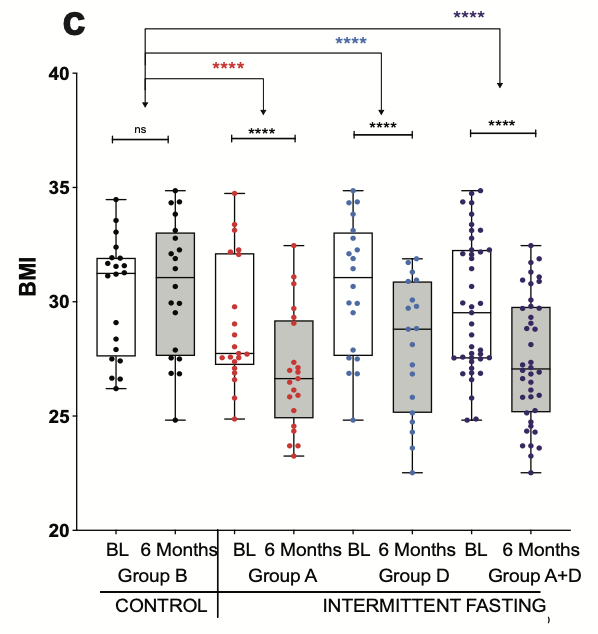
My take on the Australian intermittent fasting (IF) study, which asked 50 people, ages 30-65, to not eat for 2 or 3 non-consecutive days/week. Despite an 8% average weight loss, IF showed little to no benefit on insulin sensitivity, inflammation, or protein turnover...1/10

In earlier IF studies, there have been promising results. For example, alternate-day fasting for 3 - 12 weeks reduced body weight (≈3%-7%), body fat (≈3-5.5 kg), total cholesterol (≈10%-21%), and triglycerides (≈14%-42%)... 2/10 academic.oup.com
If fasting works well in mice to improve health and extend lifespan, why didn't it work here in humans, other than "humans are different"? Here are some thoughts, some of which are from the paper itself... 3/10
1. Fasting a 2-3 days a week then eating normal food may not be enough to have major health benefits. I try to eat one main meal within a 4 hr window/day and choose plant-based foods whenever possible, based on advice of @chefserenapoon ... 4/10
2. Most people in the West, including this study's participants in the first 6 months, "consume large amounts of ultra-processed, obesogenic food" that is bad for metabolism and the gut microbiome... 5/10
3. "A 24-hour fast–feed cycle in mice that extends lifespan equates to a ~5 day fast in humans." Most strains of mice starve to death after only 48–60 hrs without food, while lean humans can survive without food for 2 months... 6/10
4. As this study shows, weight loss should not be the main readout of IF success. Weight loss was associated with mTOR activation and decreased autophagy gene expression (in gut lining biopsies), not in the direction of longevity... 7/10
4. cont'd..It's worth noting the gut lining is highly sensitive to nutrient intake, as is the microbiome. It's a stretch when the authors see changes to mTOR activity in gut cilia cells and infer this is what is happening in other parts of the body ...8/10
5. In mice, there is a non-linear relationship between decreased caloric intake and lifespan extension, which also depends on genetic background. The same is probably true for humans... 9/10
In summary, If you want to have a major impact on lifespan, it may be necessary to fast more than 2-3 days a week and eat fresh food. And don't forget to move, sleep, have friends, and grateful. Here's the IF paper, led by my friend @LuigiFontanaMD: tinyurl.com 10/10
Hats off to the authors. By their own admission, this was an "exploratory, technically challenging, and highly labor-intensive study." True: scientific research, especially on humans, is slow, hard, thankless, & requires grants or donations. Being a critic is easy
The journal, Aging Biology, was founded recently by scientists who had a 3 yr dispute with publisher @WileyGlobal @AgingCell over workload & lack of comp. that resulted in a mass resignation & founding of this journal📚Wait, what? Scientists should get comp'd for hard work?😉
Loading suggestions...