

Is the idea of "Great Powers" obsolete?
No.
[THREAD]
No.
[THREAD]
![Is the idea of "Great Powers" obsolete?
No.
[THREAD] https://t.co/glWtNo3y0B](https://pbs.twimg.com/media/Fz8y5LZWcAADawK.png)
In a recent @ForeignAffairs piece, @PhillipsPOBrien argues that we should do away with the phrase.
foreignaffairs.com
foreignaffairs.com
There's no denying the widespread use of the phrase "Great Power", perhaps even to the point of 🙄
Look no further than mentions of "Great Power Competition" in policy circles.
foreignpolicy.com
Look no further than mentions of "Great Power Competition" in policy circles.
foreignpolicy.com

There's also no denying that the phrase "Great Powers" is an old one, going back well into the 19th century.
Consider its use in Bailey's 1861 book...
google.com
Consider its use in Bailey's 1861 book...
google.com


...or even in the 1803 Annual Register of World Events edited by Edmund Burke.
google.com
google.com
But should we drop it? To address whether we should indeed jettison the concept, we need to start with defining "great power"
Many pages have been dedicated to defining major/great powers, too many to cover in one 🧵.
Works that have spent a lot of effort on the concept include this chapter by Cline et al...
link.springer.com
Works that have spent a lot of effort on the concept include this chapter by Cline et al...
link.springer.com
...this paper by Ben Fordham...
journals.sagepub.com
journals.sagepub.com


...and, perhaps most notably, Jack Levy's book.
amazon.com
amazon.com

Overall, these works highlight 3 dimensions of being a "Great Power", summarized well by Danilovic:
- Capability (primarily military)
- Space (wide geographic scope of interest, not just in your region)
- Status (others, namely other great powers, label you a great power)
- Capability (primarily military)
- Space (wide geographic scope of interest, not just in your region)
- Status (others, namely other great powers, label you a great power)
The capability (also, referred to as "power") angle seems to create much confusion.
- If you have a nuclear weapon, is that enough power?
- If you have a huge economy, but no military, is that enough power?
- If you have a permanent UNSC seat, is that enough power?
- If you have a nuclear weapon, is that enough power?
- If you have a huge economy, but no military, is that enough power?
- If you have a permanent UNSC seat, is that enough power?
The key is not that your military or economic size crosses a particular numerical threshold (though bigger is better in this regard).
Instead, the key, captured well by Levy (p 16), is that a Great Power can't be conquered by a non-power and need only fear other Great Powers.
Instead, the key, captured well by Levy (p 16), is that a Great Power can't be conquered by a non-power and need only fear other Great Powers.
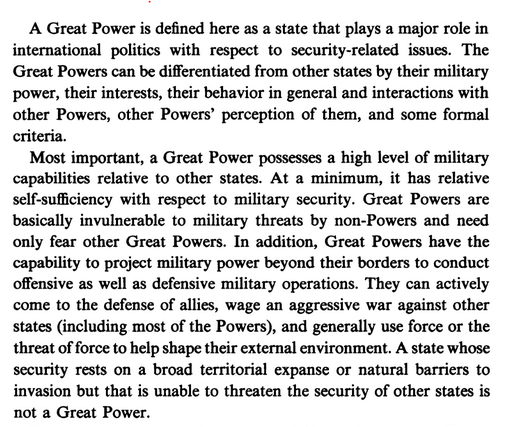
The power/capability dimension leads to the space dimension. How much "space" must a state seek to influence with its military?
- its own region?
- neighboring regions?
- distant regions?
- its own region?
- neighboring regions?
- distant regions?
On these questions, Hans Morgenthau, in his classic Politics Among Nations, offers a useful rule of thumb.
amazon.com
amazon.com

Specifically, in Chapter 19, he describes the world's major powers as "countries that play a major role in international politics", by which he means the ability to dramatically shape the outcomes of major international wars, wherever they happen.
While capability and space matter, the most important dimension is probably the third: status.
To be a Great Power, you need to be seen as a Great Power by others.
To be a Great Power, you need to be seen as a Great Power by others.
The concept of status is so important, that Morgenthau considered it one of the "basic" dimensions of the struggle for power in international politics.
I elaborated on this point, and the idea of "status" more generally, in this recent 🧵
I elaborated on this point, and the idea of "status" more generally, in this recent 🧵
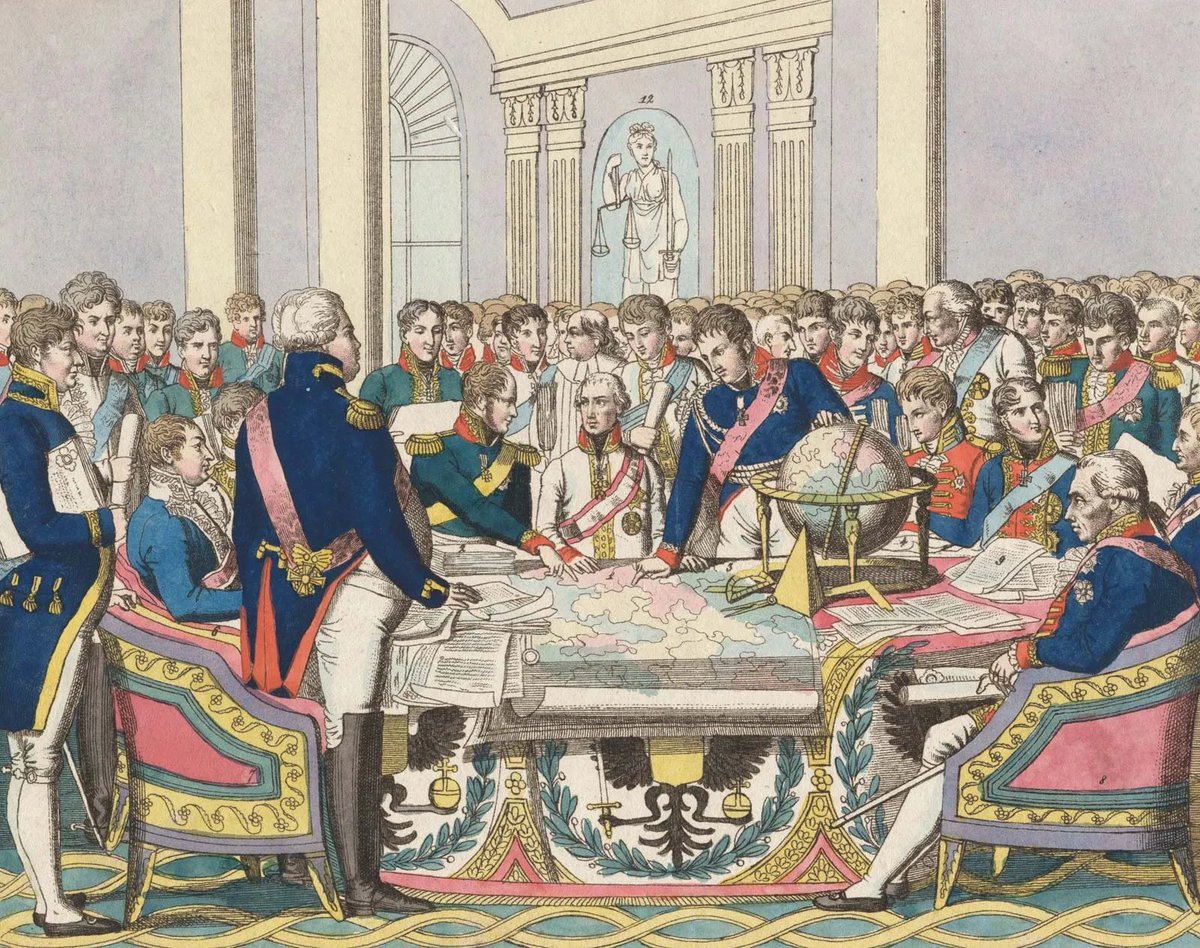
The idea that you are a Great Power if others call you a Great Power (and that states care about being called Great Powers) goes back to the early 19th Century uses of the term.
It was a phrase used to describe the main signatories of the Congress of Vienna at the conclusion of the Napoleonic Wars.
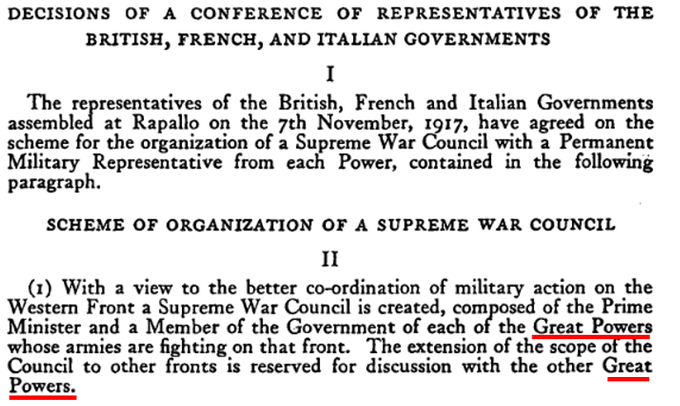
It is also the phrase the allies used to refer to themselves during World War I.
And not wanting to call 🇨🇳 a "Great Power" could have been a key reason the Biden administration adopted "Strategic Competition" instead of "Great Power Competition" to describe the 🇺🇸 rivalry with 🇨🇳.
So the core reason why "Great Power" is not obsolete is because because states want and care about that title.
They want to be seen as near the top of the pecking order
amazon.com
They want to be seen as near the top of the pecking order
amazon.com

So even if use a different PHRASE than "Great Powers", the IDEA of "Great Powers" will remain.
If states didn't use "Great Power" as a title, they would simply come up with something else.
[END]
If states didn't use "Great Power" as a title, they would simply come up with something else.
[END]
Loading suggestions...