

1/6
RBC PARAMETERS IN SPHEROCYTOSIS
Spherocytic RBCs result from a loss of membrane surface area and, consequently, exhibit increased cell sphericity and reduced cellular deformability. Two major causes are hereditary spherocytosis (HS) and autoimmune hemolytic anemia (AIHA).
RBC PARAMETERS IN SPHEROCYTOSIS
Spherocytic RBCs result from a loss of membrane surface area and, consequently, exhibit increased cell sphericity and reduced cellular deformability. Two major causes are hereditary spherocytosis (HS) and autoimmune hemolytic anemia (AIHA).
2/6
Mechanisms of spherocyte formation:
1. In HS, increased propensity of abnormal RBCs to shed membrane in the circulation due to improper assembly of membrane proteins.
2. In AIHA, partial macrophage-mediated phagocytosis of circulating RBCs bound by antibodies.
Mechanisms of spherocyte formation:
1. In HS, increased propensity of abnormal RBCs to shed membrane in the circulation due to improper assembly of membrane proteins.
2. In AIHA, partial macrophage-mediated phagocytosis of circulating RBCs bound by antibodies.
3/6
Common to both conditions:
1. Presence of spherocytes on the peripheral smear
2. Anemia
3. Elevated MCHC
4. Reticulocytosis
5. Increased osmotic fragility
(Diameter of RBCs smaller than normal, but MCV typically normal)
Common to both conditions:
1. Presence of spherocytes on the peripheral smear
2. Anemia
3. Elevated MCHC
4. Reticulocytosis
5. Increased osmotic fragility
(Diameter of RBCs smaller than normal, but MCV typically normal)
4/6
... other than DAT, eosin-5-maleimide (EMA) binding test, or genotyping, how can these two conditions be separated?
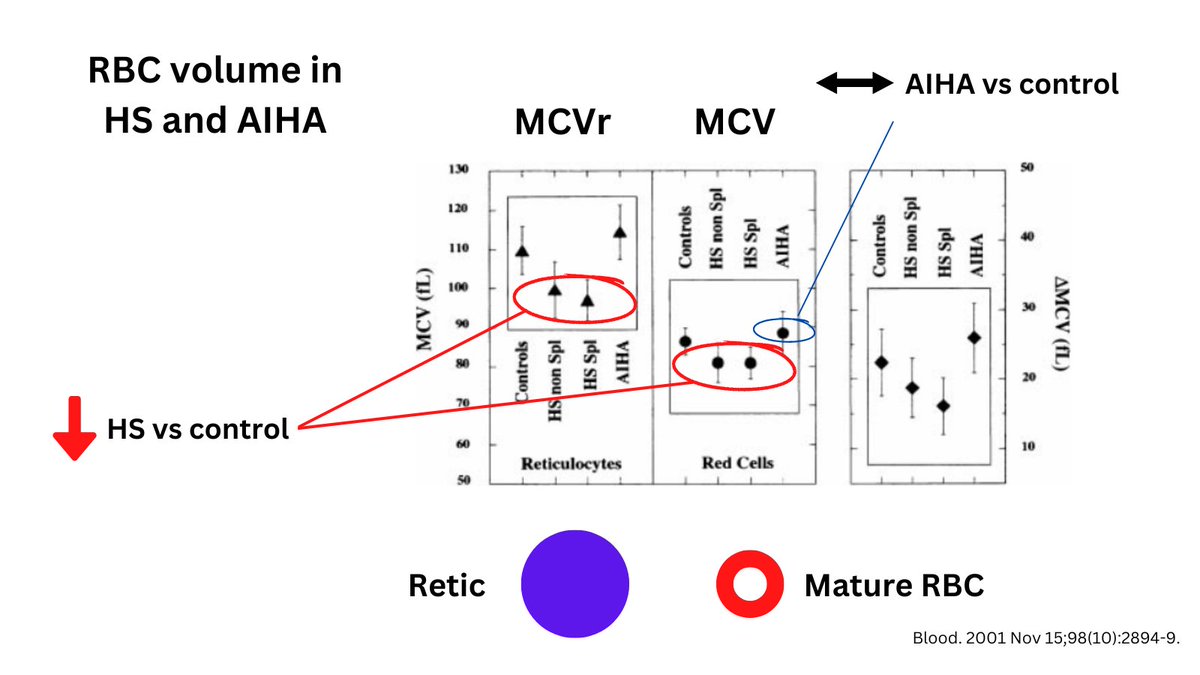
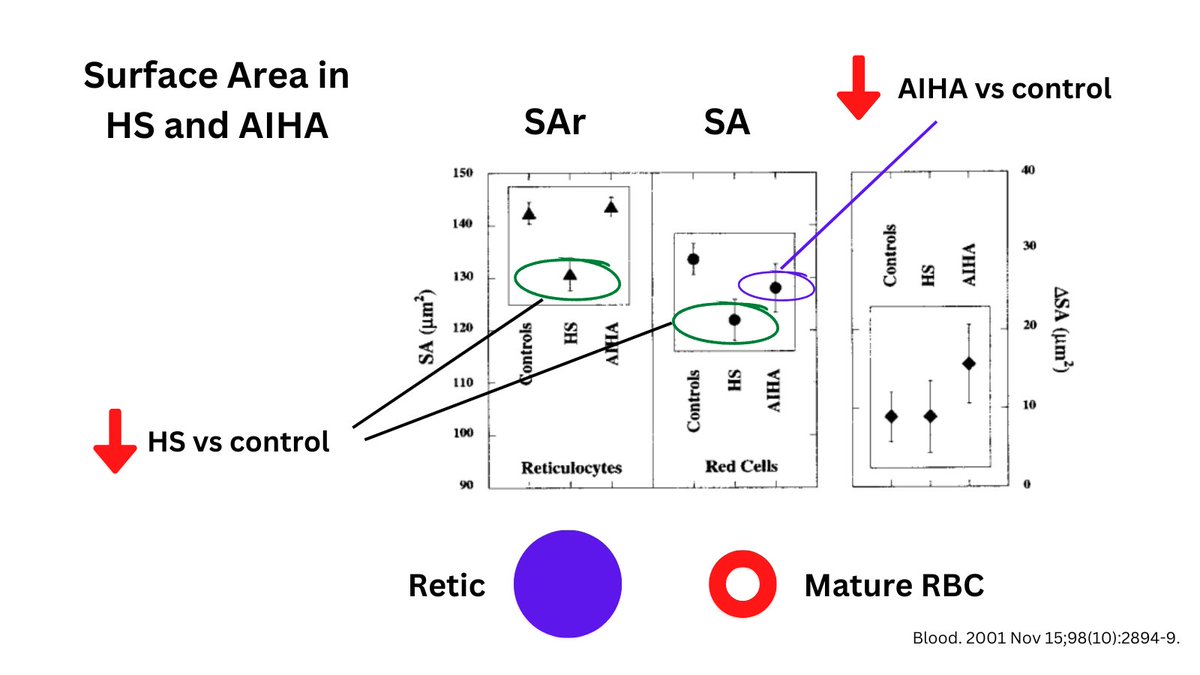
It turns out that decreased membrane surface area and volume loss (with increased MCHC) is a feature of HS reticulocytes but not of AIHA reticulocytes.
... other than DAT, eosin-5-maleimide (EMA) binding test, or genotyping, how can these two conditions be separated?
It turns out that decreased membrane surface area and volume loss (with increased MCHC) is a feature of HS reticulocytes but not of AIHA reticulocytes.
5/6
No further loss of membrane or volume occurs in mature HS RBCs.
In contrast, cell surface loss in AIHA occurs during the lifespan of the mature RBCs in circulation.
The MCV of reticulocytes, which is available on hematology analyzers has been proposed as a marker for HS.
No further loss of membrane or volume occurs in mature HS RBCs.
In contrast, cell surface loss in AIHA occurs during the lifespan of the mature RBCs in circulation.
The MCV of reticulocytes, which is available on hematology analyzers has been proposed as a marker for HS.
6/6
What is even cooler is that the volume loss of spherocytes in HS may NOT be related to loss of surface area but may be from red cell dehydration and represent an adaptation by increasing SA: volume ratio!
Am J Physiol Cell Physiol . 2000 Oct;279(4):C970-80
What is even cooler is that the volume loss of spherocytes in HS may NOT be related to loss of surface area but may be from red cell dehydration and represent an adaptation by increasing SA: volume ratio!
Am J Physiol Cell Physiol . 2000 Oct;279(4):C970-80
Loading suggestions...