

Once you see it, you can't unsee it.
The Prisoner's Dilemma.
Let's start with the most non-obvious example:
The Prisoner's Dilemma.
Let's start with the most non-obvious example:

1) Should you do the dishes, or wait for your roommate?
2) Have the hard conversation, or avoid the conflict?
3) Would you Steal, or Split the money? ⬇️
2) Have the hard conversation, or avoid the conflict?
3) Would you Steal, or Split the money? ⬇️

The point:
Prisoner's Dilemma is everywhere.
But what is it?
Prisoner's Dilemma is everywhere.
But what is it?
You've probably heard the scenario:
Two suspects are placed in seperate interragation rooms.
• If both remain silent (cooperate), they receive a 1 year sentence.
Two suspects are placed in seperate interragation rooms.
• If both remain silent (cooperate), they receive a 1 year sentence.
• If one betrays (defects), while the other remains silent: The one who betrays goes free while the other gets 3 years.
• If both betray each other, each will get 2 years.
This is the classic example of Prisoners Dilemma.
• If both betray each other, each will get 2 years.
This is the classic example of Prisoners Dilemma.
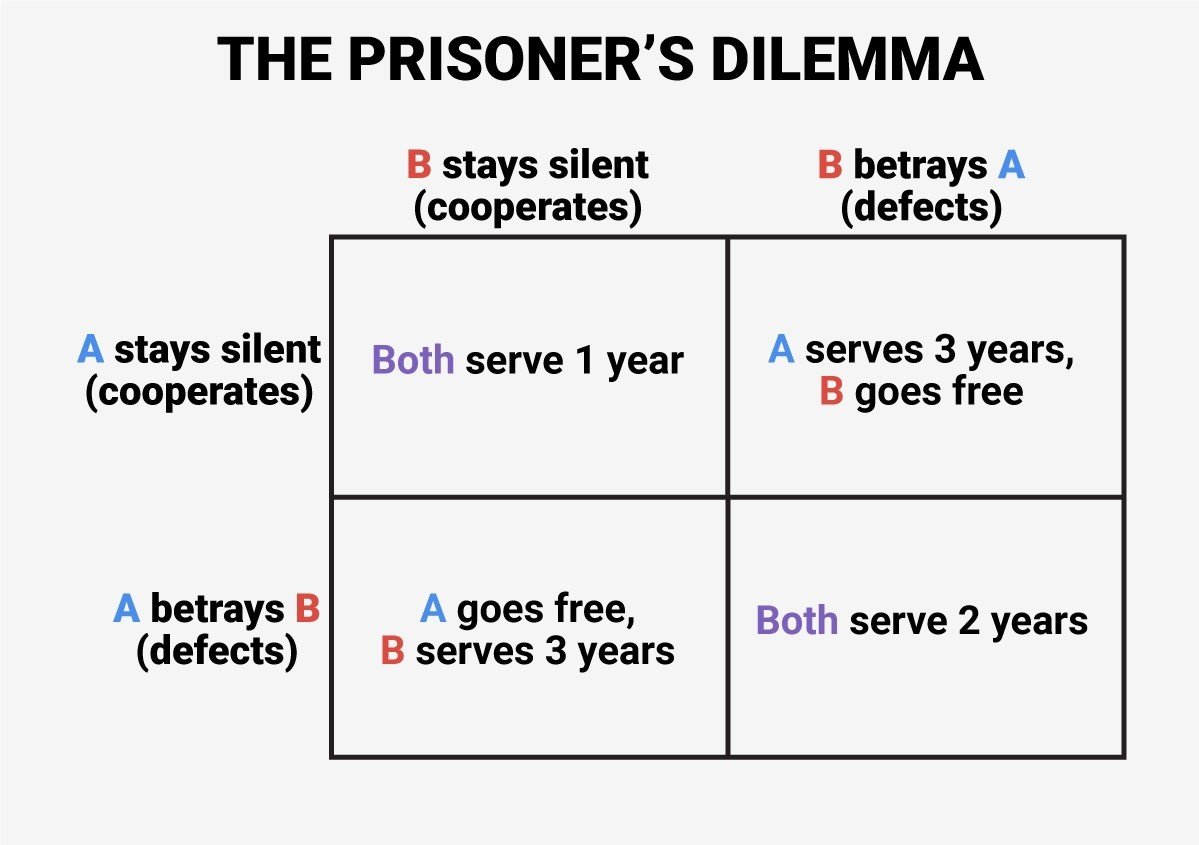
Prisoner's Dilemma is a famous problem in game theory.
It's any situation where:
Someone can choose to benefit themselves, at the expense of the other.
But if they do, both are in a worse state than if they cooperated.
An example in real life:
It's any situation where:
Someone can choose to benefit themselves, at the expense of the other.
But if they do, both are in a worse state than if they cooperated.
An example in real life:
Do the dishes or wait for your roommate?
• Cooperate, and take turns washing the dishes?
• Have a standoff and let the dishes pile up?
• Or do you suck it up and do it all yourself?
• Cooperate, and take turns washing the dishes?
• Have a standoff and let the dishes pile up?
• Or do you suck it up and do it all yourself?
I started to think about the ways this plays out in my life:
I see how it emerges within my relationships.
• Family
• Friends
• Girlfriend
Prioritize personal interests, or compromise for the benefit of the relationship?
I see how it emerges within my relationships.
• Family
• Friends
• Girlfriend
Prioritize personal interests, or compromise for the benefit of the relationship?
So I did some research on if there's an optimal strategy.
In a true Prisoner's Dilemma:
• Both parties are unable to communicate
• Only played once
There's no true optimal decision.
In a true Prisoner's Dilemma:
• Both parties are unable to communicate
• Only played once
There's no true optimal decision.
But most real life Prisoner's Dilemma scenarios are repeatedly played.
We constantly get into situations with:
• Colleagues
• Roommates
• Family & Friends
With this variation, there seems to be an optimal strategy:
We constantly get into situations with:
• Colleagues
• Roommates
• Family & Friends
With this variation, there seems to be an optimal strategy:
Tit-for-Tat (with forgiveness)
1) Always cooperate in the first round.
2) From that round on, copy what the other does.
3) Occasionally cooperate even in the face of defection
Let's cover how to use this in real life:
1) Always cooperate in the first round.
2) From that round on, copy what the other does.
3) Occasionally cooperate even in the face of defection
Let's cover how to use this in real life:
Have an Optimism Bias.
Notice how the optimal strategy was Tit-for-Tat "with forgiveness"?
Key Lesson:
We should bias for optimism, even if it's not reciprocated.
Notice how the optimal strategy was Tit-for-Tat "with forgiveness"?
Key Lesson:
We should bias for optimism, even if it's not reciprocated.
The case for optimism:
Pessimists sound smart, Optimists get rich.
Pessimists are right 99% of the time:
Until the 1 time that it actually matters.
Pessimists sound smart, Optimists get rich.
Pessimists are right 99% of the time:
Until the 1 time that it actually matters.
Optimists:
• See obstacles as an opportunity, rather than a permanent block.
• Are more resilient in the face of challenge.
• Actively seek solutions, rather than focusing on problems.
As a result - live a happier, more successful life.
• See obstacles as an opportunity, rather than a permanent block.
• Are more resilient in the face of challenge.
• Actively seek solutions, rather than focusing on problems.
As a result - live a happier, more successful life.
As I think more about this, I realize:
I can incorporate more optimism, trust and forgiveness, during Prisoner's Dilemma situations.
Main Lesson:
Be more optimistic, trusting and forgiving because it pays off in the long term.
I can incorporate more optimism, trust and forgiveness, during Prisoner's Dilemma situations.
Main Lesson:
Be more optimistic, trusting and forgiving because it pays off in the long term.
Boom. That's it!
If you liked this thread you would love my newsletter.
I do deep dives on evidence-based frameworks and tools for personal growth.
Join 1000+ competitors ⬇️:joshgessner.com
If you liked this thread you would love my newsletter.
I do deep dives on evidence-based frameworks and tools for personal growth.
Join 1000+ competitors ⬇️:joshgessner.com

If you enjoyed this or learned something:
1. Retweet this thread to someone it might interest.
2. Follow me @GessnerJosh for more writing like this.
1. Retweet this thread to someone it might interest.
2. Follow me @GessnerJosh for more writing like this.
Loading suggestions...