
Then I spent 80 hours+ binging every single Andrew Huberman podcast online.
Here’s what I found.
The Huberman stress protocol:

But when I started my now 7-figure agency, I needed to learn quickly.
I looked everywhere and somehow landed on Andrew Huberman's podcast.
It changed my life.
Here's his stress protocol:
But most people are not taught how to drive their nervous system.”
This is the problem with stress - we all experience it. But we don’t know how to control it.
As deadlines loom, work piles up, and the stakes get bigger, it takes over our lives.
It paralyzes us into submission.
94% of workers report feeling stress at work.
And as many as 66% of students have suicidal thoughts when under stress.
It’s a deadly epidemic that we don’t talk about enough.
Yet to overcome it, we need to understand what stress actually is.
It’s a misunderstood phenomenon that we can harness for good…
The hypothalamus tells the adrenal glands to release cortisol and adrenaline.
Our heart pounds faster. Muscles tense. Senses sharpen.
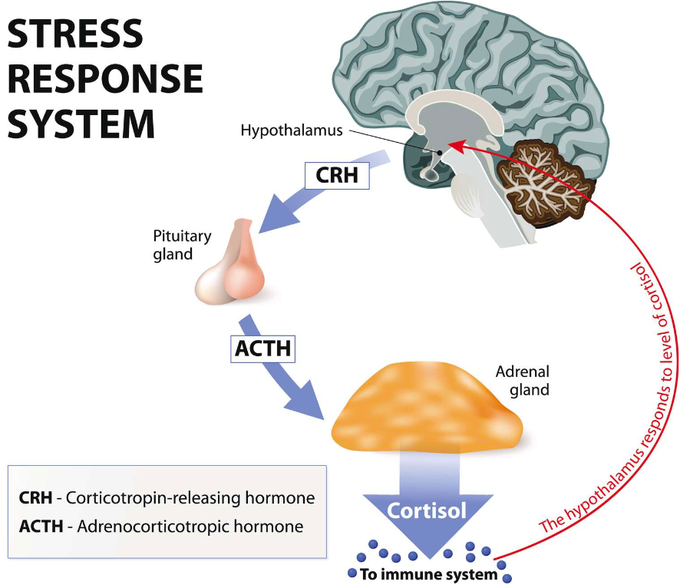
It prepares our mind and body for potential action and response.
But most of us were never taught how to control it.
And when left unchecked, it can ruin your life.
First, recognize that there are 2 main forms of stress. Identify which one you face:
• Acute stress - intense bursts from immediate pressures
• Chronic stress - drawn out from lingering issues
Identification leads to clarity. Clarity leads to control.
Rather than a sign of struggle, properly framed stress can boost performance.
It acts like a laser, focusing energy with pinpoint efficiency.
Combined with a growth mindset, stress becomes fuel to expand your abilities.
4 research-backed tools to leverage this superpower through your physiology and thoughts:
You can deliberately induce acute stress states through rapid breathing.
By doing rounds of 30-40 fast, full breaths, you:
• Increase oxygen intake
• Flood your body with adrenaline
As your body courses with energy, hold your breath and consciously stay calm.
This builds the skill of remaining calm and clear-headed even as stress molecules flood the body.
Huberman calls this the most thoroughly grounded method to calm down:
1. Inhale rapidly
2. Exhale slowly
The slow exhale reduces heart rate and blood pressure.
The torso softens. The mind clears.
The beauty of it? You can do it anytime, anywhere.
So next time you face an emotional storm, take control of your breath.
The power is within us. Just breathe.
Stress bubbles up because we are stretching beyond our comfort zone.
Not because we are failing. It's the expansion of our minds in real-time.
It’s like our muscles: stressing our muscles during workouts stimulates and grows them.
Instead, you’re often met with frustration, inadequacy, and doubt as you struggle to grasp new concepts.
Yet you can learn to embrace these cognitive growing pains.
Internalize the belief that you’re expanding your horizons.
Embrace the stresses of learning as the reward itself and turn the tension of mental resistance into learning traction.
Reinterpret your pain as gain.
Your word choice with praise and feedback is paramount.
Specifically, replace labels like "gifted" or "talented" with action verbs on effort invested.
This encourages the behaviors tied to growth.
Labeling them like this undermines their future performance when they inevitably face challenges.
They don’t have the ingrained behaviors tied to growth to fall back on.
Reward the actions, not the traits.
The key is realizing it can expand limits, not confirm them.
Stress evolved to give us peak energy to adapt and thrive. Let’s harness it.
You'll love my newsletter.
People say, "success takes hard work and sacrifice" — that's a lie.
Join Eddie's Extracts to learn how to achieve your goals quickly & effortlessly: join.eddiecheng.com

More from this author
I’m obsessed with learning how to learn. So, I spent 100+ hours studying how Elon Musk, Sam Altman, and Naval Ravikant absorb information. Here’s wh...
Look at this guy. He’s a millionaire who went homeless as a social experiment. His goal? Prove that anyone can make $1M in 12 months with just a pho...
I’m 33. When I was young, I wasted years drinking, smoking, and being a degenerate. Then I discovered Naval Ravikant and he changed my life forever...
I just read about a phenomenon I can't stop thinking about… The Cobra Effect: https://t.co/J2YDbIdYCU
Recent Threads
I’ve recently seen a lot of people criticizing smaller indie projects for releasing merchandise or doing kickstarter funding to fund their projects. T...

I compiled all the specific references I noticed in May's moveset! #イニブ #g_bd #g_bdr #GBDR https://t.co/PvNHzH6yj6

taekook taguan ng anak au wherein jk received a surprising gift from their xmas party… [ christmas special 🎄] https://t.co/WY3C450KpV

@HitWithAHeart I hear him before I see him. The weight of his steps on the stairs. Slower than usual. Measured. Like he’s already bracing for whatev...

(1/7) I'm not going to do a full trailer breakdown for Zach Cregger's Resident Evil film, since we have an early form of the script you can place a lo...

Nikola Jokic is 0-6 against 50+ win teams in the playoffs. https://t.co/l5hCeVCoUj

Popular Threads
Top 20 Players with the most goals + assists in football history, only players with assists available (following the Opta criteria for assists) Seaso...

DON'T ARGUE WITH DONKEYS (Fable) The donkey said to the tiger: - "The grass is blue". The tiger replied: - "No, the grass is green." The discussion...

These are the 41 most powerful tenants of Tateism for a man to live by. Wether you are Christian, Muslim; It doesn’t matter if you are strong, weak...

ICT’s 2022 Mentorship Summarized: https://t.co/zFJCgIfDAR

Top-40 Footballers with Most Goal Contributions (Goals + Assists) in history. [ A MEGA THREAD ] https://t.co/gAb3QcqdYQ

Here's 40 TikTok hooks that could make you go viral. (Not in any particular order) //THREAD//
