

Skewness 🧵

Distribution is symmetric if it looks the same to the left and right of the center point.
Skewness differentiates extreme values in one versus the other tail.

Negative values for the skewness indicate data that are skewed left - the left tail is long relative to the right tail.
The mean of a left-skewed distribution is almost always less than its median.

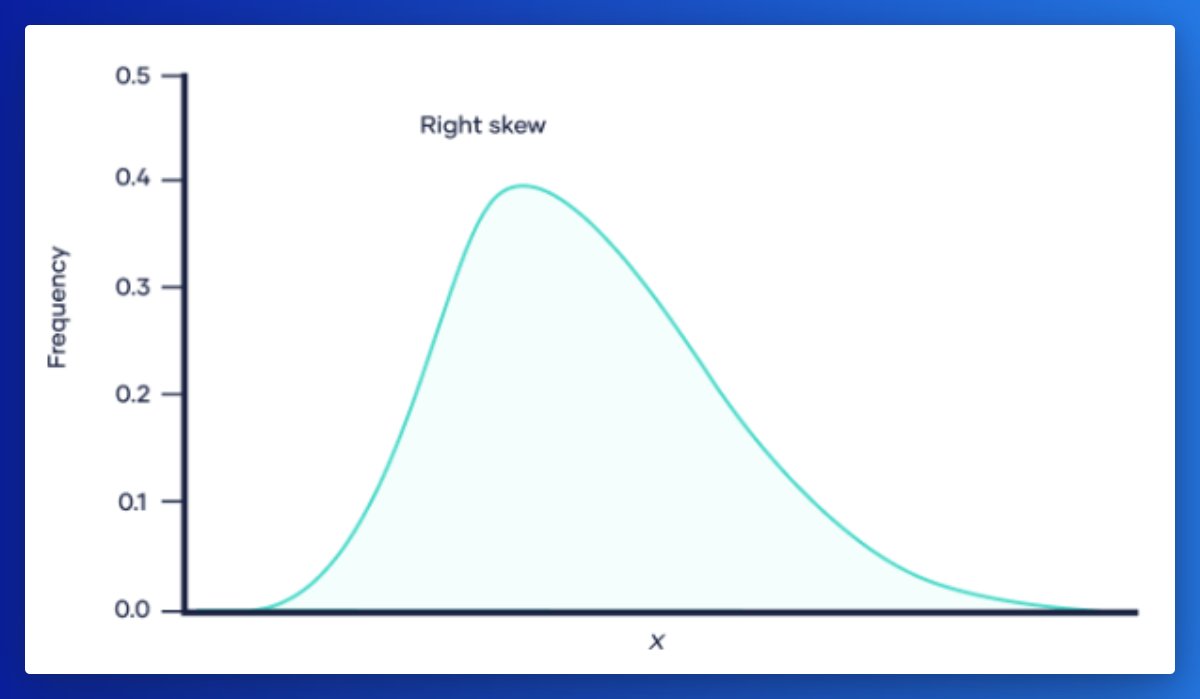
Positive values for the skewness indicate data that are skewed right - the right tail is long relative to the left tail.
Here the mean is almost always greater than the median.
Because extreme values affect the mean more than the median.
When a distribution has zero skew, it is symmetrical. Its left and right sides are mirror images.
The skewness for a normal distribution is zero.
The mean = median

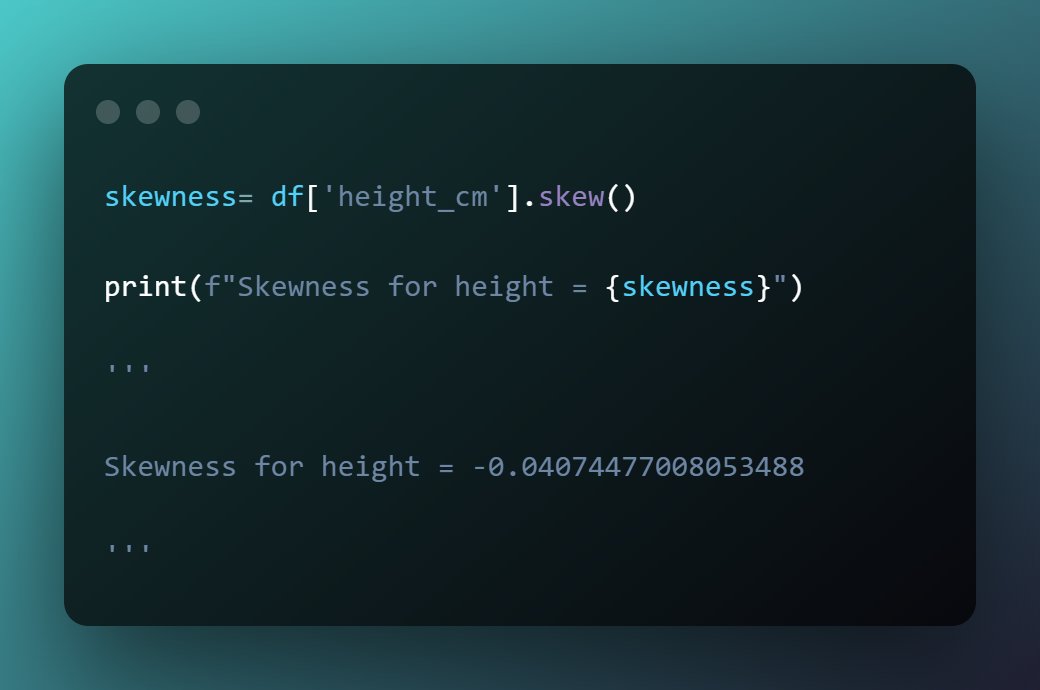
Since the value is negative, the data is skewed to the left - the left tail is slightly longer than the right tail.
I hope you've found this thread helpful.
Follow me @levikul09 for more.
Like/Retweet the first tweet below for support, Thanks 😉
We share:
• Interviews
• Podcast notes
• Learning resources
• Interesting collections of content
dsboost.dev

More from this author
R² is a widely used measure of fit, but for many analysts, it is just a number. They believe high R² ➡...
5 Regression Algorithms you should know 🧵 https://t.co/DACn4b6QJ5
5 activation functions you should know! 🧵 1/8 https://t.co/wO84nkE5tJ
There are 3 types of means. But what is the difference between them? An introduction to the arithmetic, geometric, and harmonic mean. https://t.co/h...
Recent Threads
taekook taguan ng anak au wherein jk received a surprising gift from their xmas party… [ christmas special 🎄] https://t.co/WY3C450KpV

@HitWithAHeart I hear him before I see him. The weight of his steps on the stairs. Slower than usual. Measured. Like he’s already bracing for whatev...

(1/7) I'm not going to do a full trailer breakdown for Zach Cregger's Resident Evil film, since we have an early form of the script you can place a lo...

Nikola Jokic is 0-6 against 50+ win teams in the playoffs. https://t.co/l5hCeVCoUj

Uni is a fighter! https://t.co/AXkBVFJ2My

Triggered girl at comedy show… https://t.co/z1BC2qG7Rd

Popular Threads
ICT’s 2022 Mentorship Summarized: https://t.co/zFJCgIfDAR

The ICT Mentorship Core Content Month 1 Summarized: https://t.co/6tXJxPMDhm
Top-40 Footballers with Most Goal Contributions (Goals + Assists) in history. [ A MEGA THREAD ] https://t.co/gAb3QcqdYQ

Here's 40 TikTok hooks that could make you go viral. (Not in any particular order) //THREAD//

DON'T ARGUE WITH DONKEYS (Fable) The donkey said to the tiger: - "The grass is blue". The tiger replied: - "No, the grass is green." The discussion...

1. There are more people added on the list of arrests and executions of famous people but no further intel is available at this time. ARRESTS and EXE...
